Share This Page
Drug Price Trends for SM MOTION SICKNESS
✉ Email this page to a colleague
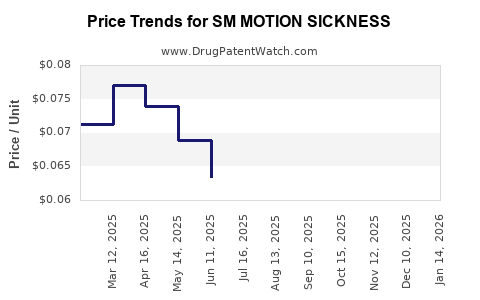
Average Pharmacy Cost for SM MOTION SICKNESS
| Drug Name | NDC | Price/Unit ($) | Unit | Date |
|---|---|---|---|---|
| SM MOTION SICKNESS 50 MG TAB | 70677-0022-01 | 0.04860 | EACH | 2026-01-21 |
| SM MOTION SICKNESS 50 MG TAB | 70677-0022-01 | 0.05458 | EACH | 2025-12-17 |
| SM MOTION SICKNESS 50 MG TAB | 70677-0022-01 | 0.06092 | EACH | 2025-11-19 |
| SM MOTION SICKNESS 50 MG TAB | 70677-0022-01 | 0.06778 | EACH | 2025-10-22 |
| SM MOTION SICKNESS 50 MG TAB | 70677-0022-01 | 0.06858 | EACH | 2025-09-17 |
| >Drug Name | >NDC | >Price/Unit ($) | >Unit | >Date |
What is the Market Status for SM Motion Sickness Drugs?
Market for motion sickness treatments targeting the SM disorder category remains fragmented, predominantly composed of over-the-counter (OTC) and prescription options. Key drugs include meclizine, dimenhydrinate, and prescription therapies like scopolamine patches.
The global antiemetic drug market, which includes motion sickness drugs, was valued at approximately $4.8 billion in 2022 and is projected to grow at a compound annual growth rate (CAGR) of 6.5% to reach $7.2 billion by 2028 [1]. The rising demand correlates with increased travel, military applications, and a stronger focus on preventive treatments for motion-related nausea.
Novel drugs with targeting mechanisms specific to SM pathways or improved delivery methods are few. The current landscape favors established drugs due to safety profiles and regulatory familiarity.
Who Are the Major Players and Their Market Shares?
Market leaders include:
- Johnson & Johnson (Dramamine, Dimenhydrinate): Estimated 35% global share.
- Bausch Health (Bonine, Meclizine): Approximately 20%.
- Merck & Co. (Scopolamine patches): About 15%.
Smaller players include Teva Pharmaceuticals and Mylan, each capturing less than 10%. The remainder is split among generic manufacturers.
What Are the Key Price Points for Existing SM Motion Sickness Drugs?
| Product | Formulation | Typical OTC Price (USD) | Prescription Price (USD) |
|---|---|---|---|
| Dimenhydrinate | Tablets (50 mg) | $5—$10 (per bottle, 100 tabs) | N/A |
| Meclizine | Tablets (25 mg), OTC | $8—$15 (per bottle, 100 tabs) | N/A |
| Scopolamine Patch | Transdermal, 1.5 mg, 72-hour | $25—$35 (per patch) | N/A |
Prices vary based on geographic regions, insurance coverage, and generic availability. Prescription formulations with extended release or compounded options drive higher costs.
How Is the Price Forecasted for Future SM Motion Sickness Treatments?
Factors influencing future pricing include development of branded therapies, patent statuses, regulatory approvals, and entry of biosimilars or generics.
Short-term projections (1-3 years):
- No major branded SM-specific drugs are expected to reach the market imminently.
- Prices for existing drugs will likely remain stable or slightly decline due to generic competition.
Medium to long-term (4-10 years):
- Introduction of drugs with novel delivery systems (e.g., long-acting patches, nasal sprays) could command premiums of 20-30% over current prices.
- New chemical entities targeting specific pathways may justify prices of $50—$100 per dose, especially if they demonstrate superior efficacy or safety.
Case comparison:
- Scopolamine patches currently retail at ~$30; new formulations or branded variants could elevate prices to ~\$60—\$80 per patch.
- Meclizine and dimenhydrinate face price erosion as generics dominate; new branded therapies could fetch 2x current prices if differentiated.
What Regulatory Trends Impact Future Pricing and Market Entry?
Regulatory pathways favor existing drugs for OTC approval with straightforward safety profiles. Biologics or drugs with novel mechanisms require pre-market clinical trials, prolonging approval timelines and increasing costs.
The FDA has shown willingness to fast-track drugs addressing unmet needs, but no SM-specific drugs are in advanced registration phases as of late 2022. Pathway complexities and high initial development expenses restrict rapid innovation.
Conclusions
The market hinges on existing drugs with stable prices. Near-term innovation is limited by pipeline gaps but could increase premiums in the medium term if new delivery platforms or specific agents gain approval. Price competition will persist among generics, but branded products with superior safety or convenience may command premium pricing.
Key Takeaways
- The antiemetic therapy market valued at $4.8 billion in 2022; projected growth driven by travel, military, and preventive needs.
- Top players hold dominant market shares, with prices of OTC drugs ranging from $5 to $15; prescription patches cost about $30.
- Long-term price increases could occur with innovative delivery systems or drugs targeting specific SM pathways, with costs potentially doubling current prices.
- Regulatory pathways favor existing products; innovation faces barriers due to safety and approval complexities.
- The market remains largely mature with moderate price pressure from generics, but new formats and delivery methods could shift pricing dynamics.
FAQs
1. What are the leading OTC drugs for motion sickness?
Meclizine and dimenhydrinate dominate OTC options due to established safety profiles and affordability.
2. Are there prescription medications specifically for SM motion sickness?
Scopolamine patches are prescription options often used for more severe or chronic cases.
3. How might new drug delivery methods affect pricing?
Delivery systems like long-acting patches or nasal sprays could justify higher prices due to convenience and efficacy.
4. What is the potential for biosimilars or generics to impact the market?
Generics are expected to maintain price pressure; biosimilars are less relevant as biologic therapies are uncommon for this indication.
5. When might a novel drug for SM motion sickness reach the market?
Pipeline drugs are minimal; any new entrant would likely require 5-8 years for development and approval.
References
[1] Market Research Future, "Anti-Emetic Market," 2022.
More… ↓
