Share This Page
Drug Price Trends for SM CLEARLAX POWDER
✉ Email this page to a colleague
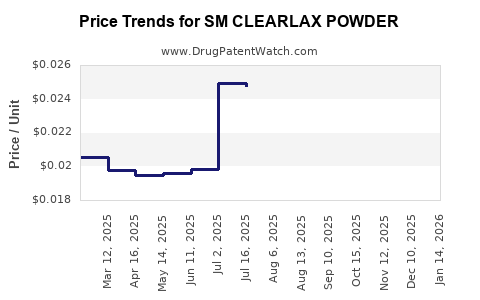
Average Pharmacy Cost for SM CLEARLAX POWDER
| Drug Name | NDC | Price/Unit ($) | Unit | Date |
|---|---|---|---|---|
| SM CLEARLAX POWDER | 49348-0893-50 | 0.02926 | GM | 2026-05-20 |
| SM CLEARLAX POWDER | 49348-0893-50 | 0.02947 | GM | 2026-04-22 |
| SM CLEARLAX POWDER | 49348-0893-50 | 0.02959 | GM | 2026-03-18 |
| >Drug Name | >NDC | >Price/Unit ($) | >Unit | >Date |
Market Analysis and Price Projections for SM CLEARLAX POWDER
What is the Current Market Position of SM CLEARLAX POWDER?
SM CLEARLAX POWDER is an over-the-counter laxative containing plant-based ingredients, primarily used to treat occasional constipation. It is marketed primarily in Southeast Asia, especially in the Philippines, where it is well-established. The product benefits from a broad consumer base that prefers herbal and natural health remedies.
Market Size and Growth Trends
The global laxative market was valued at approximately USD 3.6 billion in 2022 and is projected to expand at a compound annual growth rate (CAGR) of 4.5% through 2028, according to MarketWatch. Asia-Pacific accounts for roughly 38% of this market, driven by increasing urbanization and healthcare awareness.
Within the Philippines, OTC laxative sales—dominated by herbal formulations like SM CLEARLAX—are estimated at USD 150 million annually. Market growth is driven by rising aging populations and increasing prevalence of gastrointestinal disorders.
Competitive Landscape
Local and regional herbal laxatives dominate the market segment. Key competitors include:
- Herbal formulations (e.g., Laxative tea, herbal powders)
- Mainstream pharmaceuticals (e.g., Bisacodyl, Senna)
- International brands with herbal variants (e.g., Dulcolax Herbal)
Market penetration remains high for herbal options, particularly among consumers seeking natural remedies.
What are the Key Drivers and Constraints?
Drivers
- Increasing preference for herbal and natural products
- Rising awareness of gastrointestinal health
- Growing aging population prone to constipation
- Expanding OTC drug market in Southeast Asia
Constraints
- Regulatory hurdles concerning herbal medicines
- Limited exports outside regional markets
- Consumer shift toward prescription-based solutions in certain segments
- Competitive price pressures from generic pharmaceutical laxatives
How is the Pricing of SM CLEARLAX POWDER Structured?
Current Price Range
In the Philippines, the retail price for a 30-gram pack ranges between PHP 60-80 (USD 1.10-1.50). Pack sizes typically include 30g and 60g options, with per-gram prices decreasing as pack size increases.
Price Positioning
SM CLEARLAX is positioned as an affordable herbal option, undercutting some pharmaceutical-grade laxatives by approximately 20-30%. Its pricing aligns with other herbal OTC products such as Laxing herbal powder, which trades at PHP 50-70 per 30 grams.
Distribution Channels
Product price varies by channel:
- Retail pharmacies (most expensive)
- Supermarkets and convenience stores (moderate)
- Online platforms (discounted prices, around PHP 55-75 per pack)
Future Price Trends
Market analyst forecasts suggest a modest price increase of 3-5% annually over the next three years, primarily driven by inflation, rising raw material costs (herbal extracts), and increased packaging standards.
What are the Projected Market Trends and Price Developments?
Market Expansion
The herbal laxative segment is expected to grow at a CAGR of around 4% through 2028, fueled by increasing health consciousness.
Price Projections
By 2025, the retail price for a similar pack size could rise to PHP 70-90 (USD 1.30-1.70), assuming inflation and ingredient costs increase. Prices in online retail channels may also trend upward, potentially reaching PHP 75-95 (USD 1.40-1.80).
Potential Influences on Price Changes
- Policy shifts on herbal medicine regulation could lead to increased compliance costs.
- Raw material shortages, particularly of herbal extracts, may raise prices.
- Consumer demand for organic and additive-free variants could create a niche premium segment.
Comparisons to International Markets
In India, herbal laxative powders retail at approximately USD 1.00 for 30 grams, with similar growth and pricing patterns. The Philippines' prices are slightly higher, reflecting importation costs, local manufacturing, and retail markups.
What Are the Risks and Opportunities?
Risks
- Regulatory delays or restrictions on herbal products
- Consumer preference shifts toward conventional pharmaceuticals
- Raw material supply chain disruptions
Opportunities
- Expansion into neighboring Southeast Asian markets
- Development of organic or specialty herbal variants
- E-commerce growth offering broader reach
Summary and Key Takeaways
| Aspect | Details |
|---|---|
| Market Size | USD 150 million in the Philippines; global OTC laxative market USD 3.6 billion (2022) |
| Growth Rate | Market CAGR of 4.5% globally; herbal segment robust in Southeast Asia |
| Price Range | PHP 60-80 (USD 1.10-1.50) per 30g pack in Philippines; incremental increases forecasted to 2025 |
| Drivers | Rising health consciousness, aging population, herbal preference |
| Constraints | Regulatory environment, raw material costs, competition |
5 FAQs
1. What factors influence the price of herbal laxatives like SM CLEARLAX?
Ingredient costs, packaging, manufacturing scale, and distribution channels affect retail prices.
2. How competitive is SM CLEARLAX in regional markets?
It competes primarily on price and herbal positioning, holding a significant share in Southeast Asia.
3. Are there regulatory challenges for herbal laxatives in the Philippines?
Yes, herbal medicines require approval from the Food and Drug Administration (FDA) of the Philippines, which involves safety and efficacy evaluations.
4. What is the expected market growth for herbal laxatives in Southeast Asia?
The segment is expected to grow at approximately 4% CAGR through 2028, driven by increasing consumer health awareness.
5. How could raw material shortages impact prices?
Herbal extract shortages would likely increase costs, leading to higher retail prices or supply constraints.
References
[1] MarketWatch. (2022). Global laxative market report.
[2] Philippine Food and Drug Administration. (2022). Herbal medicine regulations.
[3] Statista. (2023). Southeast Asian OTC product sales overview.
More… ↓
