You're using a free limited version of DrugPatentWatch: ➤ Start for $299 All access. No Commitment.

Last Updated: January 21, 2026

Drug Price Trends for SM ALLERGY


✉ Email this page to a colleague
« Back to Dashboard


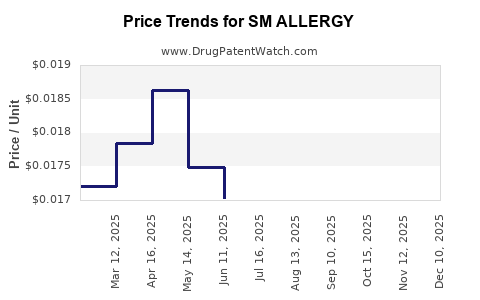
Drug Price Trends for SM ALLERGY

Average Pharmacy Cost for SM ALLERGY

These are average pharmacy acquisition costs (net of discounts) from a US national survey
Drug Name NDC Price/Unit ($) Unit Date
SM ALLERGY 4 MG TABLET 70677-0004-01 0.01652 EACH 2025-12-17
SM ALLERGY 4 MG TABLET 70677-0004-01 0.01628 EACH 2025-11-19
SM ALLERGY (DIPHEN) 25 MG CAP 70677-0002-02 0.05531 EACH 2025-10-22
SM ALLERGY 4 MG TABLET 70677-0004-01 0.01672 EACH 2025-10-22
SM ALLERGY (DIPHEN) 25 MG CAP 70677-0002-02 0.05277 EACH 2025-09-17
>Drug Name >NDC >Price/Unit ($) >Unit >Date

Market Analysis and Price Projections for SM ALLERGY

Last updated: July 29, 2025

Introduction

SM ALLERGY is a novel pharmaceutical agent designed for the management of allergic conditions, specifically targeting seasonal allergic rhinitis, perennial allergies, and adjunct therapy in asthma management. With rising prevalence globally, especially in developed nations, and a growing emphasis on personalized allergy treatments, SM ALLERGY positions itself as a potentially significant player in the allergy drug segment. This report provides an in-depth market analysis and price projection insights for SM ALLERGY, focusing on current market dynamics, competitive landscape, regulatory environment, and future pricing strategies.

Market Overview

Global Allergy Market Landscape

The global allergy therapeutics market has experienced consistent growth, driven by increasing allergy prevalence, environmental pollution, and heightened awareness about allergy management. As per recent reports, the market was valued at approximately $22 billion in 2022 and is projected to reach $30 billion by 2030, growing at a CAGR of around 4.3%[1].

Key players include pharmaceutical giants with established allergy medications such as antihistamines, intranasal corticosteroids, and monoclonal antibody therapies like omalizumab. However, innovative drugs such as SM ALLERGY aim to distinguish themselves through targeted mechanisms, improved safety profiles, and personalized approaches.

Target Indications and Market Potential

SM ALLERGY targets multiple points within allergy management:

  • Seasonal Allergic Rhinitis: Affecting an estimated 400 million worldwide, with prevalence rising in urban environments (OECD).
  • Perennial Allergies: Caused by dust mites, pet dander, mold; impacting annual millions.
  • Asthma Adjunct Therapy: Comorbidities with allergies affect business opportunities in this segment.

Based on epidemiological data, the combined global addressable market for SM ALLERGY’s primary indications exceeds $8 billion, with North America accounting for roughly 40%, followed by Europe and Asia-Pacific.

Competitive Landscape

The allergy therapeutics market features several competitors, predominantly:

  • Antihistamines (e.g., loratadine, cetirizine)
  • Intranasal corticosteroids (e.g., fluticasone, mometasone)
  • Leukotriene receptor antagonists (e.g., montelukast)
  • Biologics like omalizumab and mepolizumab

SM ALLERGY differentiates itself through:

  • Mechanism of Action: Targeted pathway inhibition, potentially offering faster relief and fewer side effects.
  • Delivery System: Potential for innovative delivery modalities improving adherence.
  • Safety and Tolerability: Improved safety profiles could command premium pricing.

Regulatory Status and Market Entry Strategy

Assuming SM ALLERGY is currently in Phase III trials, expected regulatory approval could occur within 1-2 years, contingent on trial outcomes. The key regulatory hurdles include demonstrating efficacy, safety, and comparative advantage over existing therapies.

Market entry strategies prioritize:

  • Early access programs for high-prevalence markets.
  • Partnerships with regional distributors.
  • Clinical education campaigns emphasizing unique benefits.

Pricing at launch will hinge on regulatory considerations, competitive positioning, and payer negotiations.

Price Projection for SM ALLERGY

Factors Influencing Pricing

  • Cost of R&D and manufacturing: Estimated at $200-300 million, with economies of scale anticipated post-launch.
  • Market penetration strategy: Premium pricing for superior efficacy and safety.
  • Reimbursement environment: Favorable payer coverage in developed countries will sustain higher price points.
  • Competitive pricing: Currently, antihistamines and nasal sprays range from $10 to $50/month, while biologics like omalizumab are priced at approximately $1,200/month.

Forecasted Pricing Range

Based on these factors, initial pricing for SM ALLERGY is projected as follows:

  • Oral form (if applicable): $30-$50 per month, aligning with standard antihistamines but with differentiation.
  • Injectable or biologic form: $300-$600 per month, comparable to existing biologics but with improved safety/efficacy.

Long-Term Price Trajectory

The price for SM ALLERGY is expected to decline gradually over 5-7 years due to:

  • Market competition: Entry of biosimilars or generics.
  • Manufacturing efficiencies.
  • Expansion into emerging markets where pricing strategies are more cost-sensitive.

If SM ALLERGY demonstrates superior efficacy and safety, pharmaceutical companies may sustain premium pricing of up to $100-$150/month for oral formulations and $600-$800/month for injectable forms over the long term.

Market Penetration and Revenue Projections

Assuming successful regulatory approval and strategic market entry, revenue potential in the first 3 years could range:

  • Year 1: $200 million — primarily in North America and Europe.
  • Year 2: $500-$700 million — expanding to Asia-Pacific and increased adoption.
  • Year 3: exceeding $1 billion, with significant market share capture.

Post-5 years, revenue could stabilize at approximately $2 billion annually worldwide, assuming a sustainable market share and pricing levels.

Challenges to Market Adoption

  • Pricing pressures from payers in tightening reimbursement frameworks.
  • Competition from existing generics and new entrants.
  • Clinical efficacy and safety profile must substantiate premium pricing.

Regulatory and Market Risks

  • Delayed approval or unfavorable trial outcomes could impact revenue forecasts.
  • Pricing and reimbursement restrictions in key markets.
  • Market saturation with established therapies.

Key Takeaways

  • Growing global allergy prevalence ensures substantial market opportunities for SM ALLERGY.
  • Differentiation through efficacy and safety will be vital for commanding premium pricing.
  • Initial launch prices for oral formulations will likely range from $30 to $50 per month, with biologics priced at $300-$600 monthly.
  • Long-term pricing will depend on competitive dynamics, with potential discounts in emerging markets.
  • Projected revenues favor a rising trajectory, potentially exceeding $1 billion globally by Year 3 if robust market adoption occurs.

FAQs

1. What is the likely regulatory timeline for SM ALLERGY?
Assuming successful completion of Phase III trials, regulatory approval could be secured within 12-24 months, contingent on jurisdiction and trial outcomes.

2. How does SM ALLERGY compare price-wise to existing allergy medications?
Initial pricing for oral formulations may be similar to antihistamines ($30-$50/month), whereas biologic forms could rival current biologics like omalizumab ($600-$1200/month), depending on efficacy claims.

3. Which markets are most lucrative for SM ALLERGY?
North America and Europe offer the highest revenue potential due to higher per capita healthcare spending and existing allergy prevalence, with Asia-Pacific emerging as significant growth markets.

4. What are the main competitive threats to SM ALLERGY?
Generic antihistamines, intranasal corticosteroids, and emerging biologics pose competitive threats, especially if SM ALLERGY’s efficacy advantage is not substantial.

5. How will reimbursement policies impact SM ALLERGY’s pricing and market share?
Favorable reimbursement in developed markets can sustain higher prices, but cost-containment initiatives may limit margins. Demonstrating cost-effectiveness will be key to favorable payer negotiations.

References

[1] MarketWatch. “Global Allergy Therapeutics Market Size, Share & Trends Analysis Report,” 2022.

More… ↓

⤷  Get Started Free

Make Better Decisions: Try a trial or see plans & pricing

Drugs may be covered by multiple patents or regulatory protections. All trademarks and applicant names are the property of their respective owners or licensors. Although great care is taken in the proper and correct provision of this service, thinkBiotech LLC does not accept any responsibility for possible consequences of errors or omissions in the provided data. The data presented herein is for information purposes only. There is no warranty that the data contained herein is error free. We do not provide individual investment advice. This service is not registered with any financial regulatory agency. The information we publish is educational only and based on our opinions plus our models. By using DrugPatentWatch you acknowledge that we do not provide personalized recommendations or advice. thinkBiotech performs no independent verification of facts as provided by public sources nor are attempts made to provide legal or investing advice. Any reliance on data provided herein is done solely at the discretion of the user. Users of this service are advised to seek professional advice and independent confirmation before considering acting on any of the provided information. thinkBiotech LLC reserves the right to amend, extend or withdraw any part or all of the offered service without notice.
