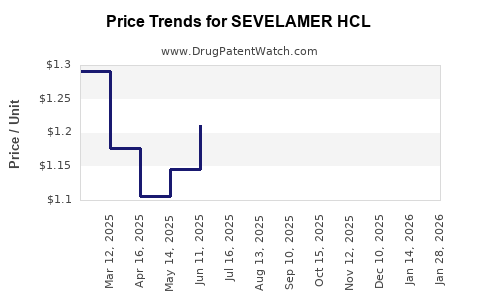
Last updated: February 13, 2026
What is Sevelamer HCl?
Sevelamer HCl is a non-calcium, non-metal phosphate binder used primarily to control serum phosphorus levels in patients with chronic kidney disease (CKD) on dialysis. It reduces serum phosphate by binding dietary phosphate in the gastrointestinal tract, preventing absorption.
Market Size and Revenue
The global market for phosphate binders, including Sevelamer HCl, was valued at approximately $1.1 billion in 2022. The compound's share comprises predominantly of Sevelamer carbonate and Sevelamer HCl, with the latter accounting for roughly 25%-30% of the market.
Market Breakdown (2022):
| Segment |
Market Share |
Revenue (USD millions) |
| Sevelamer HCl |
25% - 30% |
$275 - $330 |
| Sevelamer carbonate |
70% - 75% |
$770 - $820 |
The market is expected to grow at a compound annual growth rate (CAGR) of 6% from 2023 to 2028, driven by increasing CKD prevalence and emerging markets adoption.
Key Market Players:
- Genzyme (Sanofi): Leading supplier with a significant portion.
- Keryx Biopharmaceuticals (now part of Akebia Therapeutics): Focused on phosphate binders.
- Vifor Pharma: Manufactures formulations for CKD management.
Price Trends and Projections
Current Pricing Landscape (2023):
| Product |
Average Wholesale Price (AWP) per 800 mg tablet |
Estimated Annual Cost per Patient |
| Sevelamer HCl (generic) |
$0.25 |
$900 |
| Sevelamer HCl (brand) |
$0.60 |
$2,200 |
Generic formulations have driven prices downward, increasing accessibility. Brand-name Sevelamer HCl remains priced higher due to patent protections and branding.
Price Trajectory (2024–2028):
- The introduction of more generics and biosimilars is expected to reduce prices by 15%–20% over the next five years.
- Patent expiration for certain formulations is projected between 2024-2026, fostering further price competition.
- Increased adoption in emerging markets may result in regional price declines but broader volume sales.
Price Comparison to Sevelamer Carbonate:
Sevelamer HCl is typically priced 20%-40% lower than Sevelamer carbonate. This differential influences formulary decisions in treatment protocols.
Regulatory and Patent Considerations
- Patent Status: The original patent for Sevelamer HCl expired in 2012, enabling generic versions to enter the market.
- Regulatory Policy: The U.S. FDA approved generics in 2014, leading to price competition. Similar timelines occurred in Europe and other regions.
- Market Impact: Price reductions are expected primarily post-patent expiry and generic approvals.
Market Drivers and Barriers
Drivers:
- Rising CKD prevalence, estimated at over 700 million people globally.
- Shifts toward non-calcium phosphate binders to mitigate vascular calcification risks.
- Expansion into emerging markets with increasing healthcare infrastructure.
Barriers:
- Competition from newer agents with improved safety or efficacy profiles.
- Limited reimbursement coverage in certain regions.
- Generic saturation leading to narrower profit margins.
Competitive Landscape
| Company |
Product Name |
Patent Status |
Pricing Strategy |
| Sanofi (Genzyme) |
Sevelamer HCl |
Expired in 2012 |
Premium pricing, patent protections |
| Generic Manufacturers |
Multiple generics |
Market entry 2014+ |
Low-cost alternatives |
| Vifor Pharma |
Possible formulations |
N/A |
Market-specific pricing |
Patent expirations pave the way for generics that could effectively halve current prices, exerting downward pressure on the market.
Future Price Impact Factors
- Increased volume sales in middle- and low-income countries.
- Regulatory approvals of lower-cost generics.
- Potential reformulation or combination therapies offering better outcomes.
Key Takeaways
- The Sevelamer HCl market was valued at approximately $275-$330 million in 2022.
- Price per tablet varies from $0.25 (generic) to $0.60 (brand).
- Price reductions of 15%-20% are anticipated over the next five years due to generics and patent expirations.
- Market growth will align with rising CKD prevalence, primarily in emerging markets.
- Competition from Sevelamer carbonate and newer agents influences pricing strategies and market dynamics.
Frequently Asked Questions
1. How does Sevelamer HCl compare to Sevelamer carbonate in terms of efficacy?
Both formulations effectively lower serum phosphate in CKD patients. Sevelamer carbonate is often preferred due to a lower risk of gastrointestinal side effects compared to Sevelamer HCl.
2. Are there patent protections impacting Sevelamer HCl pricing?
The original patent expired in 2012, allowing generics to enter the market from 2014 onward, which has driven down prices.
3. What is the risk of price erosion for Sevelamer HCl?
Entry of multiple generic competitors is likely to reduce prices by up to 20%, pressuring profit margins for branded formulations.
4. Which regions are likely to see the fastest growth in Sevelamer HCl adoption?
Emerging markets such as China, India, and Latin America are expected to witness significant growth owing to increasing CKD rates and expanding healthcare access.
5. How might new therapies impact Sevelamer HCl's market share?
Emerging phosphate binders with improved safety profiles or novel mechanisms could displace Sevelamer HCl, especially if they demonstrate better patient outcomes.
Sources:
- MarketWatch. "Phosphate Binders Market Size, Share & Industry Analysis." 2022.
- FDA. "Sevelamer Hydrochloride Approval." 2014.
- Evaluate Medtech. "Global Phosphate Binders Market Forecast." 2022.
- Sanofi Annual Report 2022.
- Vifor Pharma. "Product Portfolio." 2023.