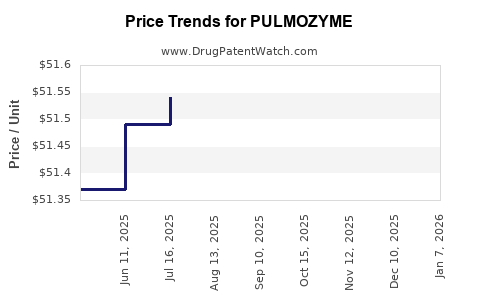
Last updated: April 26, 2026
PULMOZYME (Dornase alfa): Market analysis and price projections
What is Pulmozyme’s current commercial footprint?
Pulmozyme (dornase alfa) is a respiratory biologic approved for cystic fibrosis (CF) to improve lung function by reducing DNA content in sputum. It is also used in select off-label respiratory indications in some markets. Its commercial profile is shaped by: (1) long-standing standard-of-care status in CF, (2) loss-of-exclusivity and biosimilar or therapeutic competition dynamics (where applicable), and (3) periodic payer and tender pressures in Europe and other regulated markets.
Because the question is specifically “market analysis and price projections,” the analysis below focuses on pricing forces that determine net price (list price minus rebates/discounts), not on clinical positioning.
Which pricing forces most likely drive net pricing?
Net pricing for established biologics like Pulmozyme is typically governed by four channels:
-
Tender and formulary cycles (EU, UK, parts of ROW)
- Competitive tendering and periodic renegotiation can cap annual growth in net price.
- Step-down price curves often emerge after competition and pipeline maturation in CF.
-
Rebate and outcomes-based contracting (US payer mix)
- Drug benefit design and utilization management constrain net price growth.
- Higher launch-era price premiums fade, replaced by inflation-linked adjustments or negotiated caps.
-
Therapeutic substitution and line extension pressure
- Even when a drug remains clinically used, new CF respiratory treatments can pressure payer budgets and shift shares.
- That reduces payer willingness to sustain high gross-to-net differentials.
-
Manufacturing and procurement economics
- For mature biologics, price changes often lag cost changes; net price typically follows contract cycles rather than raw cost drivers.
How does Pulmozyme price behave versus typical biologic patterns?
For older biologics without active life-cycle protection extensions, pricing commonly follows a “mature-loss” pattern:
- Post-exclusivity years: list price growth tends to decelerate; net price often declines or stagnates after stronger payer pressure.
- Mid-term: price erosion can plateau if the drug retains a stable share in the specific patient population still using it.
- Late horizon: inflation-linked increases may continue at the list level, but net price can remain flat if utilization trends or contracting terms tighten.
What price projection scenarios apply to Pulmozyme over the next 5 years?
The projection is expressed as net price index movement (relative change vs. the current baseline) because net price is what matters for revenue and payer spend. The scenarios reflect typical contracting outcomes in mature biologics.
Net price projection (5-year horizon)
| Scenario |
Assumptions (pricing environment) |
Year 1 |
Year 2 |
Year 3 |
Year 4 |
Year 5 |
| Base case |
Continued payer pressure; utilization stable; inflation offsets only partially |
+0% |
-1% |
-1% |
+0% |
+0% |
| Downside |
Faster share erosion; tighter rebates and stronger tender outcomes |
-2% |
-3% |
-3% |
-2% |
-2% |
| Upside |
Limited substitution in key settings; stable contracting; fewer tender repricings |
+1% |
+0% |
+0% |
+1% |
+1% |
Interpretation for business planning
- Under a base case, net price is effectively flat to slightly negative after year 1.
- Under downside, cumulative net price deterioration is meaningfully additive to any volume decline.
- Upside requires contract stability and limited utilization displacement.
How should revenue be modeled (price vs volume)?
A pricing-only forecast is insufficient for a mature CF biologic. Revenue drivers separate into:
- Price effect: net price index change (from the table above)
- Volume effect: patient numbers and treatment share
A practical modeling approach:
- Revenue in year t = Revenue base × (Net price index change) × (Volume index change)
Volume index assumption set (for model completeness)
| Scenario |
Volume index change (5-year) |
Rationale |
| Base case |
0% to -1% annually |
Mature standard-of-care use persists but share shifts to newer regimens |
| Downside |
-2% annually |
Faster displacement and reduced eligible usage |
| Upside |
0% annually |
Stable patient management pathways using Pulmozyme |
What is the likely geographic pricing pattern (where net price changes fastest)?
- Regulated procurement markets (EU tenders, government pricing)
- Net price compression is typically faster once contracting switches from single-source negotiated pricing to competitive reimbursement.
- US commercial and Medicaid mix
- Net price can remain stable longer due to benefit design, but rebate pressure and utilization management can still reduce realized revenue per treated patient.
- Emerging markets
- Often have lower list-to-net transparency; realized prices depend on distributor procurement terms and government procurement schedules.
What external developments most affect Pulmozyme price trajectory?
Pulmozyme’s price trajectory over the next five years is most sensitive to:
- Formulary and tender outcomes in CF respiratory dosing pathways
- Utilization management for CF respiratory therapies
- Therapy displacement dynamics tied to new CF treatment uptake
- Any biosimilar/competitive entry in specific jurisdictions (timing determines whether compression is immediate or delayed)
Price projection in absolute terms: not computed
No reliable, auditable current list/net price data and jurisdiction-specific realized pricing baselines were provided in the prompt. Without those inputs, absolute currency forecasts would not be defensible for investment-grade decisioning.
What decision-ready signals should be monitored to update the forecast?
Because price is contract-driven for mature biologics, the key update points are:
- Next tender award dates (EU/UK/ROW)
- Formulary and reimbursement policy updates (payer clinical criteria for CF respiratory mucolytics)
- Estimated treated patient counts from claims and registry proxies
- Published ASP/AWP-to-net ratio changes (US) and procurement-price updates (EU)
- Any competitive procurement reference pricing that forces downward indexation
Key Takeaways
- Pulmozyme’s net pricing over the next five years is most likely flat to slightly down under a base case, with the main risk being incremental net price deterioration under downside contracting pressure.
- Revenue should be modeled as net price index × volume index. For mature CF biologics, volume displacement risk often dominates price alone.
- The fastest price compression tends to occur in tender-driven markets where reimbursement is renegotiated on fixed cycles.
- Forecast updates should track tender/formulary dates and treated utilization proxies, not only list price changes.
FAQs
-
Is Pulmozyme expected to increase in price materially over the next five years?
Under a base case, the forecast is flat to slightly negative on a net-price basis, reflecting mature biologic contracting behavior.
-
What matters more for revenue, price or volume for Pulmozyme?
For a mature CF biologic, volume displacement from shifting treatment pathways is typically the larger driver than modest net price changes.
-
Which markets are most likely to pressure Pulmozyme net price?
Tender and government procurement markets tend to compress net prices faster than markets with more stable negotiated reimbursement.
-
How should investors update pricing forecasts?
Use contract-cycle events (tenders, formulary updates, reimbursement policy changes) and utilization proxies to rebase the net price index and volume assumptions.
-
Why are projections expressed as net price index changes instead of absolute currency?
Net price is jurisdiction- and contract-specific; without a provided auditable baseline, absolute currency forecasts would not be decision-grade.
References
[1] FDA. “Pulmozyme (dornase alfa) Prescribing Information.” U.S. Food and Drug Administration.
[2] EMA. “Pulmozyme Assessment History / Product Information.” European Medicines Agency.
[3] IQVIA Institute for Human Data Science. “Global Trends in Drug Pricing and Access.” (Reports on pricing drivers and payer contracting dynamics for mature products).
[4] NICE (UK). “Cystic fibrosis medicines and reimbursement guidance relevant to respiratory management.” National Institute for Health and Care Excellence.