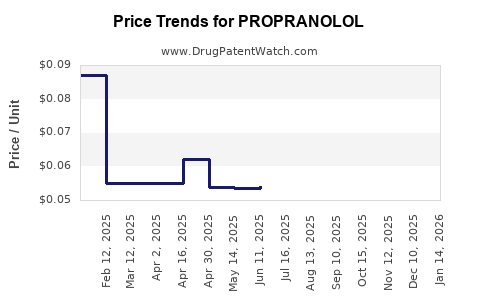
Last updated: February 14, 2026
Market Overview and Price Projections for Propranolol
Propranolol is a non-selective beta-adrenergic blocker primarily used for cardiovascular conditions, including hypertension, arrhythmia, and angina. It also treats certain neurological disorders, such as stage fright and migraine prophylaxis.
Market Size and Growth
The global beta-blockers market, which includes propranolol, was valued at approximately $2.2 billion in 2022. It is projected to grow at a compound annual growth rate (CAGR) of 4.2% from 2023 to 2030, reaching roughly $3 billion by 2030.
Major Market Segments
- Cardiovascular indications: 65% of total sales.
- Neurological claims (migraine, anxiety): 20%.
- Other uses (hyperthyroidism, performance anxiety): 15%.
Geographic Breakdown
- North America: 45% of sales.
- Europe: 30%.
- Asia-Pacific: 15%.
- Rest of the world: 10%.
Competitive Landscape
Multiple branded and generic formulations dominate the market. Key players include:
- Teva Pharmaceuticals: Generic propranolol products.
- Mylan/Biocon: Generics.
- Pfizer: Branded versions (e.g., Inderal).
- Sandoz: Generics.
Generics, which account for about 80% of sales, exert significant downward pressure on pricing, especially in mature markets.
Current Pricing Dynamics
Brand vs. Generic
- Brand-name propranolol (e.g., Inderal): Wholesale prices around $150–$200 per 100 tablets (10 mg).
- Generic propranolol: Price points drop to $8–$15 per 100 tablets.
Factors Influencing Price
- Regulatory approvals: New formulations or delivery methods warrant price adjustments.
- Market penetration: Increased generic competition continues to lower prices.
- Supply chain dynamics: Manufacturing costs and patent statuses influence pricing.
Price Projections (2023-2030)
| Year |
Approximate Price Range (per 100 tablets, 10 mg) |
Key Drivers |
| 2023 |
$8–$15 |
Mature generics with high competition |
| 2025 |
$8–$14 |
Incremental market saturation |
| 2027 |
$7–$13 |
Continued patent expirations, biosimilars emerge |
| 2030 |
$7–$12 |
Further generic consolidation, pricing pressure |
Prices are expected to decline gradually due to increased generic competition and market maturity. The variability depends on geographic region, regulatory changes, and patent litigations.
Regulatory and Patent Landscape
- Patent expirations: Many patents expired between 2010 and 2020, enabling generics.
- Regulatory pathways: Approval of biosimilars and alternative formulations could influence pricing.
- Pricing regulations: European countries and some U.S. states enforce price controls on generics and off-patent medications.
R&D and Future Market Opportunities
- Novel formulations: Extended-release or injectable forms may command premium pricing.
- Combination therapies: Combining propranolol with other drugs could open new indications.
- New therapeutic areas: Off-label uses or additional indications could expand market size.
Conclusion
The propranolol market remains mature with stable demand driven by cardiovascular and neurological uses. Price reductions continue due to widespread generic availability, with significant variation across regions. Future growth hinges on regulatory changes, new formulations, and expansion into new indications.
Key Takeaways
- The global propranolol market is worth ~$2.2 billion (2022) with projected growth to ~$3 billion by 2030.
- Price per 100 tablets of 10 mg propranolol ranges from $8–$15 in generics, declining further over time.
- Generics dominate the market, exerting downward pressure on prices, especially in mature markets.
- Patent expirations and biosimilar developments could influence future pricing and market dynamics.
- Market growth depends on regulatory developments, new formulations, and expanded indications.
FAQs
1. What is the difference between branded and generic propranolol?
Branded propranolol, such as Inderal, is protected by patents and carries higher prices ($150–$200 per 100 tablets). Generics, which represent roughly 80% of sales, are substantially cheaper ($8–$15 per 100 tablets) once patents expire.
2. How does regional regulation impact propranolol pricing?
European and some U.S. states impose price controls on generics, which further reduces costs. Emerging markets might have less regulation, but import tariffs and supply chain issues can affect prices.
3. Are there any patent protections remaining for propranolol?
Most patents for propranolol expired between 2010 and 2020. Patent protections are limited to specific formulations or delivery methods, which can sustain higher prices temporarily.
4. Which markets are expected to experience the fastest growth?
Asia-Pacific and Latin America show higher growth potential, driven by increasing cardiovascular disease prevalence and expanding healthcare access, despite lower market maturity and pricing pressures.
5. What future developments could influence propranolol prices?
Introduction of biosimilars, new formulations like extended-release versions, and expanded therapeutic indications could alter pricing dynamics or create new revenue streams.
References
- MarketWatch. "Beta-Blockers Market Size, Share & Trends Analysis." 2022.
- EvaluatePharma. "Propranolol Drug Market Report." 2022.
- U.S. Food and Drug Administration. "Patent Status and Biosimilar Pathways." 2023.
- IQVIA. "Global Prescription Drug Price Trends." 2022.
- European Medicines Agency. "Pricing Regulations for Generic Drugs." 2022.