Last updated: February 13, 2026
Market Overview
PILOCARPINE HCL, a parasympathomimetic drug, is used primarily to treat glaucoma and xerostomia arising from Sjögren’s syndrome. It has a long-standing market presence and is available both as an ophthalmic solution and oral formulation. The global demand remains steady, driven by ophthalmology, dental, and neurologic indications.
Market Size and Trends
The global ophthalmic drugs market, including glaucoma treatments, was valued at approximately $11.4 billion in 2021 and is projected to grow at a compound annual growth rate (CAGR) of 4.8% through 2028[1]. PILOCARPINE HCL accounts for an estimated 2% of the glaucoma segment, roughly $228 million in 2021.
The oral form’s market, used for xerostomia, particularly in post-radiation therapy and Sjögren's syndrome, accounts for an additional $150 million globally. Increased disease awareness and demographic shifts toward aging populations sustain steady demand.
Competitive Landscape
Market players include Pfizer, Sandoz, Topcon, and generic manufacturers. Established formulations face generic competition; however, branded versions maintain premium pricing in certain markets.
Patent expirations for older formulations occurred in the early 2000s, leading to price erosion. New formulations or delivery methods are limited, constraining innovation-driven price uplift.
Pricing Dynamics
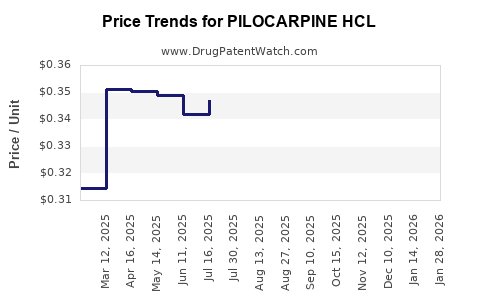
In the United States, the average wholesale price (AWP) for ophthalmic PILOCARPINE HCL solutions hovers around $100 per 15-mL bottle, with insurance coverage and pharmacy discounts influencing actual transaction prices.
Oral PILOCARPINE HCL typically sells for $0.10 to $0.15 per 5-mg tablet, with variations based on distributor and region.
Generic manufacturers offer prices approximately 20-30% lower than branded options. North American prices range from $0.08 to $0.12 per tablet, depending on volume and supplier.
Regulatory and Policy Impact
Patent exclusivity and regulatory exclusivity periods affect pricing. In the U.S., the drug's current status is off-patent, favoring price competition and generic proliferation. Limited patent protection in other markets restricts pricing power.
Reimbursement policies and formulary listings influence access and pricing variations across regions. Some markets have strict reimbursement caps, suppressing potential price increases.
Future Price Projections
-
Short-term (1-3 years):
Pricing is expected to remain stable due to generics' dominance. Slight declines or stabilization in prices are likely, barring new formulations or formulations with improved delivery mechanisms.
-
Medium-term (3-5 years):
Potential price increases could occur if new delivery methods, such as sustained-release or targeted delivery systems, receive regulatory approval and market acceptance. Projected price increases could be 5-10%, contingent on regulatory success and clinical adoption.
-
Long-term (5+ years):
Market saturation and patent status stabilization imply limited upside. However, niche indications or formulations with patent exclusivity might command premium prices. Prices could modestly grow, but average prices likely will stay within current bounds, adjusted for inflation.
Pricing Risks and Opportunities
- Risks: Price erosion due to generic competition, regulatory hurdles for new formulations, and reimbursement restriction.
- Opportunities: Development of novel delivery devices, combination therapies, and niche indications could create pricing premiums.
Summary:
PILOCARPINE HCL faces pricing pressures from generics but maintains stable market demand. Future price growth hinges on innovation and regulatory approvals, with potential modest increases in specific segments.
Key Takeaways
- The global PILOCARPINE HCL market is approximately $378 million, with stabilized demand in ophthalmology and xerostomia.
- Generic competition drives prices downward; wholesale prices for ophthalmic solutions are around $100/book, and oral tablets are $0.10–$0.15 per unit.
- Future price increases depend on new formulations, which could yield 5-10% growth over the next 3-5 years.
- Regulatory status and market access significantly influence pricing dynamics.
FAQs
1. How does patent status affect PILOCARPINE HCL pricing?
Patent expiration allows generic manufacturers to enter the market, reducing prices. Limited or no patent protection constrains pricing power and sustains low prices.
2. What are the main drivers of demand for PILOCARPINE HCL?
The primary drivers are treatment for glaucoma and xerostomia, especially in aging populations and post-radiation therapy patients.
3. Are there new formulations or delivery methods under development?
Currently, limited innovations are in clinical trials. Success could lead to premium pricing and expanded market segments.
4. How does regional regulation impact pricing?
Regions with strict reimbursement policies and high generic penetration tend to have lower prices. Conversely, markets with fewer generics and less regulation may see higher prices.
5. What is the outlook for pricing over the next decade?
Prices will likely remain stable or decrease marginally due to generics, with potential for moderate increases if novel formulations gain approval.
Citations
[1] MarketsandMarkets, “Ophthalmic Drugs Market”, 2022.
[2] IQVIA, "Global Pharmaceutical Pricing Trends," 2022.