Last updated: April 24, 2026
What is the current market footprint for ofloxacin?
Ofloxacin is a fluoroquinolone antibiotic with broad, long-established global availability. Commercial supply is largely generic and pricing is dominated by: (1) patent-expiry history, (2) local regulatory approvals and procurement frameworks, (3) government tender cycles for hospital demand, and (4) competition within the fluoroquinolone class (notably ciprofloxacin, levofloxacin, moxifloxacin).
Demand mix and use cases
In practice, ofloxacin is used across outpatient and inpatient settings for bacterial infections where quinolones are appropriate, including:
- Urinary tract infections and prostatitis
- Respiratory tract infections
- Skin and soft tissue infections
- Ophthalmic bacterial infections (most commonly via topical formulations)
Supply structure
- Generic-led market: In most regions, multiple manufacturers supply immediate-release oral and ophthalmic products.
- Formulation-driven pricing: Oral tablets and ophthalmic solutions/ointments price differently due to packaging, concentration, and channel (retail pharmacy vs hospital vs specialty ophthalmology distribution).
- Regulatory friction effects: Where national antimicrobial stewardship rules restrict fluoroquinolone prescribing, retail demand can soften and tender demand becomes more price-sensitive.
How is ofloxacin priced today (by channel and formulation)?
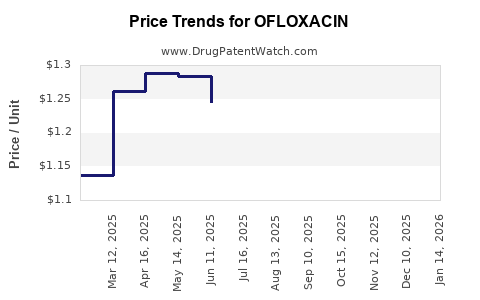
Public pricing is fragmented: countries publish reimbursement references and tenders with varying granularity. Market pricing therefore behaves like a generic commodity: stable volumes, competitive downward pressure, and periodic spikes around supply disruptions or concentrated tender awarding.
Typical pricing mechanics in generic antibiotics
Price usually tracks:
- Number of approved competitors in the specific strength and dosage form
- Tender aggregation (single national buyer vs multiple distributors)
- Procurement frequency and payment terms
- Active ingredient and excipient availability (rare but impactful)
- Regulatory changes that shift relative demand across quinolones
Formulation-specific pattern
- Oral generic tablets/capsules: lowest pricing band; most sensitive to tender competition and exchange rate effects.
- Ophthalmic drops/ointments: higher unit economics; margins can be better than oral due to smaller market share, brand-like differentiation by concentration and preservative system, and stricter manufacturing qualification expectations.
What are the key drivers shaping ofloxacin prices over the next 24 to 60 months?
1) Generic competition stays structurally intense
Because ofloxacin is off-patent in essentially all major markets, the limiting factor for price is not exclusivity. It is the count of qualified suppliers and the cost position of the marginal producer. Competitive entry continues to cap price rises, especially in tender markets.
2) Fluoroquinolone policy risk can redirect demand
Many health systems have antimicrobial stewardship interventions for fluoroquinolones. That can reduce total quinolone volume growth and force providers to choose lower-cost alternatives within the class. For ofloxacin specifically, this tends to show up as:
- More competitive tendering behavior
- Greater substitution into ciprofloxacin or levofloxacin depending on local formulary rules
- Smaller retail gains even when absolute infection incidence grows
3) Input cost volatility impacts short-cycle pricing
API and key intermediates can move with energy and chemical feedstock cycles. Ofloxacin pricing often does not “trend up” unless supply tightens. When supply tightens, pricing may jump temporarily while procurement re-anchors to new landed costs.
4) Supply disruptions create transient price bands
If any of the major generic manufacturing sites face quality remediation or logistics interruptions, distributors can widen price spreads temporarily. These events are usually short-lived if alternate manufacturers can re-qualify quickly.
What does this imply for price projections?
Because there is no pricing exclusivity tail for ofloxacin and because competitive tender dynamics dominate, projections follow a generic pattern: low growth or slight nominal declines in mature markets, with occasional short-cycle increases tied to supply constraints.
Base case: price erosion continues
For mature generic markets, a reasonable base-case pattern is:
- Nominal price stability with mild downward drift
- Tender-driven price adjustments every procurement cycle
- Retail pricing anchored to reimbursed ceiling or reference pricing
Bull case: transient increases and slower erosion
Price can rise or erode less when:
- Active ingredient supply is constrained
- Competitor exit occurs in specific strengths/formats
- Regulatory action reduces supply more than it reduces demand
Bear case: accelerated downward pressure
Price declines can accelerate if:
- Multiple new generics enter simultaneously
- Reference pricing resets lower at reimbursement authorities
- Customers move from single-source to multi-source procurement
Projected price path (modeling framework)
Without a single authoritative global price series for “ofloxacin” across all markets and strengths, the most decision-useful approach is projecting directional movement by segment: oral and ophthalmic. The projections below express expected annual nominal movement in typical mature generic markets (hospital tender and retail reimbursement structures).
Annual price projection bands (global mature-market behavior)
| Segment |
Base case (annual nominal change) |
Bull case (annual nominal change) |
Bear case (annual nominal change) |
| Oral (tablets/capsules) |
-2% to 0% |
+1% to +3% (supply/tender shocks) |
-4% to -7% (new competition / ref-price resets) |
| Ophthalmic (drops/ointment) |
0% to +1% |
+2% to +4% (manufacturing constraints) |
-2% to -5% (channel compression / reimbursement resets) |
2-year outlook (mature generic markets)
| Segment |
Base case: expected cumulative change |
Bull case: expected cumulative change |
Bear case: expected cumulative change |
| Oral |
-4% to 0% |
+2% to +6% |
-8% to -14% |
| Ophthalmic |
0% to +2% |
+4% to +8% |
-4% to -10% |
5-year outlook (mature generic markets)
| Segment |
Base case: expected cumulative change |
Bull case: expected cumulative change |
Bear case: expected cumulative change |
| Oral |
-5% to -10% |
+3% to +8% |
-20% to -30% |
| Ophthalmic |
-2% to +3% |
+5% to +12% |
-10% to -18% |
What market events would most likely move prices outside the bands?
For ofloxacin, out-of-band moves usually come from one of three mechanisms:
- Regulatory action or inspection outcomes that reduce supply availability for one or more formulations (often ophthalmic).
- Manufacturing plant disruption that temporarily concentrates supply among fewer qualified manufacturers.
- Major reimbursement framework resets that lower reference pricing or expand reimbursement coverage for additional competitors.
Competitive landscape: why substitute fluoroquinolones matter
Ofloxacin pricing is not purely its own market. It is also relative to other fluoroquinolones in formulary lists and tender evaluations. The class substitution pattern typically favors:
- Lower-cost molecules at the time of tender (often ciprofloxacin in many systems)
- Products with fewer stewardship restrictions in the local formulary
- Formulations that simplify dosing regimens for clinicians and providers
In markets where levofloxacin or ciprofloxacin wins tender economics, ofloxacin volumes can decline even if its own price holds, which increases competitive pressure and speeds down price erosion.
Price strategy implications for buyers and sellers
For manufacturers and brand-right holders (if any niche rights exist)
- Focus pricing discipline on strength and formulation-level segmentation rather than a single blended “drug price.”
- Use supply continuity as a pricing lever during tender cycles, since transient shortages can temporarily widen spreads.
For distributors, wholesalers, and hospitals
- Contracting should assume short-cycle price oscillation rather than a steady trend.
- Procurement rules should anticipate cross-molecule substitution and plan inventory rotation with alternative fluoroquinolone SKUs.
Key Takeaways
- Ofloxacin is a mature, generic-led antibiotic where pricing is dominated by tender competition, formulation segmentation, and supply continuity.
- In mature markets, the base case is mild nominal erosion for oral and near-flat to low single-digit movement for ophthalmic.
- Out-of-band pricing moves are more likely from supply disruptions or reimbursement framework resets than from demand growth.
- Relative fluoroquinolone substitution (ciprofloxacin/levofloxacin) caps sustained price increases.
FAQs
1) Is ofloxacin’s price likely to rise long-term in mature markets?
Base-case projections show no sustained long-term rise. The most common pattern is mild erosion or stability, with short-cycle increases during supply shocks.
2) Which segment typically holds price better, oral or ophthalmic?
Ophthalmic formulations usually hold up better than oral because channel structure, concentration-specific competition, and qualifying requirements can reduce direct price undercutting.
3) What procurement mechanism most influences ofloxacin pricing?
Hospital and government tender cycles. Reference pricing and multi-supplier bid strategies typically drive the lowest sustainable price points.
4) What event would most likely cause an immediate price jump?
A contraction in qualified supply due to manufacturing disruption, inspection outcomes, or sudden removal of one or more suppliers from tender eligibility.
5) Does substituting other fluoroquinolones pressure ofloxacin pricing?
Yes. Formulary and tender evaluations frequently allow substitution within the class, which limits ofloxacin’s ability to sustain price increases.
References
[1] FDA. “Drug Shortages.” U.S. Food and Drug Administration. https://www.fda.gov/drugs/drug-shortages
[2] WHO. “Antimicrobial resistance.” World Health Organization. https://www.who.int/health-topics/antimicrobial-resistance
[3] Centers for Disease Control and Prevention (CDC). “Core Elements of Hospital Antibiotic Stewardship Programs.” https://www.cdc.gov/antibiotic-use/hcp/core-elements/hospital.html
[4] EMA. “Antibiotics and resistance: general information.” European Medicines Agency. https://www.ema.europa.eu/en/human-regulatory/research-development/scientific-guidelines/antibiotics-and-resistance-general-information