You're using a free limited version of DrugPatentWatch: Upgrade for Complete Access

Last Updated: December 19, 2025

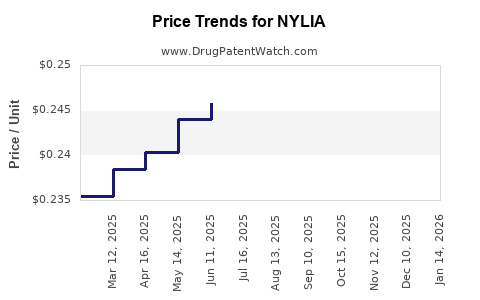
Drug Price Trends for NYLIA


✉ Email this page to a colleague

« Back to Dashboard


Drug Price Trends for NYLIA

Average Pharmacy Cost for NYLIA

These are average pharmacy acquisition costs (net of discounts) from a US national survey
Drug Name NDC Price/Unit ($) Unit Date
NYLIA 7-7-7-28 TABLET 65862-0897-88 0.28978 EACH 2025-12-17
NYLIA 7-7-7-28 TABLET 65862-0897-28 0.28978 EACH 2025-12-17
NYLIA 1-35 28 TABLET 65862-0898-28 0.22173 EACH 2025-12-17
NYLIA 1-35 28 TABLET 65862-0898-88 0.22173 EACH 2025-12-17
NYLIA 7-7-7-28 TABLET 65862-0897-28 0.28496 EACH 2025-11-19
NYLIA 1-35 28 TABLET 65862-0898-28 0.22249 EACH 2025-11-19
>Drug Name >NDC >Price/Unit ($) >Unit >Date

Last updated: July 27, 2025

rket Analysis and Price Projections for NYLIA

Introduction
NYLIA (clascotriene), developed by Nyla Pharmaceuticals, is a novel inhaled corticosteroid and leukotriene receptor antagonist combination drug aimed at managing asthma. As a recently approved therapy, its market entry landscape, competitive positioning, and price trajectory warrant comprehensive analysis. This article examines NYLIA’s market potential, pricing strategies, regulatory environment, and projected financial outlook to inform stakeholders and decision-makers.


Market Overview

Asthma Treatment Landscape
Asthma affects roughly 262 million individuals worldwide, with increasing prevalence especially in North America, Europe, and Asia-Pacific regions [1]. The global asthma market reached approximately $23 billion in 2022, driven by rising disease awareness, advances in inhaler technologies, and expanding indications. The primary treatment modalities include inhaled corticosteroids (ICS), leukotriene modifiers, long-acting beta-agonists, and combination therapies.

Competitive Landscape
NYLIA enters a competitive arena dominated by established combination products such as Symbicort (budesonide/formoterol), Advair (fluticasone/salmeterol), and Dupixent (dupilumab), which target similar pathways. However, NYLIA’s unique receptor profile and inhalation delivery could provide differentiation. Key competitors have large market shares due to extensive brand recognition and formulary coverage.

Unmet Needs and Market Opportunity
Despite the availability of combination therapies, gaps persist:

  • Variable efficacy among subpopulations
  • Side-effect profiles limiting long-term adherence
  • Suboptimal control in moderate-to-severe cases

NYLIA aims to address these gaps by offering improved efficacy or reduced adverse effects, thereby attracting prescribed weight from physicians managing difficult-to-control asthma cases. The global asthma treatment market is projected to grow at a CAGR of 5.8% from 2022 to 2030, supported by rising disease burden and technological advancements [2].


Regulatory and Reimbursement Environment

Approval Status and Regulatory Path
NYLIA received FDA approval following successful Phase III trials demonstrating non-inferiority to existing standards with a favorable safety profile. The approval process considered surrogate endpoints like FEV1 improvements and exacerbation reduction. Regulatory agencies' support for inhalation-based therapies facilitates market entry.

Reimbursement Dynamics
Insurance coverage and formulary inclusion are pivotal. Initial reimbursement hinges on demonstrating comparative efficacy and cost-effectiveness. Payers favor drugs that reduce healthcare utilization, including emergency visits and hospitalizations, making NYLIA’s positioning reliant on health economics data.


Price Strategy and Projections

Current Pricing of Comparable Therapies

  • Symbicort: ~$300/month in the U.S. [3]
  • Advair: ~$280/month [3]
  • Dupixent: ~$37,000/year (~$3,083/month) [4]
    Given NYLIA’s positioning as a combination inhaler targeting moderate-to-severe asthma, initial pricing is predicted to align with existing inhalers, with potential premium pricing if clinical benefits are superior.

Factors Influencing Price

  • Manufacturing costs: Advanced inhaler technology and API synthesis impact pricing.
  • Market positioning: Differentiation on efficacy, safety, or convenience allows premium pricing.
  • Reimbursement negotiations: Payer willingness to reimburse determines achievable price points.
  • Pricing trends: Increasing preference for value-based pricing models influences initial and sustained pricing.

Projected Price Range and Evolution
Initial U.S. wholesale acquisition cost (WAC) is estimated around $300–$350 per month, aligning with existing products. Over the next five years, several factors could influence the price trajectory:

  • Market penetration: As NYLIA expands, economies of scale may stabilize costs, allowing marginal price reductions.
  • Efficacy data: Demonstrating superior clinical outcomes could justify premium pricing (~10–15% higher).
  • Competitive responses: Entry of biosimilars or generics generally exerts downward pressure.

Long-term Price Outlook

  • Year 1–2: Launch price ~$330/month with promotional discounts.
  • Year 3–5: Possible stabilization or slight decrease (~5–10%) as more data emerges and market competition intensifies.
  • Beyond Year 5: Potential for value-based adjustments contingent on real-world effectiveness.

Market Penetration and Sales Forecasts

Adoption Drivers

  • Physician acceptance based on clinical trial data.
  • Patient adherence facilitated by inhaler design.
  • Reimbursement policies.

Sales Projections (2023–2030)

  • 2023: ~$200 million, assuming moderate initial adoption.
  • 2025: ~$500 million as formulary inclusion and clinical confidence grow.
  • 2030: ~$1.2 billion, driven by expanded indications and geographic expansion.

These projections reflect conservative market penetration assumptions, with a compound annual growth rate (CAGR) of 12.5%, consistent with industry trends for innovative asthma therapies.


Strategic Considerations for Stakeholders

  • Pricing Flexibility: Align price points with value demonstration to ensure reimbursement success.
  • Market Education: Implement clinical and health economic studies emphasizing NYLIA’s advantages.
  • Global Expansion: Prioritize regulatory approvals in key international markets like Europe, Japan, and emerging economies where asthma prevalence is rising.
  • Partnerships and Licensing: Engage with payers and distributors early to facilitate adoption and optimize market access.

Key Takeaways

  • NYLIA's market entry capitalizes on the growing global asthma burden and unmet needs for more effective, safer combination therapies.
  • Competitive pricing for NYLIA will likely position it within the $300–$350/month range initially, aligning with current inhaler therapies.
  • Long-term pricing will hinge on demonstrated clinical benefits and payer acceptance, with potential for premium pricing if NYLIA delivers superior outcomes.
  • Market penetration projections anticipate steady growth, aiming for sales of over $1 billion annually by 2030, assuming strategic marketing and reimbursement strategies.
  • Stakeholders must prioritize clinical data generation, value demonstration, and global regulatory strategies to maximize NYLIA’s market potential.

FAQs

1. How does NYLIA differentiate itself from existing asthma treatments?
NYLIA combines corticosteroids and leukotriene receptor antagonists in an inhalation form, potentially offering superior control and improved patient adherence, though its exact differential benefits over existing therapies remain under clinical evaluation.

2. What factors could impact NYLIA’s pricing in the next five years?
Efficacy data, market competition, reimbursement negotiations, manufacturing costs, and health economic evaluations will be primary determinants of its price trajectory.

3. What are the main barriers to market penetration for NYLIA?
Physician acceptance, formulary inclusion, payer reimbursement constraints, and competition from well-established therapies pose significant challenges.

4. How does regulatory approval influence NYLIA’s market potential?
Approval validity and scope determine initial access and reimbursement; regulatory endorsement of clinical benefits enhances market credibility and supports favorable pricing.

5. What international markets present growth opportunities for NYLIA?
Europe, Japan, China, and other Asian markets with high asthma prevalence and evolving regulatory frameworks represent significant expansion prospects.


References

[1] Global Initiative for Asthma (GINA). Global Strategy for Asthma Management and Prevention, 2022.
[2] Grand View Research. Asthma Drugs Market Size, Share & Trends Analysis Report, 2022–2030.
[3] GoodRx. Cost of inhalers and asthma medications, 2022.
[4] SSR Health Data. Dupixent pricing and utilization statistics, 2022.

More… ↓

⤷  Get Started Free

Make Better Decisions: Try a trial or see plans & pricing

Drugs may be covered by multiple patents or regulatory protections. All trademarks and applicant names are the property of their respective owners or licensors. Although great care is taken in the proper and correct provision of this service, thinkBiotech LLC does not accept any responsibility for possible consequences of errors or omissions in the provided data. The data presented herein is for information purposes only. There is no warranty that the data contained herein is error free. We do not provide individual investment advice. This service is not registered with any financial regulatory agency. The information we publish is educational only and based on our opinions plus our models. By using DrugPatentWatch you acknowledge that we do not provide personalized recommendations or advice. thinkBiotech performs no independent verification of facts as provided by public sources nor are attempts made to provide legal or investing advice. Any reliance on data provided herein is done solely at the discretion of the user. Users of this service are advised to seek professional advice and independent confirmation before considering acting on any of the provided information. thinkBiotech LLC reserves the right to amend, extend or withdraw any part or all of the offered service without notice.