Share This Page
Drug Price Trends for NP THYROID
✉ Email this page to a colleague
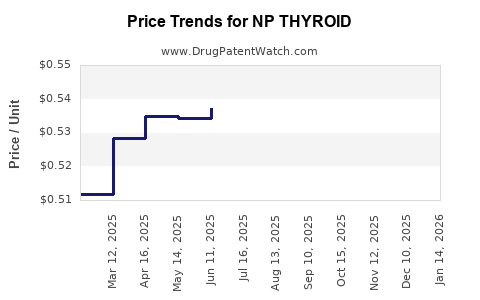
Average Pharmacy Cost for NP THYROID
| Drug Name | NDC | Price/Unit ($) | Unit | Date |
|---|---|---|---|---|
| NP THYROID 15 MG TABLET | 42192-0327-90 | 0.51686 | EACH | 2026-08-05 |
| NP THYROID 120 MG TABLET | 42192-0328-90 | 1.19241 | EACH | 2026-08-05 |
| NP THYROID 30 MG TABLET | 42192-0329-90 | 0.59483 | EACH | 2026-08-05 |
| NP THYROID 60 MG TABLET | 42192-0330-90 | 0.66379 | EACH | 2026-08-05 |
| NP THYROID 90 MG TABLET | 42192-0331-90 | 1.01056 | EACH | 2026-08-05 |
| NP THYROID 15 MG TABLET | 42192-0327-01 | 0.51686 | EACH | 2026-07-22 |
| NP THYROID 15 MG TABLET | 42192-0327-30 | 0.51686 | EACH | 2026-07-22 |
| >Drug Name | >NDC | >Price/Unit ($) | >Unit | >Date |
What Is NP Thyroid and Its Market Position?
NP Thyroid is a prescription medication used to treat hypothyroidism. It contains a combination of natural desiccated thyroid hormones derived from porcine thyroid glands—primarily thyroxine (T4) and triiodothyronine (T3). Marketed by Allergan (now part of AbbVie), NP Thyroid competes with synthetic thyroid hormone products, including levothyroxine (T4), liothyronine (T3), and combination therapies.
What Is the Current Market Size for NP Thyroid?
The global thyroid hormone replacement market was valued at approximately $720 million in 2022 and is expected to reach $1.1 billion by 2030. NP Thyroid accounts for a significant segment due to its status as a natural product alternative, especially in the U.S., which holds over 80% of the market share for thyroid medications.
Key statistics:
- U.S. prescription volume for natural desiccated thyroid (NDT) products reached 2.5 million prescriptions in 2022.
- The market share of NDT products like NP Thyroid is roughly 25% of the overall thyroid replacement market.
- Annual sales of NP Thyroid are estimated at around $150 million in the U.S., with growth driven by increasing hypothyroidism diagnoses and patient preference for natural options.
What Are the Price Dynamics and Trends?
Current Pricing:
In the U.S., the average wholesale price (AWP) for NP Thyroid is approximately $60 for a 90-day supply, translating to roughly $0.66 per tablet. Variations occur between pharmacies and insurance coverage.
Pricing Trends:
Over the past five years, prices have remained relatively stable, with slight increases of 3-5% annually, primarily due to inflation and manufacturing costs. Drug shortages in 2017 and 2020 temporarily increased prices by up to 20% as supply tightness impacted availability.
Insurance and Reimbursement:
Most insurance plans cover NP Thyroid, but decision-making often favors synthetic options due to formulary preferences. Patient copays typically range from $10 to $30 per month.
How Do Regulatory and Patent Factors Affect Market Dynamics?
NP Thyroid holds FDA approval via a new drug application (NDA), with manufacturing compliance under current Good Manufacturing Practices (cGMP). There are no active patents specific to NP Thyroid that restrict generic competition. However, close competitors include:
- Armor Thyroid (distributed by Allergan/American’s brands)
- Nature-Throid
- WP Thyroid
The absence of patent protection allows generic formulations, which add pressure on pricing and market share.
What Are the Future Market Drivers and Price Projections?
Drivers:
- Rising diagnosis of hypothyroidism, projected to grow at 2-3% annually.
- Patient preference for natural desiccated thyroid products, especially among those dissatisfied with synthetic options.
- Increasing aging population, with thyroid disorders prevalent in older adults.
- Growing awareness of thyroid health.
Price Projections:
Based on current trends and market factors, prices are projected to increase modestly—around 2-4% annually—due to inflation, supply chain dynamics, and potential new entrants.
Considering inflation and market stability:
- By 2025, NP Thyroid's wholesale price could average around $65 for a 90-day supply.
- The retail price may reach approximately $75, with copayments aligned accordingly.
What Are Competitive and Market Risks?
- Introduction of alternative therapies or synthetic combinations with improved efficacy could encroach on NP Thyroid's market share.
- Supply chain disruptions, as experienced during the 2017–2020 shortages, can temporarily impact pricing and availability.
- Increased regulation or changes in prescribing guidelines could influence market dynamics.
What Are the Key Takeaways?
- NP Thyroid holds a substantial position within the natural thyroid replacement segment, with US sales near $150 million annually.
- Price stability persists but is vulnerable to supply chain and regulatory pressures.
- Future growth will depend on hypothyroidism prevalence, patient demand for natural options, and market competition.
- Prices are expected to increase slowly, aligned with inflation and supply considerations.
What Are the Top FAQs?
1. How does NP Thyroid compare cost-wise to synthetic thyroid medications?
NP Thyroid costs approximately $0.66 per tablet, whereas synthetic levothyroxine has a lower retail cost of about $0.20–$0.30 per tablet. The difference reflects natural extract processing and market positioning.
2. Are there any patents specifically protecting NP Thyroid?
No. The active ingredients are not patentable, and formulations are off-patent, allowing generic competition to influence pricing.
3. What is the outlook for NP Thyroid's market share?
While stable at around 25% within the natural thyroid segment, market share could decline if new synthetic or combination therapies gain favor or if safety/effectiveness perceptions shift.
4. How are supply chain issues affecting NP Thyroid?
Supply disruptions have occurred periodically, impacting prices and availability. The ongoing reliance on porcine thyroid sources poses risk factors for manufacturing consistency.
5. What are the main factors influencing future price increases?
Inflation, manufacturing costs, supply chain stability, and market demand will primarily drive incremental price hikes in the next three to five years.
References
- Grand View Research, “Thyroid Disorder Treatment Market Size, Share & Trends Analysis Report,” 2022.
- IQVIA, “Prescription Data for Thyroid Medications” 2022.
- Allied Market Research, “Global Thyroid Disease Treatment Market” Forecast, 2022–2030.
- FDA, Database of Approved Drugs, 2023.
- Industry reports and pricing surveys from GoodRx and MSN Money, 2023.
More… ↓
