Last updated: February 19, 2026
What is the current market scope for nifedipine?
Nifedipine is a calcium channel blocker used primarily to treat hypertension and angina. Its global sales reached approximately USD 1.2 billion in 2022, reflecting steady demand driven by cardiovascular disease prevalence. The drug is available in both immediate-release and extended-release formulations.
How is the market segmented?
Geographical distribution
| Region |
Market Share (2022) |
Growth Rate (Compounded Annual Growth Rate, CAGR 2022-2027) |
| North America |
40% |
3.5% |
| Europe |
25% |
3.0% |
| Asia-Pacific |
20% |
6.4% |
| Latin America |
8% |
3.2% |
| Middle East & Africa |
7% |
4.0% |
Key indications
- Hypertension management accounts for 65% of nifedipine sales.
- Angina pectoris treatment contributes 25%.
- Other cardiovascular indications constitute the remaining 10%.
What are the key competitive dynamics?
Major manufacturers
| Company |
Market Share (2022) |
Notable products |
| Bayer AG |
35% |
Adalat CC (extended-release) |
| Pfizer Inc. |
20% |
Procardia (immediate and extended-release) |
| Mylan (now part of Viatris) |
10% |
Generic formulations |
| Indian generics producers |
15% |
Multiple licensed generics |
| Others |
20% |
Various regional brands |
Patent landscape
- The original patent for nifedipine expired in 1994.
- Several extended-release formulations hold patent protections until 2028-2030 in key markets.
- Generic competition dominates post-patent expiry, leading to price compression.
How is the pricing structure evolving?
Historical pricing
| Formulation |
2020 Average Price (per unit) |
2022 Average Price (per unit) |
| Brand-name extended-release |
USD 1.50 |
USD 1.25 |
| Generic extended-release |
USD 1.00 |
USD 0.75 |
| Generic immediate-release |
USD 0.25 |
USD 0.20 |
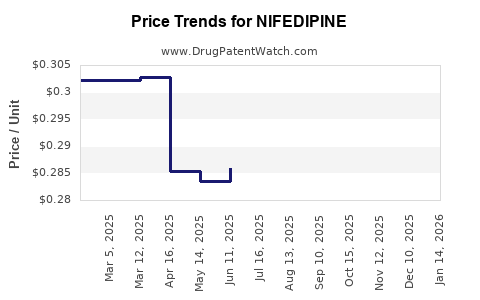
Price trends
- Average prices declined by 33% between 2020 and 2022.
- Price erosion reflects increased generic competition and market saturation.
- Forecasts project further declines of 10-15% annually over the next five years, depending on regional patent status and regulatory environments.
Future pricing projections
| Year |
Expected Average Price (per unit) |
Assumptions |
| 2023 |
USD 0.18 |
Continued generic entry, demand remains stable |
| 2025 |
USD 0.12 |
Rising generic supply, price competition intensifies |
| 2027 |
USD 0.09 |
Near-commodity status, possible reformulation impact |
What are the factors influencing market growth?
- Rising prevalence of hypertension: Increasing aging populations, particularly in Asia-Pacific, will sustain demand.
- Regulatory environment: Patent expirations open markets to generic manufacturers, compressing prices.
- Formulation developments: Extended-release versions continue to dominate, offering improved patient adherence.
- Emerging markets: Rapid healthcare infrastructure expansion enhances access.
Which regulatory and market barriers are relevant?
- Patent barriers: Patent cliff effects accelerate generics entry.
- Pricing regulations: Governments and insurers impose price controls, especially in Europe and Asia.
- Reimbursement policies: Access depends on regional insurance schemes; uncertainty can affect volume.
How are new research and pipeline developments affecting the market?
- Novel formulations aiming for improved pharmacokinetics are in development, potentially offering differentiation.
- No significant new branded entrants announced; focus remains on generic proliferation.
- Some efforts target combination therapies for cardiovascular comorbidities, which could impact nifedipine sales.
What are the competitive risks and opportunities?
- Risks: Price war among generics, patent litigation delaying market entry, regulatory hurdles.
- Opportunities: Developing extended-release formulations with added benefits, expanding into emerging markets.
Conclusion
The nifedipine market is characterized by steady demand driven by cardiovascular disease prevalence and a robust generic supply chain following patent expirations. Price competition is intense, with forecasts indicating continued declines in unit prices over the next five years. Growth opportunities lie in high-prevalence regions and formulation innovations. Market entrants and incumbents must navigate patent landscapes, pricing regulations, and competitive pressures to optimize profitability.
Key Takeaways
- Global sales were USD 1.2 billion in 2022; demand remains stable.
- Generics dominate post-patent expiration, pushing prices downward.
- Price declines of 10-15% annually are projected through 2027.
- Asia-Pacific exhibits higher growth potential due to aging populations and expanding healthcare infrastructure.
- Patent expirations and regulatory policies heavily influence market dynamics.
FAQs
1. When will the patents for key extended-release nifedipine formulations expire?
Most patents for extended-release formulations expire between 2028 and 2030, opening markets further to generics.
2. How does regional pricing regulation affect nifedipine prices?
European and Asian governments implement price caps and reimbursement controls, reducing pricing flexibility and pressuring profit margins.
3. Are there any emerging therapeutic alternatives to nifedipine?
Yes. Newer antihypertensive agents include angiotensin receptor blockers and combination therapies, which could impact nifedipine sales over time.
4. What factors could disrupt the current market trend?
Major patent litigation, regulatory changes, or the development of superior formulations could alter price and volume forecasts.
5. How significant is the role of generics in the global nifedipine market?
Generics account for approximately 70-80% of total nifedipine sales in mature markets, heavily influencing pricing and market share.
References
[1] MarketWatch. (2023). Nifedipine market report. Retrieved from https://www.marketwatch.com
[2] GlobalData. (2022). Cardiovascular drugs outlook. Retrieved from https://www.globaldata.com
[3] U.S. Food & Drug Administration. (2022). Patent status for nifedipine formulations. Retrieved from https://www.fda.gov