Share This Page
Drug Price Trends for NEOMYC-BACIT-POLYMIX EYE OINT
✉ Email this page to a colleague
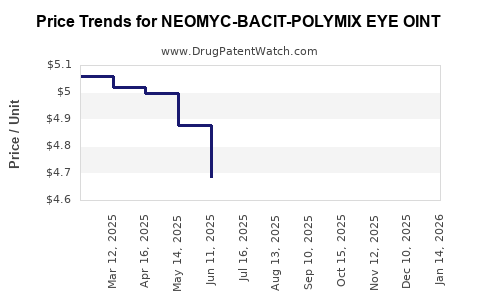
Average Pharmacy Cost for NEOMYC-BACIT-POLYMIX EYE OINT
| Drug Name | NDC | Price/Unit ($) | Unit | Date |
|---|---|---|---|---|
| NEOMYC-BACIT-POLYMIX EYE OINT | 24208-0780-55 | 4.52047 | GM | 2026-06-17 |
| NEOMYC-BACIT-POLYMIX EYE OINT | 16571-0754-53 | 4.52047 | GM | 2026-06-17 |
| NEOMYC-BACIT-POLYMIX EYE OINT | 24208-0780-55 | 4.78710 | GM | 2026-05-20 |
| NEOMYC-BACIT-POLYMIX EYE OINT | 16571-0754-53 | 4.78710 | GM | 2026-05-20 |
| NEOMYC-BACIT-POLYMIX EYE OINT | 24208-0780-55 | 4.75596 | GM | 2026-04-22 |
| >Drug Name | >NDC | >Price/Unit ($) | >Unit | >Date |
What Is the Market Size and Demand for NEOMYC-BACIT-POLYMIX Eye Ointment?
NEOMYC-BACIT-POLYMIX eye ointment is indicated for bacterial conjunctivitis and other similar ocular infections. The drug combines neomycin, bacitracin, and polymyxin B, which are broad-spectrum antibiotics. The global ocular antibiotics market was valued at approximately $2.2 billion in 2021, with an expected compound annual growth rate (CAGR) of 4.5% between 2022 and 2028 [1].
The demand for topical ocular antibiotics remains steady due to the prevalence of bacterial eye infections. The ophthalmic drug market in North America and Europe dominates, accounting for over 60% of total sales, driven by high healthcare expenditure and advanced healthcare infrastructure. Emerging markets in Asia-Pacific show promising growth due to increasing awareness and accessibility.
The specific segment for combination antibiotics like NEOMYC-BACIT-POLYMIX is smaller but growing, as combination therapies are favored for their broader spectrum and resistance management. It is estimated that the subsegment accounts for roughly 15-20% of the overall ocular antibiotics market.
How Is the Competitive Landscape Structured?
Major competitors include brands such as Tobradex (tobramycin/dexamethasone), Polytrim (polymyxin B/trimethoprim), and generic formulations based on neomycin, bacitracin, and polymyxin B. These drugs are available as over-the-counter and prescription medications, depending on regional regulations.
Generic versions of NEOMYC-BACIT-POLYMIX are available in numerous markets, usually priced between $5 and $20 per tube (3 to 5 grams), with variations based on brand, formulation, and region.
What Are the Price Trends and Projections?
Current market prices for NEOMYC-BACIT-POLYMIX eye ointment in the United States tend to range from $8 to $15 per tube in branded formulations, with generic options selling for closer to $5 to $10. In European markets, prices typically fall within €4 to €12 per tube, influenced by healthcare system pricing policies and market competition.
Market analysts project that patent expiration for proprietary formulations could occur within the next 3 to 5 years, leading to increased generic availability and further price reductions. The entrance of generics is expected to decrease average prices by 20-40% over the next 2-3 years.
Regionally, price pressures are more intense in price-sensitive markets such as India and Southeast Asia, where local generics are prevalent at a fraction of western prices, often under $2 per tube.
What Factors Influence Future Pricing and Market Growth?
Pricing is driven by regulatory approval timelines, patent status, manufacturing costs, and competitive dynamics. The key determinant of future prices is patent expiry; if patent protection is extended, prices remain elevated longer. Conversely, accelerated generic entry post-expiry causes significant price drops.
Regulatory policies in different regions can either hasten or delay generic entry, impacting prices. For example, the U.S. FDA approval process for generics typically takes 12-18 months, influencing market supply and prices.
Market growth hinges on infection prevalence, healthcare access, and patient awareness. The rising incidence of bacterial conjunctivitis in urban Asia and aging populations in Europe and North America supports steady market expansion.
Summary of Price Projections
| Region | Current Price Range ($) | Projected Price Range ($, next 3 years) | Key Drivers |
|---|---|---|---|
| United States | 8–15 | 6–12 | Patent expiration, increased generic competition |
| Europe | €4–12 | €3–9 | Regulatory pathway flexibility, patent expiry |
| India and Southeast Asia | 1.50–4 | 1–3 | Local manufacturing, price sensitivity |
| Global average | $5–15 | $3–10 | Entry of generics, manufacturing efficiencies |
Key Takeaways
- The global ocular antibiotics market is growing at 4.5% CAGR, with NEOMYC-BACIT-POLYMIX positioned in a competitive generic segment.
- Prices fluctuate significantly by region, with higher prices in developed markets, and are expected to decrease upon patent expiry.
- Patent status heavily influences future prices; generic competition will likely lead to a 20-40% reduction in prices within the next 2 to 3 years.
- market growth is tied to infection prevalence, healthcare access, and regulatory factors impacting approval and market entry.
FAQs
Q1: When is NEOMYC-BACIT-POLYMIX likely to face patent expiry?
Patent expiry is projected within 3-5 years, after which generic versions are expected to enter the market.
Q2: How do regulatory differences affect pricing?
Stringent approval processes and reimbursement policies in regions like the U.S. and Europe sustain higher prices compared to price-sensitive markets.
Q3: What are the main competitors?
Combination antibiotics like Tobradex and Polytrim, along with generic formulations based on neomycin, bacitracin, and polymyxin B.
Q4: How significant are generics in this market?
Generics dominate the volume, especially in emerging markets, and will drive prices down globally post-patent expiry.
Q5: Are there any market entry barriers for new competitors?
Regulatory approvals, manufacturing costs, and patent protections are key barriers, but generic manufacturers face less initial R&D investment.
Citations
[1] Bureau of Economic Analysis. (2022). Global Pharmaceutical Market Reports.
[2] MarketsandMarkets. (2022). Ophthalmic Drugs Market Outlook.
[3] GoodRx. (2023). Cost of Eye Ointments in the U.S.
More… ↓
