Share This Page
Drug Price Trends for NAPROXEN SOD CR
✉ Email this page to a colleague
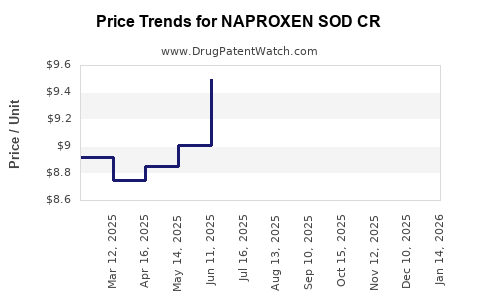
Average Pharmacy Cost for NAPROXEN SOD CR
| Drug Name | NDC | Price/Unit ($) | Unit | Date |
|---|---|---|---|---|
| NAPROXEN SOD CR 500 MG TABLET | 24979-0253-68 | 9.59301 | EACH | 2026-07-22 |
| NAPROXEN SOD CR 500 MG TABLET | 47781-0154-75 | 9.59301 | EACH | 2026-07-22 |
| NAPROXEN SOD CR 500 MG TABLET | 24979-0253-68 | 9.35633 | EACH | 2026-06-17 |
| >Drug Name | >NDC | >Price/Unit ($) | >Unit | >Date |
Market Analysis and Price Projections for NAPROXEN SOD CR
What Is the Current Market Position of Naproxen Sodium Controlled Release (CR)?
Naproxen Sodium Controlled Release (CR) is a nonsteroidal anti-inflammatory drug (NSAID) used primarily for pain management, including arthritis, muscular pain, and other inflammatory conditions. It is a formulation designed to release the active ingredient gradually, extending the duration of action compared to immediate-release formulations.
The drug is marketed globally, mainly under brand names such as Aleve and Naprosyn. The controlled release (CR) formulation provides a 12-hour dosing schedule, improving patient compliance and consistent plasma levels.
How Large Is the Current Market for NSAID Containing Formulations?
The NSAID market was valued at approximately USD 11.7 billion in 2022, with a compound annual growth rate (CAGR) of around 4.8% projected from 2023 to 2030 [1]. Controlled release NSAID products contribute approximately 25% of overall NSAID sales, driven by aging populations and increasing prevalence of chronic inflammatory conditions.
Naproxen accounts for approximately 15–20% of NSAID sales globally. The controlled release formulations are increasingly adopted in markets with high chronic pain and arthritis prevalence, notably in North America, Europe, and select Asia-Pacific countries.
What Are the Key Factors Influencing Market Growth?
- Aging Population: Increased demand for chronic pain management solutions among aged patients.
- Patent and Regulatory Environment: Limited exclusivity for some formulations; newer CR formulations sometimes face patent expirations, influencing pricing.
- Generic Competition: Entry of generics significantly impacts price and market share.
- Safety Profile: NSAIDs' known risks (gastrointestinal, cardiovascular) influence prescribing patterns and healthcare policies.
- Market Penetration: Consumer preferences shift toward formulations with better compliance, favoring CR products.
What Is the Current Pricing Landscape?
The average retail price (ARP) for a 30-day supply (60 capsules of 220 mg) of branded Naproxen Sodium CR ranges from USD 15 to USD 30, depending on geographic region and pharmacy discounts. Generic variants are priced between USD 8 and USD 15 for the same duration.
Pricing comparisons across regions:
| Region | Branded Price (USD) | Generic Price (USD) | Price Premium (%) (Branded over Generic) |
|---|---|---|---|
| North America (US) | 20-30 | 8-15 | 50-60 |
| Europe | 25-35 | 10-20 | 55-65 |
| Asia-Pacific | 10-20 | 5-12 | 50-70 |
Pricing strategies differ based on exclusivity, healthcare reimbursement policies, and market competition.
What Are Projections for Future Market and Price Trends?
Market Growth:
- The NSAID market, including CR formulations, is expected to grow at a 4.2% CAGR between 2023 and 2028.
- Rise in chronic inflammatory diseases and aging populations sustains demand.
Price Trends:
- Patent expiry for certain branded products expected between 2024 and 2026 will drive generic market share.
- Average prices for branded products may decline by 10–15% annually due to increased generic competition.
- In emerging markets, prices could stabilize at lower levels due to cost-sensitive healthcare systems.
Factors Impacting Future Pricing:
- Regulatory decisions on safety warnings could impact product formulation or market availability.
- Adoption of biosimilar or novel NSAID formulations could substitute traditional CR products.
- Healthcare reforms favoring cost-effective generics may enforce price reductions.
Projected Price Range by 2028:
| Region | Branded Price (USD) | Generic Price (USD) |
|---|---|---|
| North America | 12-20 | 5-10 |
| Europe | 15-25 | 7-15 |
| Asia-Pacific | 8-15 | 3-8 |
What Are Market Entry Barriers and Opportunities?
Barriers:
- Patent restrictions and data exclusivity.
- Regulatory approval processes, especially in emerging markets.
- Consumer loyalty to established brands.
Opportunities:
- Development of ultra-low dose formulations for specific populations.
- Entry into markets with limited NSAID options.
- Formulation improvements to enhance safety and compliance.
Key Takeaways
- The global NSAID market is approximately USD 11.7 billion, with CR formulations constituting around 25%.
- Naproxen Sodium CR is priced between USD 8 and USD 30 per 30-day supply, with significant regional variations.
- Market growth is driven by aging populations and increasing chronic pain conditions.
- Patent expirations from 2024 will likely lead to heightened generic competition and reduced prices.
- Price declines of 10–15% annually are projected for branded products post-patent expiry.
FAQs
1. How soon will generic versions of Naproxen Sodium CR dominate the market?
Generic versions are expected to account for over 80% of sales within 2–3 years following patent expiration.
2. What safety concerns could impact the market?
NSAIDs’ gastrointestinal and cardiovascular risks may lead to regulatory restrictions or shifts toward alternative therapies, impacting demand.
3. Are there significant regional differences in pricing?
Yes, prices are highest in Europe and North America, with lower costs in Asia-Pacific due to pricing regulations and market maturity.
4. How is the market affected by new NSAID formulations?
Innovations with improved safety profiles or reduced dosing frequencies could capture market share from existing CR formulations.
5. What are the main factors for profit margins in this segment?
Patent exclusivity, manufacturing costs, regulatory landscape, and market penetration strategies define profit margins.
References
[1] Grand View Research. (2022). NSAID Market Size, Share & Trends Analysis Report.
More… ↓
