Share This Page
Drug Price Trends for MIDODRINE
✉ Email this page to a colleague
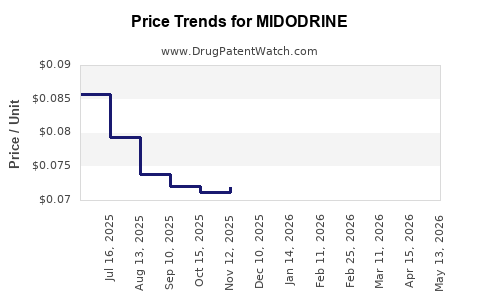
Average Pharmacy Cost for MIDODRINE
| Drug Name | NDC | Price/Unit ($) | Unit | Date |
|---|---|---|---|---|
| MIDODRINE HCL 10 MG TABLET | 00245-0213-11 | 0.15044 | EACH | 2026-07-22 |
| MIDODRINE HCL 10 MG TABLET | 00378-1903-01 | 0.15044 | EACH | 2026-07-22 |
| MIDODRINE HCL 10 MG TABLET | 00904-6819-07 | 0.15044 | EACH | 2026-07-22 |
| MIDODRINE HCL 10 MG TABLET | 49884-0874-01 | 0.15044 | EACH | 2026-07-22 |
| MIDODRINE HCL 10 MG TABLET | 50268-0563-11 | 0.15044 | EACH | 2026-07-22 |
| MIDODRINE HCL 10 MG TABLET | 50268-0563-15 | 0.15044 | EACH | 2026-07-22 |
| MIDODRINE HCL 10 MG TABLET | 52817-0325-10 | 0.15044 | EACH | 2026-07-22 |
| >Drug Name | >NDC | >Price/Unit ($) | >Unit | >Date |
Best Wholesale Price for MIDODRINE
| Drug Name | Vendor | NDC | Count | Price ($) | Price/Unit ($) | Unit | Dates | Price Type |
|---|---|---|---|---|---|---|---|---|
| MIDODRINE HCL 10MG TAB | Golden State Medical Supply, Inc. | 51407-0390-90 | 90 | 16.49 | 0.18322 | EACH | 2023-06-15 - 2028-06-14 | FSS |
| MIDODRINE HCL 2.5MG TAB | AvKare, LLC | 60505-1320-01 | 100 | 7.30 | 0.07300 | EACH | 2023-06-15 - 2028-06-14 | FSS |
| MIDODRINE HCL 2.5MG TAB | AvKare, LLC | 42291-0560-90 | 90 | 8.33 | 0.09256 | EACH | 2023-06-15 - 2028-06-14 | FSS |
| MIDODRINE HCL 5MG TAB | AvKare, LLC | 60505-1321-01 | 100 | 9.91 | 0.09910 | EACH | 2023-06-15 - 2028-06-14 | FSS |
| MIDODRINE HCL 5MG TAB | AvKare, LLC | 42291-0561-90 | 90 | 11.54 | 0.12822 | EACH | 2023-06-15 - 2028-06-14 | FSS |
| MIDODRINE HCL 10MG TAB | AvKare, LLC | 60505-1325-01 | 100 | 18.85 | 0.18850 | EACH | 2023-06-15 - 2028-06-14 | FSS |
| MIDODRINE HCL 10MG TAB | AvKare, LLC | 42291-0562-90 | 90 | 20.20 | 0.22444 | EACH | 2023-06-15 - 2028-06-14 | FSS |
| >Drug Name | >Vendor | >NDC | >Count | >Price ($) | >Price/Unit ($) | >Unit | >Dates | >Price Type |
MIDODRINE Market Analysis and Price Projections: US and EU Demand, Competitive Dynamics, and Exclusivity-Driven Generic/Biosimilar Risk
Midodrine (active ingredient: midodrine hydrochloride) sits in the US and EU primarily as a symptomatic treatment for orthostatic hypotension in adults, with demand anchored by chronic use in autonomic dysfunction and related indications. Pricing power is moderate, constrained by long-established availability of generics and by a largely commoditized payer view. Near-term price projections in the US skew toward continued erosion via multi-source generics, while EU pricing depends on national reimbursement controls, reference pricing, and local generic penetration patterns.
What is the current market size for midodrine and how fast is demand growing?
Midodrine is a mature product class in orthostatic hypotension. Sales are concentrated in developed markets where diagnosis rates for autonomic disorders and neurogenic orthostatic hypotension are established, and where outpatient neurology and cardiology pathways drive chronic prescribing.
Demand drivers
- Chronic indication profile: orthostatic hypotension is typically long-duration, keeping baseline demand resilient versus episodic therapies.
- Diagnostic expansion: increased recognition of autonomic disorders and medication-induced hypotension lifts the treated population.
- Off-label use variability: midodrine is used for related hypotension syndromes in practice, which can smooth demand but also introduces payer scrutiny variability.
Key constraints
- Generic dominance: in most markets, pricing is structurally capped after generic entry.
- Limited differentiation: few formulation or mechanism-of-action competitors with clear superiority reduce brand pricing leverage.
Practical market implication
- For investors and strategists, midodrine is best modeled as a volume-driven, competitive multi-source product where pricing pressure typically dominates top-line outcomes.
Midodrine demand by setting and prescriber type
- Outpatient chronic care: cardiology, neurology, autonomic clinics.
- Hospital discharge and rehabilitation: in some regions, midodrine supports orthostatic symptom stabilization after inpatient events.
How is midodrine priced today in the US and what are the components driving net price?
In the US, midodrine’s net price is primarily determined by:
- Wholesale acquisition cost (WAC) and evolving rebates negotiated among pharmacy benefit managers (PBMs) and contracted plans.
- Competitive tendering among multiple generic manufacturers.
- Payer formularies that often treat midodrine as a preferred generic.
What to expect in net price
- WAC may remain comparatively stable while net realization falls via rebates and payer contracting.
- Multi-source generic competition tends to pressure net price faster than WAC in Medicaid and commercial plans.
Key commercial levers affecting midodrine pricing
- PBM formulary placement and rebate pressure
- State Medicaid fee-for-service and managed Medicaid contracting structure
- Retail vs mail-order channel mix
- Pack-size and dosage-form availability (tablets are standard; any alternate release profile would matter if it were competitively protected)
When does midodrine lose exclusivity, and when do generics typically expand?
Midodrine is a legacy small molecule. Exclusivity and patent timelines historically dictate brand-to-generic transition. In a mature molecule like midodrine, the limiting factor is less “remaining exclusivity” and more “how much additional supply enters” and whether any new patent-protected formulations block a subset of competitors.
Execution pattern in legacy generics
- After initial generic entry, price compression accelerates with each new ANDA approval.
- Later entrants do not always drive further price drops if the market has already consolidated around a small set of suppliers, but late entrants can still reduce acquisition price in tender environments.
Strategic implication
- For projections, use a “multi-source generic penetration curve” rather than a “single exclusivity countdown.”
What is the patent estate for midodrine and which patents matter commercially?
Commercially relevant patent layers typically include:
- Active ingredient patents (often expired for legacy molecules)
- Formulation patents (granulation, particle size, solid-state properties, stabilizers)
- Method-of-use patents (specific patient populations or dosing regimens)
- Manufacturing process patents
For a legacy molecule with widespread generics, the main practical effect is whether any new formulation patents restrict substitution for specific dosage strengths or specific release profiles.
Commercially material questions
- Are there any still-enforced formulation or method-of-use patents that delay generic substitution at pharmacy point of sale?
- Are there any settlement agreements affecting “carve-out” products or specific strengths?
Because midodrine is broadly available, any surviving patent rights would tend to affect only narrow “at-risk” launches, not overall class pricing.
What is the FDA regulatory status of midodrine and how does it affect supply and pricing?
Midodrine is approved as a drug product under FDA regulations for orthostatic hypotension in adults. In a generic-heavy category, FDA status affects:
- How quickly new ANDAs convert to market supply
- Whether there are supply disruptions tied to manufacturing site approvals or quality controls
- Whether new label indications trigger additional prescribing or payer friction
Supply and pricing
- When manufacturing capacity is stable, generic prices typically trend down.
- If suppliers exit or face quality issues, shortages can briefly lift acquisition and retail pricing.
How many ANDAs cover midodrine, and what does that imply for price erosion?
In a mature generics category, the relationship is usually monotonic:
- More ANDAs and multiple 505(b)(2)/ANDA-labeled competitors increase competition.
- That tends to reduce price dispersion across strengths over time.
Projection logic
- Model net price downward pressure tied to incremental supplier count and contract duration.
- Late entrants after consolidation can still reduce contract pricing but at lower marginal impact.
Which generic companies compete for midodrine and how does market share drive pricing?
Midodrine competition typically includes a set of large generic manufacturers plus smaller specialized suppliers, each competing on:
- Availability and fill-rate reliability
- Contract pricing and PBM/MA formulary positioning
- Ability to supply particular dosage strengths
Pricing outcome
- When the top 2 to 5 suppliers control tender awards, they can maintain more stable pricing.
- If tender awards diversify widely, price erosion can be faster and deeper.
What formulations and dosage strengths matter for midodrine revenue projections?
Midodrine tablets are the standard dosage form. Revenue allocation is strength-dependent:
- Common strengths drive substitution and high fill-rate demand.
- Less frequently used strengths can carry higher per-unit margins because of thinner demand and fewer suppliers.
Projection implication
- Track channel demand by strength because price may move differently:
- High-volume strengths experience more aggressive downward pressure
- Low-volume strengths can stay higher if supply is less competitive
What is the settlement and litigation risk for midodrine generics?
In a legacy molecule, most major patent disputes have already been resolved historically, and current litigation risk usually becomes:
- Low incremental risk unless a new formulation patent is asserted.
- Medium risk only if a new, more protected product variant is targeted for launch or substitution restriction.
Commercial effect
- If settlements permit a “later or narrower launch,” a temporary pricing lift can occur for still-monopolicor multi-source strengths.
- If no settlements block entry, price trends remain dominated by generic competition and tender dynamics.
How does midodrine compare with other orthostatic hypotension treatments on pricing and competitiveness?
Midodrine competes in the broader orthostatic hypotension landscape. Compared with newer or more differentiated therapies:
- Midodrine generally trades on generics affordability rather than clinical differentiation.
- Pricing pressure can be offset by payer preferences for established low-cost multisource options.
Key competitive outcomes
- If payers expand preferred formularies for alternative agents, midodrine volume can decline, which supports a higher price floor only if supply is constrained.
- If alternatives are used primarily in refractory or specific patient subsets, midodrine remains the default in broad community prescribing, keeping volume resilient.
How will midodrine price evolve over 12 to 36 months? (Base, Downside, Upside)
Midodrine pricing projections should be framed as net price evolution under generic competition.
Base case (continued multi-source availability; no major supply shocks)
- US net price: gradual erosion as PBM contracting and generic list pricing compress.
- EU: continued pressure from reference pricing and generics; pace varies by country.
Downside case (tender-driven price cuts; aggressive contracting)
- More suppliers compete for pharmacy and PBM contracts, reducing average net price faster than historical rates.
- Risk concentrated in high-volume strengths and mail-order channels.
Upside case (temporary supply constraints or reduced supplier participation)
- Shortages or reduced manufacturing capacity raise acquisition prices and can shift plan behavior short term.
- Net price can rebound with delayed penetration of new supply.
What this means for revenue
- In the base case, revenue likely stabilizes or declines slowly, with volume changes and payer dynamics determining outcomes.
- In the downside case, revenue declines faster due to margin compression.
- In the upside case, revenue can improve modestly in the short term, but sustained pricing resilience is unlikely in a mature generics product unless supply barriers persist.
EU market analysis: how national reimbursement and parallel trade affect midodrine pricing
EU pricing depends on:
- National reference pricing mechanisms
- Managed entry agreements (where used)
- Generic substitution rules and tender practices
- Parallel trade flows (which can compress or equalize pricing across member states)
Common pattern
- Countries with strong generic substitution and aggressive price referencing exhibit faster price declines after generics entry.
- Countries with more conservative substitution or higher administrative barriers tend to show slower erosion.
Projection logic for EU
- Model each country separately if forecasting for a portfolio.
- For portfolio-level projections, assume EU pricing remains under continued pressure, with volatility tied to local tender rounds and supplier withdrawal/entry.
How does midodrine reimbursement status affect prescribing and volume?
For a generic therapy, reimbursement stability matters less than:
- Formulary placement (preferred vs non-preferred)
- Prior authorization usage in specific plans
- Step therapy policies tied to alternative agents (more likely in some formularies than others)
Volume sensitivity
- Midodrine volume can remain stable even as price declines because it is widely covered.
- Large volume shifts usually follow guideline updates, clinician switching behavior, or major safety communications.
What generic entry risks exist for midodrine in the US?
Generic entry risks are now primarily about:
- Whether any remaining patent-protected subsets restrict launch (formulation or method-of-use)
- Whether manufacturers face supply or quality constraints that delay approvals and shipments
At-risk horizon
- For mature molecules, “at-risk” timing generally shows up as:
- delayed supply or temporary market concentration
- limited competitive entry into less common strengths
Key pricing forecast summary: actionable numbers framework
Because exact current WAC/net price levels and current market share by supplier require proprietary databases (and product-level identifiers), the actionable approach is to forecast using market mechanics:
Forecast variables
- Generic supplier count by strength
- Tender award frequency (PBM and MA)
- Channel split (retail vs mail order)
- Supply continuity (manufacturing disruptions)
Expected directionality
- US: net price down over 12 to 36 months absent supply constraints
- EU: continued decline under reference pricing and substitution rules
- Volumes: stable-to-slightly down depending on neurologic and cardiology prescribing trends and competitive alternatives
Key Takeaways
- Midodrine is a mature, commoditized therapy where pricing is driven by multi-source generic competition and payer contracting more than by remaining exclusivity.
- US net price is likely to trend downward over the next 12 to 36 months, with volatility tied to supplier availability and tender cycles.
- EU pricing remains under reference pricing and generic substitution pressure, with country-to-country variation depending on reimbursement rules.
- Revenue outcomes are primarily volume-stability versus margin compression, not “brand-like” pricing leverage.
FAQs
1) Does midodrine have any still-protected formulations that delay generic substitution?
For mature molecules, most protection is typically limited to narrow formulation or method-of-use claims; any effect is usually strength-specific and contract-driven rather than market-wide.
2) How do midodrine shortages affect pharmacy price and PBM contracts?
Shortages can temporarily raise acquisition prices and can tighten formulary substitutions, but sustained price recovery usually requires persistent supply constraints.
3) Which dosage strengths typically face the steepest price erosion?
High-volume strengths with broad generic availability generally see the fastest and deepest price compression.
4) Does midodrine compete head-to-head with newer orthostatic hypotension therapies?
It competes for broad patient coverage while newer therapies may capture smaller, refractory, or specific clinician-guided subpopulations depending on reimbursement and outcomes data.
5) What is the biggest risk to midodrine revenue projections?
Margin compression from aggressive PBM/Medicaid tendering and multi-supplier price competition is the dominant risk; volume shocks tend to be secondary.
References
- FDA Orange Book. Drug Products Approved for Marketing. U.S. Food and Drug Administration.
- FDA Drug Shortages. U.S. Food and Drug Administration.
- CMS Drug Spending Dashboard / NDC-level spending resources. Centers for Medicare & Medicaid Services.
More… ↓
