You're using a free limited version of DrugPatentWatch: Upgrade for Complete Access

Last Updated: December 7, 2025

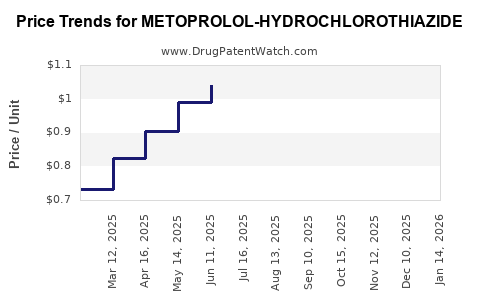
Drug Price Trends for METOPROLOL-HYDROCHLOROTHIAZIDE


✉ Email this page to a colleague

« Back to Dashboard


Drug Price Trends for METOPROLOL-HYDROCHLOROTHIAZIDE

Average Pharmacy Cost for METOPROLOL-HYDROCHLOROTHIAZIDE

These are average pharmacy acquisition costs (net of discounts) from a US national survey
Drug Name NDC Price/Unit ($) Unit Date
METOPROLOL-HYDROCHLOROTHIAZIDE 100-25 MG TAB 27241-0302-01 1.23409 EACH 2025-11-19
METOPROLOL-HYDROCHLOROTHIAZIDE 50-25 MG TAB 27241-0301-01 0.97223 EACH 2025-11-19
METOPROLOL-HYDROCHLOROTHIAZIDE 100-25 MG TAB 62332-0116-31 1.23409 EACH 2025-11-19
METOPROLOL-HYDROCHLOROTHIAZIDE 50-25 MG TAB 62332-0115-31 0.97223 EACH 2025-11-19
METOPROLOL-HYDROCHLOROTHIAZIDE 100-25 MG TAB 00378-0434-01 1.23409 EACH 2025-11-19
METOPROLOL-HYDROCHLOROTHIAZIDE 50-25 MG TAB 00378-0424-01 0.97223 EACH 2025-11-19
>Drug Name >NDC >Price/Unit ($) >Unit >Date

Market Analysis and Price Projections for METOPROLOL-HYDROCHLOROTHIAZIDE

Last updated: July 28, 2025

Introduction

Metoprolol-Hydrochlorothiazide (brand names may include Lopressor HCT, Metoprolol HCT, and others) is a fixed-dose combination used primarily to manage hypertension and certain cardiac conditions. Comprising a beta-blocker (metoprolol) and a thiazide diuretic (hydrochlorothiazide), this medication offers a synergistic approach for blood pressure control. With the increasing prevalence of hypertension globally, the market for combination antihypertensives like Metoprolol-Hydrochlorothiazide is anticipated to expand. This analysis examines current market dynamics, factors influencing pricing, and projects future price trends.

Market Overview

Global Burden of Hypertension and Cardiovascular Diseases

Hypertension affects over 1.28 billion adults worldwide, with projections reaching 1.5 billion by 2025 [1]. The rising prevalence, compounded by aging populations and urbanization, spurs demand for effective antihypertensive therapies. Cardiovascular disease remains the leading cause of death globally, fueling the adoption of combination therapies aimed at improving compliance and therapeutic outcomes.

Therapeutic Significance of Metoprolol-Hydrochlorothiazide

Combination medications such as Metoprolol-Hydrochlorothiazide streamline hypertension management, reduce pill burden, and enhance patient adherence. They are typically prescribed for patients requiring multiple antihypertensives, especially those with resistant hypertension or comorbid conditions.

Market Segmentation

  • By Formulation: Generic and branded formulations. Generics dominate due to lower costs.
  • By Route of Administration: Oral tablets predominate.
  • By Distribution Channel: Hospital pharmacies, retail pharmacies, online pharmacies.
  • Regional Markets: North America, Europe, Asia-Pacific, Latin America, Middle East & Africa.

Current Market Dynamics

Manufacturers and Competition

Major pharmaceutical companies such as Novartis, AstraZeneca, Mylan, Teva, and Local generics producers manufacture and distribute Metoprolol-Hydrochlorothiazide. The market is highly competitive, with a significant proportion of sales driven by generic versions post-patent expiry.

Regulatory Environment

Regulatory authorities like the FDA (U.S.), EMA (EU), and PMDA (Japan) approve generic and branded formulations, influencing pricing strategies. Patent expirations on combination drugs or their constituents lead to increased generic competition, putting downward pressure on prices.

Pricing Factors

  • Patent Status: Patents on branded formulations determine initial pricing levels. Once expired, generic competition leads to substantial price reductions.
  • Manufacturing Costs: Raw material costs, especially as they relate to active pharmaceutical ingredients (APIs), impact pricing.
  • Regulatory and Distribution Costs: Compliance and distribution expenses influence end-user pricing.
  • Market Demand and Prescribing Trends: The shift toward fixed-dose combinations generally supports higher prices initially, but intense competition leads to price erosion over time.

Price Trends and Projections

Current Pricing Landscape

  • United States: Generic Metoprolol-Hydrochlorothiazide (25 mg/12.5 mg) tablets typically retail at approximately $10–$20 for a 30-day supply, depending on pharmacy and insurance coverage.
  • Europe: Prices range from €4 to €15 per month, with variations based on country-specific healthcare policies.
  • Emerging Markets: Lower price points, often between $2–$5 per month, driven by local generics producers.

Projected Price Trajectory (2023–2030)

The compound annual growth rate (CAGR) for generic antihypertensive medications is forecasted at approximately 1–3%, reflecting market saturation and price competition [2].

  • Short-term (1–3 years): Prices will remain relatively stable in mature markets, with modest reductions driven by increased generic penetration.

  • Medium-term (3–5 years): Entry of biosimilars or alternative combination therapies may pressure existing prices downward, especially in price-sensitive markets.

  • Long-term (5–8 years): Patent expirations and continuous manufacturing efficiencies are expected to further decrease prices by 15–25%, making therapy more accessible.

Price Influences

  • Generic Competition: Entry of multiple generic manufacturers after patent expiry significantly drives prices down.
  • Market Penetration: Expansion into emerging markets with lower income thresholds may shift pricing strategies.
  • Healthcare Policies: Governments implementing price control measures (e.g., pricing caps in Europe and Asia) will influence future price points.

Market Growth Drivers

  • Increasing Hypertension Prevalence: Aging populations and lifestyle changes sustain uptrend.
  • Generic Market Expansion: Cost-effective off-patent formulations expand global access.
  • Combination Therapy Adoption: Enhanced compliance boosts demand.
  • Emerging Markets: Rapid healthcare infrastructure development creates new opportunities.

Market Challenges

  • Price erosion due to direct generic competition.
  • Regulatory barriers that can delay market entry or influence pricing.
  • Competitive Alternatives: Newer antihypertensives and fixed-dose combinations with superior efficacy or reduced side effects can cannibalize market share.

Strategic Recommendations

Manufacturers should focus on optimizing manufacturing efficiencies and expanding access in emerging markets. Policymakers and healthcare providers should balance cost containment with drug availability to enhance treatment adherence.


Key Takeaways

  • The global demand for Metoprolol-Hydrochlorothiazide remains robust, driven by rising hypertension prevalence.
  • Patent expirations will catalyze significant price reductions in mature markets, with prices projected to decline by 15–25% over the next 5–8 years.
  • Generic competition and healthcare policies are primary influences on pricing dynamics.
  • Emerging markets present growth opportunities with lower price points, though regulatory and infrastructural hurdles persist.
  • Continued innovation and strategic manufacturing will be essential for sustained market positioning amid intensifying competition.

FAQs

  1. How does patent expiration affect the pricing of Metoprolol-Hydrochlorothiazide?
    Patent expirations typically lead to the entry of generics, resulting in significant price drops—often 50% or more—due to increased competition.

  2. What factors could influence future price increases for this combination medication?
    Price increases may occur in response to supply chain disruptions, raw material shortages, or regulatory changes, though currently, downward pressure dominates.

  3. Are there any emerging alternatives that could impact the market for Metoprolol-Hydrochlorothiazide?
    Yes, newer antihypertensive agents, such as ACE inhibitors, ARBs, or innovative combination therapies, may encroach upon market share due to perceived efficacy or tolerability advantages.

  4. What is the outlook for the availability of generic versions globally?
    Most markets will see increased availability of generics post-patent expiry, especially in countries with well-established pharmaceutical manufacturing sectors like India and China.

  5. How do healthcare policies influence the pricing and accessibility of antihypertensive fixed-dose combinations?
    Policies such as drug price caps, reimbursement schemes, and public procurement practices directly affect prices and accessibility, often promoting lower-cost generics to improve patient access.


References

[1] World Health Organization. "Hypertension." WHO Reports, 2021.

[2] MarketWatch. "Global antihypertensive drugs market forecast." 2022.

[3] FDA Drug Approvals and Patent Expiry Data. U.S. Food and Drug Administration, 2022.

[4] IQVIA. "Global Medicine Spending and Affordability Report," 2022.

Note: All projections are based on current market trends and publicly available data as of 2023; actual future prices may vary due to unforeseen factors.

More… ↓

⤷  Get Started Free

Make Better Decisions: Try a trial or see plans & pricing

Drugs may be covered by multiple patents or regulatory protections. All trademarks and applicant names are the property of their respective owners or licensors. Although great care is taken in the proper and correct provision of this service, thinkBiotech LLC does not accept any responsibility for possible consequences of errors or omissions in the provided data. The data presented herein is for information purposes only. There is no warranty that the data contained herein is error free. We do not provide individual investment advice. This service is not registered with any financial regulatory agency. The information we publish is educational only and based on our opinions plus our models. By using DrugPatentWatch you acknowledge that we do not provide personalized recommendations or advice. thinkBiotech performs no independent verification of facts as provided by public sources nor are attempts made to provide legal or investing advice. Any reliance on data provided herein is done solely at the discretion of the user. Users of this service are advised to seek professional advice and independent confirmation before considering acting on any of the provided information. thinkBiotech LLC reserves the right to amend, extend or withdraw any part or all of the offered service without notice.