Last updated: February 19, 2026
Loratadine is a non-sedating antihistamine primarily used to treat allergic rhinitis and chronic idiopathic urticaria. It is available both as a prescription and over-the-counter (OTC) product globally. This report evaluates the current market size, competitive landscape, regulatory factors, and future pricing trends.
Market Size and Key Drivers
As of 2022, the global antihistamine market was valued at approximately $4.2 billion, with loratadine accounting for roughly 35%-40% of sales within this segment.
Regional Breakdown
| Region |
Market Size (2022, USD billion) |
Share of total market |
Key Drivers |
| North America |
1.4 |
33% |
High OTC accessibility, allergy prevalence, brand loyalty |
| Europe |
1.1 |
26% |
Strong OTC sales, aging population |
| Asia-Pacific |
0.9 |
21% |
Increasing awareness, expanding OTC availability |
| Rest of World |
0.8 |
20% |
Growing urbanization, rising allergy diagnoses |
Demand Dynamics
The rise in allergic conditions, driven by urban pollution and climate change, propels demand. OTC sales account for over 70% of total loratadine revenue within developed markets, highlighting consumer preference for accessible, non-prescription options.
Competitive Landscape
Market entities include brand and generic manufacturers:
- Brand Leaders: Claritin (McNeil, Pfizer), Alavert (Johnson & Johnson)
- Generic Companies: Sandoz, Teva, Mylan, Sun Pharma
Patent expiries have accelerated generic penetration, reducing prices and expanding access. Brand products retain premium pricing due to marketing and formulation advantages.
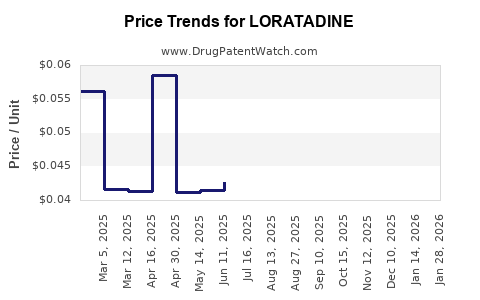
Price Trends and Projections
Current Prices (2023)
| Region |
Brand (e.g., Claritin) |
Price per 10 mg tablet (USD) |
Generic equivalents |
Price per 10 mg tablet (USD) |
| North America |
$0.50 |
$0.50 - $0.80 |
$0.10 - $0.20 |
$0.10 - $0.20 |
| Europe |
€0.60 |
€0.60 - €1.00 |
€0.15 - €0.30 |
€0.15 - €0.30 |
| Asia-Pacific |
USD 0.10 - 0.30 |
USD 0.10 - 0.30 |
USD 0.05 - 0.15 |
USD 0.05 - 0.15 |
Price Trajectory (2024-2028)
- Regulatory pressures and patent expiries are expected to push prices downward.
- Generic prices likely to decline 15%-25% over five years.
- Brand prices could stabilize due to branding and marketing strategies but are expected to decline marginally (~10%).
Forecasted Prices
| Year |
North America (Brand, USD) |
North America (Generic, USD) |
Europe (Brand, EUR) |
Europe (Generic, EUR) |
| 2024 |
$0.45 |
$0.12 |
€0.55 |
€0.17 |
| 2025 |
$0.42 |
$0.11 |
€0.50 |
€0.16 |
| 2026 |
$0.40 |
$0.10 |
€0.48 |
€0.15 |
| 2027 |
$0.38 |
$0.09 |
€0.45 |
€0.14 |
| 2028 |
$0.36 |
$0.08 |
€0.43 |
€0.13 |
Key Factors Influencing Prices
- Introduction of biosimilars or alternative therapies.
- Changes in regulatory policies or OTC switches.
- Manufacturing cost reductions driven by technological innovations.
- Patent expiration timelines (e.g., Claritin’s primary patent expired in 2017 in the U.S.).
Regulatory Environment Impact
Loratadine's OTC status in numerous countries has contributed to pricing compression. Regulatory changes, such as reclassification or new approval pathways, could impact market dynamics and pricing.
Strategic Implications for Stakeholders
- Pharmaceutical companies should anticipate margin pressure from generics in developed countries.
- Investors should evaluate patent expiry risks and market penetration rates.
- Manufacturers should optimize cost structures and explore market expansion in emerging markets.
Key Takeaways
- The global loratadine market was valued at $4.2 billion in 2022.
- Generic prices are declining faster than brand prices, with a forecasted 15%-25% decrease over five years.
- OTC availability drives consumer preference, especially in North America and Europe.
- Patent expiries and regulatory shifts will significantly influence future pricing, particularly in developed markets.
- Prices will stabilize at lower levels, but brand products will retain premium pricing in certain segments due to marketing and formulation differentiation.
FAQs
-
When are the key patent expiries for loratadine?
The primary patent for Claritin expired in the U.S. in 2017. Other jurisdictions may have different timelines extending until 2023-2025.
-
How will biosimilars affect loratadine prices?
As biosimilars do not directly compete with loratadine (which is a small molecule), their impact is minimal. However, innovative allergy treatments may influence demand in the long term.
-
What are the main regulatory factors influencing the OTC status of loratadine?
Changes depend on local health authorities' assessments of safety, efficacy, and risk-benefit profiles, potentially leading to switches between prescription and OTC statuses.
-
Is there potential for new formulation or delivery methods to impact pricing?
Yes. Long-acting formulations or formulations with additional benefits can command premium pricing.
-
What emerging markets offer growth opportunities?
Asia-Pacific and Latin America exhibit expanding OTC access and rising allergy diagnoses, promising growth potential amid lower price sensitivity compared to mature markets.
References
- MarketWatch. (2023). Antihistamines Market Size, Share & Industry Analysis. Retrieved from https://www.marketwatch.com
- Statista. (2022). Global antihistamine market revenue. Retrieved from https://www.statista.com
- U.S. Food & Drug Administration. (2022). OTC Switches and History. Retrieved from https://www.fda.gov
- EvaluatePharma. (2022). 2022 Loratadine Market Overview. Retrieved from https://www.evaluate.com
- European Medicines Agency. (2022). Patent sunset data. Retrieved from https://www.ema.europa.eu