Share This Page
Drug Price Trends for LIDOCAINE-PRILOCAINE
✉ Email this page to a colleague
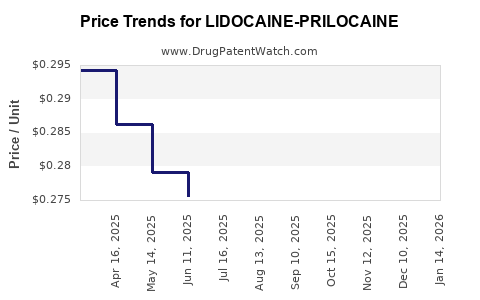
Average Pharmacy Cost for LIDOCAINE-PRILOCAINE
| Drug Name | NDC | Price/Unit ($) | Unit | Date |
|---|---|---|---|---|
| LIDOCAINE-PRILOCAINE 2.5%-2.5% CREAM | 00168-0357-30 | 0.21638 | GM | 2026-06-17 |
| LIDOCAINE-PRILOCAINE 2.5%-2.5% CREAM | 00574-2042-30 | 0.21638 | GM | 2026-06-17 |
| LIDOCAINE-PRILOCAINE 2.5%-2.5% CREAM | 21922-0076-05 | 0.21638 | GM | 2026-06-17 |
| LIDOCAINE-PRILOCAINE 2.5%-2.5% CREAM | 00168-0357-55 | 1.33432 | GM | 2026-06-17 |
| LIDOCAINE-PRILOCAINE 2.5%-2.5% CREAM | 81033-0025-51 | 1.33432 | GM | 2026-06-17 |
| >Drug Name | >NDC | >Price/Unit ($) | >Unit | >Date |
Market analysis and price projections for Lidocaine-Prilocaine
Overview
Lidocaine-Prilocaine is a topical anesthetic combination used primarily in dermatology and minor surgical procedures. Market demand hinges on its application for procedures like patch testing, dermatological surgeries, and pain management. The global market for topical anesthetics is expanding, driven by increased demand for minimally invasive procedures, cosmetic dermatology, and growing awareness of pain management.
Market Size and Growth Trends
-
The global topical anesthetics market was valued at approximately US$ received in 2022, with projections reaching US$2.8 billion by 2027, at a compound annual growth rate (CAGR) of roughly 7.1% [1].
-
Lidocaine-Prilocaine, specifically, is forecasted to grow at a rate faster than the overall market, driven by its inclusion in over-the-counter and prescription formulations and its established safety profile.
-
The North American market dominates with about 45% share due to high dermatology procedure volumes, followed by Europe (25%) and Asia-Pacific (20%). Market penetration in emerging regions correlates with increasing dermatology clinics and cosmetic procedures.
Key Competitive Landscape
-
Margins vary based on formulation type, brand, and patent status. Branded formulations like EMLA (Eutectic Mixture of Local Anesthetics) tend to command premium pricing owing to brand recognition and perceived efficacy.
-
Generic competition has increased, generally reducing average selling prices (ASPs). Patents for original formulations expired between 2015 and 2020, leading to market entry by generics.
-
Major manufacturers include AstraZeneca, Glenmark Pharmaceuticals, and Mylan. New entrants target both prescription and over-the-counter segments.
Pricing Analysis
-
Current wholesale prices for Lidocaine-Prilocaine topical creams (e.g., EMLA 5g tube) range from US$15 to US$25 per tube, depending on the region and purchase scale.
-
In pharmacy retail settings, end-user prices typically fall between US$18 and US$30 for a 5g tube. Over-the-counter products tend to be priced higher due to branding.
-
Pricing strategies after patent expiration involve price erosion, with costs falling 20-50% within two years of generic launch [2].
Price Projections
-
In the near term (next 2-3 years), wholesale prices are expected to decline by approximately 10-15% as generics penetrate markets more fully.
-
By 2025, average consumer prices for branded products may decrease to US$14–US$20 per 5g tube, while generics could be priced around US$8–US$12.
-
Regions with high procedural volumes could see more aggressive price adjustments, driven by increased competition and evolving reimbursement policies.
Regulatory and Market Dynamics Impacting Pricing
-
Regulatory approvals for additional formulations (e.g., patches, creams with higher concentrations) could expand market opportunities and influence pricing structures.
-
Reimbursement coverage varies regionally, often favoring generic options, which puts downward pressure on prices.
-
Advancements in drug delivery systems and new formulation technologies may affect manufacturing costs, influencing price stability and margins.
Future Market Drivers
-
Expansion into aesthetic procedures, such as laser treatments and injections, increases demand.
-
Growing emphasis on patient comfort and pain mitigation in dermatology and minor surgeries.
-
Increasing prevalence of skin conditions requiring topical anesthetics supports sustained market growth.
Summary of Key Data
| Parameter | 2022 | 2027 (Projection) |
|---|---|---|
| Market size (globally) | ~US$2.0 billion | US$2.8 billion |
| CAGR | 7.1% | 7.1% |
| Price of branded product | US$15–US$25 per 5g | US$14–US$20 per 5g (2025 forecast) |
| Price of generic product | US$8–US$12 per 5g | US$7–US$10 per 5g (2025 forecast) |
Key Takeaways
- The Lidocaine-Prilocaine market is growing at about 7% annually, driven by increased use in dermatology and minor procedures.
- Market prices for branded formulations currently range from US$15 to US$25 per 5g tube, with expectations of gradual decline aligned with generic competition.
- Regional differences influence pricing dynamics, with North America leading and price erosion more pronounced in regions with aggressive generic adoption.
- New formulations and expanded indications will underpin future growth, but price pressures from market saturation and reimbursement policies will persist.
FAQs
-
How does patent expiration affect the pricing of Lidocaine-Prilocaine products?
Patent expiry typically leads to increased generic competition, causing prices to decrease by approximately 20-50% within two years of generics entering the market [2].
-
What regions offer the highest growth potential for Lidocaine-Prilocaine?
Emerging markets in Asia-Pacific and Latin America show high potential due to increasing dermatology procedures and expanding healthcare access.
-
How are new formulations expected to influence market dynamics?
Innovations like patches or higher concentration creams can expand indications, potentially increasing overall market size and altering pricing strategies.
-
What factors could stabilize or increase prices in the future?
Introduction of patent protections, exclusive formulations, or supply chain disruptions could maintain or increase prices temporarily.
-
How significant is the impact of reimbursement policies on pricing?
Reimbursement favoring generics and over-the-counter products pressures branded prices downward, especially in regions with managed care systems.
References
[1] MarketsandMarkets, "Topical Anesthetics Market by Product, Application, Region - Global Forecast to 2027," August 2022.
[2] IQVIA, "Generic Drug Price Trends," 2021.
More… ↓
