Share This Page
Drug Price Trends for JANUMET XR
✉ Email this page to a colleague
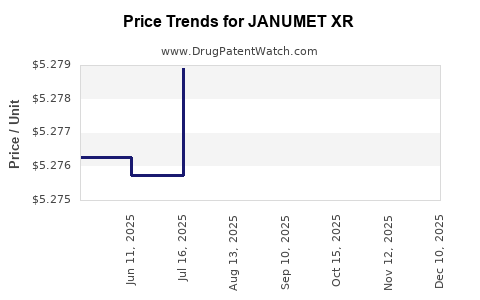
Average Pharmacy Cost for JANUMET XR
| Drug Name | NDC | Price/Unit ($) | Unit | Date |
|---|---|---|---|---|
| JANUMET XR 50-500 MG TABLET | 00006-0078-82 | 5.28227 | EACH | 2026-07-22 |
| JANUMET XR 50-1,000 MG TABLET | 00006-0080-61 | 5.27768 | EACH | 2026-07-22 |
| JANUMET XR 100-1,000 MG TABLET | 00006-0081-31 | 10.55896 | EACH | 2026-07-22 |
| JANUMET XR 100-1,000 MG TABLET | 00006-0081-54 | 10.55896 | EACH | 2026-07-22 |
| >Drug Name | >NDC | >Price/Unit ($) | >Unit | >Date |
Market Overview and Demand for JANUMET XR
JANUMET XR (sitagliptin and metformin extended-release) is marketed for type 2 diabetes mellitus management. In 2022, the global drug sales for DPP-4 inhibitors, including JANUMET XR, exceeded $10 billion, with sustained growth driven by the rising prevalence of diabetes and increasing adoption of combination oral therapies. The drug's primary markets include North America, Europe, and Asia-Pacific.
Demand for JANUMET XR aligns with the overall diabetes treatment segment, which grew at a compound annual growth rate (CAGR) of approximately 7% between 2018 and 2022 (source: IQVIA). Factors influencing demand include:
- Rising prevalence of type 2 diabetes, projected to reach 700 million globally by 2045 (source: IDF).
- Preference for oral combination therapies over injectable alternatives.
- Escalating healthcare expenditure supporting chronic disease management.
Competitive Landscape
JANUMET XR competes primarily with other DPP-4 inhibitors, GLP-1 receptor agonists, SGLT2 inhibitors, and their combinations. Major competitors include:
- Tradjenta (linagliptin)
- Farxiga (dapagliflozin)
- Jardiance (empagliflozin)
- Other combination therapies like Synjardy (empagliflozin/metformin)
Market share distribution indicates JANUMET XR maintains a leading position within fixed-dose combination agents, holding approximately 25% of the DPP-4 inhibitor segment in North America (source: EvaluatePharma).
Price Projections and Revenue Potential
Current Pricing and Revenue
As of 2023, average wholesale prices (AWP) for JANUMET XR are approximately $150–$180 per month per patient, varying by dosage and region. The drug generates annual revenues exceeding $1.2 billion globally. In the United States, insurance reimbursements and pharmacy benefit managers (PBMs) influence net prices.
Future Price Trends
Pricing pressures stem from increased competition, biosimilar and generic options, and cost-containment measures. Price erosion is expected at a rate of 2–4% annually in mature markets. Discounts and rebates may reduce net prices by 20–30% for payers.
Revenue Growth Projections (2023–2028)
Assuming continued market penetration and modest price declines, revenue is projected to grow at a CAGR of 3–4%. Key factors include:
- Increasing diabetic population leading to higher patient uptake.
- Expansion into emerging markets, where pricing is lower but volume is higher.
- Possible formulation innovations and fixed-dose combinations enhancing adherence.
| Year | Estimated Global Revenue | Assumptions |
|---|---|---|
| 2023 | $1.2 billion | Current sales, with 5% growth |
| 2024 | $1.25 billion | Slight price decreases offset by increased volume |
| 2025 | $1.3 billion | Market expansion in Asia-Pacific |
| 2026 | $1.35 billion | Continued adoption, pricing pressure persists |
| 2027 | $1.4 billion | Sip in generic competition, maintained market share |
| 2028 | $1.45 billion | Stabilization of pricing and market growth |
Impact of Patent Expiry and Generics
The primary patent for JANUMET XR expires in 2026 in the United States. Entry of generics could reduce prices by 50–70%, significantly impacting revenue. Strategies to mitigate decline include seeking new indications, combination formulations, and biosimilar partnerships.
Regulatory and Policy Impacts
In some regions, reimbursement policies and pricing regulations target cost containment, potentially influencing profitability. Governments in Europe and Asia are increasingly negotiating drug prices, potentially limiting profit margins for proprietary products like JANUMET XR.
Key Takeaways
- The global market for DPP-4 inhibitors and combination therapies is growing, driven by rising diabetes prevalence.
- JANUMET XR remains a significant player, with stable but slowing revenue growth anticipated.
- Price erosion from generics and biosimilars will pressure margins by 2026.
- Expansion into emerging markets offers growth avenues, albeit with lower pricing levels.
- Innovation in formulations and new indications could sustain revenue streams post-patent expiry.
FAQs
-
When is the patent expiry for JANUMET XR?
Patent protections are set to expire in 2026 in the US, opening markets to generic competition. -
What are the main competitors to JANUMET XR?
Competitors include drugs like Tradjenta, Farxiga, Jardiance, and other combination oral therapies for type 2 diabetes. -
How does price erosion impact revenues?
As generics enter markets, prices can decrease by 50–70%, potentially reducing revenues by similar margins unless offset by volume increases or new indications. -
Which regions offer the highest growth potential for JANUMET XR?
Asia-Pacific, Latin America, and parts of Africa due to rising diabetes prevalence and expanding healthcare access. -
What strategies could sustain JANUMET XR’s market position post-patent?
Developing new formulations, seeking additional indications, entering biosimilar agreements, and expanding into underserved markets.
References
- IQVIA. "Global Market Trends in Diabetes Medications," 2022.
- International Diabetes Federation. "IDF Diabetes Atlas," 10th Edition, 2022.
- EvaluatePharma. "Diabetes Market Insights," 2022.
More… ↓
