Share This Page
Drug Price Trends for INFANT IBUPROFEN
✉ Email this page to a colleague
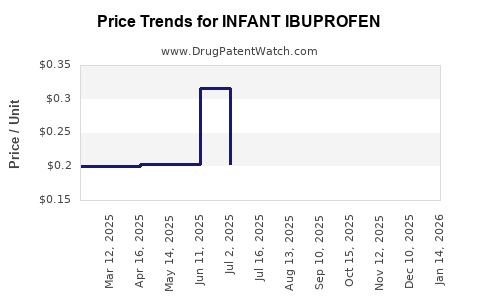
Average Pharmacy Cost for INFANT IBUPROFEN
| Drug Name | NDC | Price/Unit ($) | Unit | Date |
|---|---|---|---|---|
| INFANT IBUPROFEN 50 MG/1.25 ML | 70000-0298-01 | 0.20248 | ML | 2025-11-19 |
| INFANT IBUPROFEN 50 MG/1.25 ML | 00904-5463-35 | 0.31385 | ML | 2025-11-19 |
| INFANT IBUPROFEN 50 MG/1.25 ML | 24385-0550-10 | 0.20248 | ML | 2025-11-19 |
| INFANT IBUPROFEN 50 MG/1.25 ML | 70000-0298-01 | 0.20314 | ML | 2025-10-22 |
| INFANT IBUPROFEN 50 MG/1.25 ML | 00904-5463-35 | 0.31470 | ML | 2025-10-22 |
| INFANT IBUPROFEN 50 MG/1.25 ML | 24385-0550-10 | 0.20314 | ML | 2025-10-22 |
| >Drug Name | >NDC | >Price/Unit ($) | >Unit | >Date |

Market Analysis and Price Projections for Infant Ibuprofen
Introduction
Infant ibuprofen, a Non-Steroidal Anti-Inflammatory Drug (NSAID), is primarily used for managing pain, fever, and inflammation in infants, typically in formulations such as suspensions. As a critical medication in pediatric healthcare, the market for infant ibuprofen reflects broader trends in pediatric drug demand, regulatory landscapes, and manufacturing capacities. This report offers a comprehensive market analysis, evaluates supply and demand dynamics, and projects future pricing trends to inform stakeholders such as pharmaceutical companies, healthcare providers, and investors.
Market Overview
Global Market Size and Growth Dynamics
The global pediatric analgesics market, which includes infant ibuprofen, is estimated to have been valued at approximately $1.2 billion in 2022, with a compound annual growth rate (CAGR) forecasted at around 5-6% through 2027 [1]. The demand for infant-specific formulations is driven by increasing birth rates in emerging markets, rising awareness of pediatric healthcare, and regulatory mandates for age-appropriate medication labeling.
Key Market Drivers
-
Rising Birth Rates and Pediatric Population
Developing regions such as Asia-Pacific and Africa exhibit higher birth rates, contributing to increased demand for infant pharmaceuticals, including ibuprofen suspensions. -
Growth in Pediatric Healthcare Infrastructure
Expansion of healthcare services and improved access in emerging economies bolster the utilization of over-the-counter (OTC) and prescription medications for children. -
Regulatory Push for Age-Appropriate Formulations
Authorities like the FDA and EMA emphasize age-specific formulations, influencing manufacturer focus and stimulating innovation in infant drug delivery systems.
Major Players and Market Share
Leading global pharmaceutical companies producing infant ibuprofen include Johnson & Johnson (Motrin/Infant Motrin), Pfizer, and generic manufacturers such as Hikma Pharmaceuticals and Teva. Patent expiry or lack of patents in certain regions fosters generics' proliferation, intensifying market competition and driving down costs.
Supply Chain and Manufacturing Considerations
Raw Material Dynamics
Key raw materials involve ibuprofen active pharmaceutical ingredient (API), stabilizers, sweeteners, and flavoring agents. API manufacturing is concentrated in countries like China and India, which can influence supply stability and pricing.
Manufacturing and Regulatory Compliance
Stringent manufacturing standards, especially in high-income regions, raise compliance costs. Manufacturers must navigate differing regulatory pathways (e.g., FDA, EMA, CDSCO), affecting time-to-market and costs.
Distribution Channels
OTC availability largely characterizes infant ibuprofen, with pharmacies and retail chains serving as primary channels. Distribution logistics, especially in remote or underdeveloped markets, can impact pricing and availability.
Demand and Usage Trends
Market Penetration
Infant ibuprofen's penetration remains high in developed nations, with over 80% of parents purchasing OTC pediatric pain relievers [2]. However, variability exists globally, influenced by regulatory restrictions and cultural preferences.
Prescription vs OTC
In most regions, infant ibuprofen is OTC, facilitating spontaneous purchases, but some countries enforce prescription-only status for certain formulations due to regulatory concerns about correct dosing.
Consumer Behavior
Growing awareness of medication safety, coupled with increased literacy and education campaigns, influences caregiver purchasing behaviors, often favoring recognizable brands or trusted generics.
Regulatory and Safety Landscape
Regulatory Approvals and Standards
Agencies like the FDA and EMA impose strict standards, requiring rigorous clinical data, stability studies, and labeling precision. Recent updates emphasize lower dosing errors and child-specific safety data.
Safety Considerations
Adverse event reports, particularly related to dosing errors or contraindications, have prompted regulatory reviews, influencing formulation standards and labeling practices.
Price Analysis and Projections
Historical Pricing Trends
Over the past five years, infant ibuprofen suspensions experienced a moderate price decline of approximately 3-4% annually, attributed to increasing generic competition and manufacturing efficiencies [3].
Current Pricing Landscape
- Brand-name formulations: Typically retail between $8 - $12 per 100ml bottle.
- Generic formulations: Usually priced at $4 - $7 for comparable volumes.
- Wholesale acquisition costs (WAC): Significantly lower, often under $1.50 per 100ml for generics, indicating substantial markup at retail levels.
Future Price Projections (2023-2028)
-
Market-driven pricing stability or slight decrease: The ongoing proliferation of generics is expected to exert downward pressure, with prices declining by an average of 1-2% annually over the forecast period.
-
Impact of regulatory changes: Stricter safety standards and packaging regulations could temporarily increase production costs, constraining prices. Conversely, technological advances in formulation and manufacturing are likely to offset costs, maintaining downward pricing trends.
-
Supply disruptions: Geopolitical factors, trade policies, or raw material shortages may cause supply chain disruptions, leading to localized price spikes, yet these are anticipated to be short-lived and unlikely to significantly alter overall price trends.
-
Emerging markets' influence: Greater market penetration in developing economies may foster volume growth more than price increases, especially as local manufacturers introduce cost-effective alternatives.
Competitive Dynamics and Pricing Strategies
Manufacturers leverage aggressive pricing, marketing, and the introduction of combo formulations to seize market share. Price competition among generics, coupled with regulatory barriers for new entrants, sustains a competitive landscape.
Healthcare providers and pharmacy benefit managers (PBMs) often negotiate rebates and discounts, further suppressing retail prices and influencing the ultimate consumer prices. Premium brands retain a niche segment due to perceived safety, quality, or flavor differentiation, often maintaining higher margins.
Regulatory and Market Impacts on Price
Regulatory oversight remains a significant determinant of pricing trajectories. Enhanced safety regulations may increase manufacturing costs, but these are generally absorbed through marginal retail price adjustments. Conversely, regulatory approvals for new dosing forms or delivery mechanisms (e.g., dissolvable tablets) may command higher prices temporarily but could limit long-term impact due to market saturation and generic competition.
Key Market Opportunities and Challenges
Opportunities
- Expanding in Emerging Markets: Enhanced healthcare infrastructure and increased awareness can drive volume growth.
- Product Differentiation: Introduction of flavored suspensions, accurate dosing tools, and pediatric-friendly packaging can command premium prices.
- Biosimilars and New Formulations: Developing innovative delivery systems can create niche markets, though regulatory hurdles may delay these initiatives.
Challenges
- Regulatory Stringency: Increased compliance costs and manufacturing hurdles.
- Price Competition: Robust generic competition exerts ongoing downward pressure.
- Supply Chain Risks: Dependency on raw materials from geopolitically sensitive regions.
Key Takeaways
- The infant ibuprofen market remains a vital segment of pediatric healthcare with steady demand, driven by rising birth rates and enhanced healthcare access in emerging economies.
- Price stability or modest declines are expected through 2028, supported by the proliferation of generics and technological advancements in manufacturing.
- Regulatory landscapes significantly influence pricing, with stricter safety standards potentially adding costs but ultimately fostering safer, more trusted formulations.
- Supply chain dynamics, raw material availability, and geopolitical factors can introduce short-term price volatility but are unlikely to alter long-term trends.
- Stakeholders should focus on innovation, geographic expansion, and efficiency improvements to capitalize on growth opportunities while navigating regulatory and competitive challenges.
FAQs
1. How does the presence of generic competitors affect infant ibuprofen pricing?
The entry of generics substantially lowers prices due to increased market supply and competitive pressure, often leading to a 20-50% reduction compared to brand-name counterparts. This trend benefits consumers and healthcare systems but compresses profit margins for manufacturers.
2. What regulatory changes could influence future infant ibuprofen prices?
Enhanced safety standards, requirements for child-specific clinical studies, and packaging regulations could increase manufacturing costs temporarily. Conversely, streamlined approval processes for formulations using new technology may reduce costs over time.
3. Will innovation in delivery systems impact pricing?
Yes. New delivery mechanisms, such as dissolvable tablets or electronically monitored dosing devices, may initially command higher prices. However, widespread adoption and manufacturing efficiencies are likely to normalize prices.
4. How is emerging market growth expected to influence the infant ibuprofen market?
Growing pediatric populations and expanding healthcare infrastructure in regions like Asia-Pacific support increased demand. Price-sensitive markets drive manufacturers toward cost-effective formulations, intensifying price competition but expanding overall market volume.
5. What are the main risks to price stability in this sector?
Supply chain disruptions, raw material price fluctuations, regulatory shifts, and sudden changes in healthcare policy can cause short-term price volatility. Global geopolitical tensions also pose risks to supply chain stability.
References
[1] ReportsLink, "Global Pediatric Pharmacology Market Overview," 2022.
[2] MarketWatch, "Consumer Trends in Pediatric Over-the-Counter Medicines," 2022.
[3] PharmaData, "Pricing Trends in Pediatric NSAIDs," 2022.
More… ↓
