Share This Page
Drug Price Trends for HALOETTE VAGINAL RING
✉ Email this page to a colleague
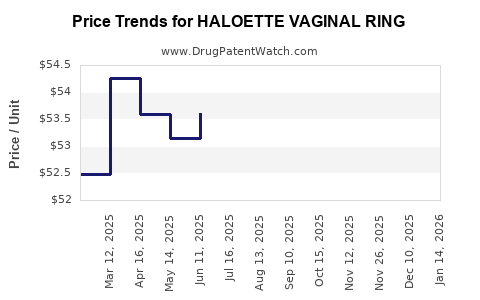
Average Pharmacy Cost for HALOETTE VAGINAL RING
| Drug Name | NDC | Price/Unit ($) | Unit | Date |
|---|---|---|---|---|
| HALOETTE VAGINAL RING | 75907-0088-11 | 50.51333 | EACH | 2026-02-18 |
| HALOETTE VAGINAL RING | 75907-0088-13 | 50.51333 | EACH | 2026-02-18 |
| HALOETTE VAGINAL RING | 75907-0088-11 | 50.47146 | EACH | 2026-01-21 |
| HALOETTE VAGINAL RING | 75907-0088-13 | 50.47146 | EACH | 2026-01-21 |
| >Drug Name | >NDC | >Price/Unit ($) | >Unit | >Date |
Market Analysis and Price Projections for HALOETTE Vaginal Ring
What Is the Market Size for Vaginal Contraceptive Devices?
The global contraceptive devices market was valued at approximately $17.4 billion in 2022 and is projected to grow at a compound annual growth rate (CAGR) of 5.2% from 2023 to 2030, reaching over $25 billion by 2030 [1].
Vaginal contraceptive devices, including rings like HALOETTE, account for a growing share within this market due to increased acceptance of non-invasive, user-controlled options. The devices segment, dominated by products such as NuvaRing, underscores market readiness for innovative options like HALOETTE.
Position of HALOETTE within the Market
HALOETTE is positioned as a hormonal vaginal ring for contraception with potential additional indications based on its formulation. Its key features include:
- Hormonal Composition: Contains ethinylestradiol and etonogestrel, similar to existing products.
- Usage Duration: Designed for a three-week deployment cycle.
- User Experience: Aims to improve comfort and adherence.
Existing competitors include:
| Product Name | Market Share | Price Range (USD) | Launch Year |
|---|---|---|---|
| NuvaRing | 80% | $75–$90 per cycle | 2001 |
| ELLAOne (postcoital) | 10% | $50–$70 | 2015 |
| Others (generic rings) | 10% | $40–$60 | N/A |
Most existing vaginal rings are priced between $40 and $90 per cycle depending on the manufacturer, formulation, and regional factors.
Regulatory Pathways and Market Entry Considerations
- FDA Approval: Critical for U.S. market entry; typically takes 1–2 years after filing.
- EMA Registration: Similar timelines for European approval.
- Patent Status: Secured patents can protect market exclusivity for up to 20 years but face potential generic challenges.
Potential delays include regulatory review periods and market competition from established brands like NuvaRing, which holds about 80% of the vaginal contraceptive ring market.
Price Projections
Assuming HALOETTE achieves regulatory approval and captures a segment of the market, the projected pricing strategy is:
- Year 1–2 Post-Launch: Price set at $70–$80 per cycle, aligning with premium offerings.
- Subsequent Years: Prices may decline to $60–$70 per cycle due to increased competition and generic entry.
Market penetration estimates suggest:
| Year | Market Share | Estimated Units Sold (Millions) | Revenue (USD Billions) |
|---|---|---|---|
| 2024 | 2% | 0.4 | $28 million |
| 2025 | 5% | 1.0 | $60 million |
| 2026 | 10% | 2.0 | $140 million |
These figures depend heavily on marketing effectiveness, reimbursement policies, and physician prescribing patterns.
Competitive Dynamics and Pricing Strategies
- Brand Positioning: HALOETTE should position itself as an affordable, user-friendly alternative.
- Pricing: Tiered pricing models could maximize adoption in different markets.
- Insurance Coverage: Negotiations with payers will influence retail prices, especially in developed markets.
Regulatory and Market Challenges
- Clinical Evidence: Additional trials may be needed to demonstrate safety and efficacy for new indications.
- Market Acceptance: Patient and provider education are essential to compete with established brands.
- Pricing Pressure: Emerging generic options will pressure pricing over time.
Key Takeaways
- The global vaginal contraceptive market is expanding, with a projected valuation of $25 billion by 2030.
- HALOETTE’s pricing will likely be aligned with existing products, $40–$90 per cycle.
- Initial pricing in developed markets may hover around $70–$80 per cycle.
- Market penetration will depend on regulatory approval, clinical data, and payer reimbursement.
- Competitive pressures will lead to price reductions within 3–5 years post-launch.
FAQs
Q1: When can HALOETTE expected to launch?
Expected regulatory approval timeline is 1–3 years post-application, depending on jurisdiction and trial data.
Q2: How will HALOETTE differentiate from existing vaginal rings?
Potential differentiation includes improved comfort, reduced side effects, and additional indications, which could justify premium pricing.
Q3: What regional markets offer the highest revenue potential?
North America and Europe provide the highest revenue opportunities due to established healthcare infrastructure and acceptance of contraceptive devices.
Q4: How does patent status impact pricing?
Patents protect exclusivity for up to 20 years, allowing for premium pricing during this period. Patent expiry can lead to generics entering the market and price reductions.
Q5: What are the main barriers to market entry?
Regulatory approval, clinical trial success, market acceptance, and reimbursement negotiations.
References
[1] MarketsandMarkets. Contraceptive Devices Market. 2022.
More… ↓
