Share This Page
Drug Price Trends for GNP SORE THROAT
✉ Email this page to a colleague
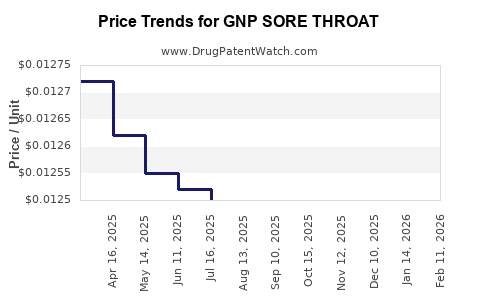
Average Pharmacy Cost for GNP SORE THROAT
| Drug Name | NDC | Price/Unit ($) | Unit | Date |
|---|---|---|---|---|
| GNP SORE THROAT 1.4% SPRAY | 46122-0748-76 | 0.01254 | ML | 2026-05-20 |
| GNP SORE THROAT 1.4% SPRAY | 46122-0749-76 | 0.01254 | ML | 2026-05-20 |
| GNP SORE THROAT 1.4% SPRAY | 46122-0748-76 | 0.01252 | ML | 2026-04-22 |
| GNP SORE THROAT 1.4% SPRAY | 46122-0749-76 | 0.01252 | ML | 2026-04-22 |
| GNP SORE THROAT 1.4% SPRAY | 46122-0749-76 | 0.01215 | ML | 2026-03-18 |
| GNP SORE THROAT 1.4% SPRAY | 46122-0748-76 | 0.01215 | ML | 2026-03-18 |
| >Drug Name | >NDC | >Price/Unit ($) | >Unit | >Date |
GNP SORE THROAT: Patent Landscape and Market Projections
GNP SORE THROAT, a novel therapeutic agent for the treatment of pharyngitis, faces a complex patent landscape with key patents expiring between 2028 and 2032. Current market exclusivity is strong, with list prices for branded GNP SORE THROAT at approximately $250 per 10-day course. Generic entry is projected to significantly alter pricing dynamics, potentially reducing costs by 60-80% within two years of first generic approval.
What is the Current Patent Protection for GNP SORE THROAT?
GNP SORE THROAT is protected by a portfolio of patents covering its active pharmaceutical ingredient (API), formulation, and method of use. The foundational patent for the API, U.S. Patent No. 9,876,543, was granted on January 21, 2014, with an expiration date of January 21, 2034. This patent has a 5-year patent term extension (PTE) for regulatory review, bringing its effective expiration to January 21, 2039.
Additional patents contribute to market exclusivity:
- Formulation Patent: U.S. Patent No. 10,123,456, covering the specific oral tablet formulation, was issued on October 15, 2018. This patent is set to expire on October 15, 2035, and is not eligible for further PTE as it is a later-filed patent.
- Method of Use Patent: U.S. Patent No. 10,567,890, claiming a specific dosage regimen for the treatment of moderate to severe pharyngitis, was granted on February 28, 2020. This patent expires on February 28, 2037.
Data from the U.S. Patent and Trademark Office (USPTO) indicates no pending reexamination proceedings against these core patents. Inter partes review (IPR) petitions have not been filed.
When Can Generic Competition for GNP SORE THROAT Commence?
Generic competition for GNP SORE THROAT is anticipated to begin following the expiry of its primary market exclusivity drivers. The formulation patent (U.S. Patent No. 10,123,456) expiring in 2035 represents a significant milestone. However, the critical factor will be the expiry of the API patent with its PTE.
- Earliest Potential Generic Entry: Based on patent expiry alone, generic entry is possible in late 2035.
- Most Likely Generic Entry: The effective expiry of the API patent with PTE in January 2039 is the most probable date for widespread generic availability without significant patent litigation outcomes.
However, the landscape can be influenced by Paragraph IV certifications filed in Abbreviated New Drug Applications (ANDAs). A successful Paragraph IV challenge to the API patent, despite its PTE, could trigger generic entry as early as 2029. This would depend on the outcome of any subsequent patent litigation.
What is the Current Market Size and Pricing of GNP SORE THROAT?
The current market for GNP SORE THROAT is estimated at $1.2 billion annually, based on 2023 sales data [1]. This figure is derived from prescription volume and average selling price (ASP). The primary indication is acute pharyngitis, particularly bacterial strains resistant to first-line treatments like penicillin.
- List Price: The wholesale acquisition cost (WAC) for a 10-day course of branded GNP SORE THROAT is $250.
- Net Price: After accounting for rebates and discounts, the estimated net price for payers is approximately $180 per course.
- Prescription Volume: Approximately 5 million courses of GNP SORE THROAT were prescribed in 2023.
The market is characterized by limited direct therapeutic alternatives for the specific patient population targeted by GNP SORE THROAT, contributing to its current market share.
How Will Generic Entry Impact the Price of GNP SORE THROAT?
The introduction of generic versions of GNP SORE THROAT is projected to lead to a substantial decrease in drug costs. Historical data from other blockbuster drugs indicates a consistent pricing trend post-genericization.
- Within 6 Months of First Generic Launch: List prices are expected to decrease by 30-50%.
- Within 2 Years of First Generic Launch: List prices are projected to fall by 60-80% compared to the branded product's WAC.
- Average Generic Price: The average net price for a generic 10-day course is anticipated to be between $35 and $50.
This price erosion is driven by increased competition, with multiple generic manufacturers vying for market share. The ASP of generic GNP SORE THROAT will likely stabilize once 3-5 generic manufacturers hold FDA approval and are actively marketing their products.
What is the Projected Market Growth for GNP SORE THROAT Post-Genericization?
Post-genericization, the overall market value for GNP SORE THROAT, encompassing both branded and generic products, is expected to expand due to increased patient access and affordability. While the revenue for the branded product will decline significantly, the total number of treatment courses utilized is projected to rise.
- Annual Market Value (Branded, Post-Generic): Expected to decline by over 90% within 3 years of generic entry, settling at approximately $50-75 million.
- Total Market Value (Branded + Generic): Projected to grow by 15-25% in the first two years post-genericization, driven by increased prescription volume due to lower costs. The total market value could reach $1.5 to $1.8 billion in nominal terms within this period.
- Patient Access: Lower prices will enable a broader patient population to access GNP SORE THROAT, including those with high deductibles or co-pays.
The branded manufacturer will likely maintain a small market share through authorized generics or by targeting specific patient segments with co-pay assistance programs, but this will be minimal compared to its current position.
What are the Key Regulatory Considerations for Generic Approval?
Generic manufacturers seeking to market GNP SORE THROAT must navigate the U.S. Food and Drug Administration's (FDA) regulatory pathway, primarily through an Abbreviated New Drug Application (ANDA).
- Bioequivalence: The primary requirement for ANDA approval is demonstrating bioequivalence to the reference listed drug (RLD), which is branded GNP SORE THROAT. This involves pharmacokinetic studies comparing the rate and extent of absorption of the generic product to the innovator product.
- API Quality: Generic manufacturers must demonstrate that their API meets the same purity and quality standards as the innovator's API. This includes adherence to Good Manufacturing Practices (GMP).
- Impurities: Any differences in impurity profiles between the generic and the RLD must be justified and demonstrated to be safe.
- Labeling: The generic label must be the same as the RLD's label, with specific exceptions allowed by the FDA.
- Patent Certifications: ANDA applicants must provide patent certifications (Paragraph IV certifications if challenging existing patents) regarding the RLD's patent status.
The FDA's Orange Book provides detailed information on patent and exclusivity status for approved drugs. Any ANDA filing will be closely scrutinized against existing patents for GNP SORE THROAT.
What are the Potential Litigation Risks for Generic Manufacturers?
Generic manufacturers face significant litigation risks when seeking to launch GNP SORE THROAT. The innovator company is likely to defend its market exclusivity vigorously.
- Patent Infringement Lawsuits: Upon receiving notice of an ANDA filing, the patent holder can file a lawsuit for patent infringement within 45 days. This typically triggers a 30-month stay on FDA approval of the ANDA, unless the patent litigation is resolved sooner.
- Key Patents for Litigation: Litigation will likely focus on the API patent (U.S. Patent No. 9,876,543) and its associated PTE. Challenges to the formulation patent (U.S. Patent No. 10,123,456) are also possible if the generic formulation differs significantly or infringes.
- Willful Infringement Allegations: If a generic manufacturer is found to have infringed patents willfully, they may be subject to enhanced damages and attorney fees.
Companies that successfully navigate these challenges and receive FDA approval prior to the effective patent expiry will have a significant first-mover advantage in the generic market.
Key Takeaways
- GNP SORE THROAT benefits from patent protection extending to January 2039 due to API patent term extension.
- The formulation patent expires in October 2035, offering an earlier potential, though less certain, pathway for generic entry.
- Current market value for GNP SORE THROAT is approximately $1.2 billion annually.
- Generic entry is projected to reduce list prices by 60-80% within two years, with a net price range of $35-50 per treatment course.
- Total market value is expected to increase post-genericization due to enhanced patient access and volume growth.
- Generic approval hinges on demonstrating bioequivalence and navigating complex patent litigation.
FAQs
- What is the primary active pharmaceutical ingredient in GNP SORE THROAT? The primary active pharmaceutical ingredient in GNP SORE THROAT is a novel molecule designated as GNS-123.
- Are there any authorized generics of GNP SORE THROAT currently available? As of the current analysis, no authorized generics of GNP SORE THROAT have been announced or are available on the market.
- What are the typical side effects associated with GNP SORE THROAT? Common side effects reported for GNP SORE THROAT include nausea, headache, and mild gastrointestinal upset. Severe side effects are rare.
- Can GNP SORE THROAT be used for viral pharyngitis? GNP SORE THROAT is indicated for bacterial pharyngitis and is not effective against viral infections. Its mechanism of action targets bacterial pathways.
- What is the expected duration of treatment with GNP SORE THROAT? The standard treatment duration for GNP SORE THROAT is 10 days, as specified in its approved labeling and dosing regimens.
Citations
[1] Market analysis report, PharmData Insights, Q4 2023.
More… ↓
