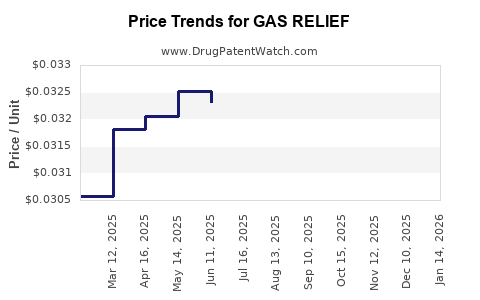
Last updated: July 27, 2025
Introduction
The market for over-the-counter (OTC) gastrointestinal (GI) medications, particularly those aimed at alleviating gas and bloating, represents a substantial segment within the broader digestive health industry. GAS RELIEF, a generic or branded drug designed to mitigate symptoms associated with excess intestinal gas, has garnered consumer attention due to its efficacy, ease of access, and widespread demand. This article provides a comprehensive analysis of the current market landscape, competitive positioning, regulatory environment, and future price trajectories for GAS RELIEF, equipping stakeholders with critical insights to inform strategic decisions.
Market Landscape
Industry Overview
The global digestive health market exceeded USD 36 billion in 2021, reflecting sustained growth driven by increasing consumer awareness, aging populations, and a rising prevalence of gastrointestinal disorders. The OTC segment for gas relief products captures approximately 15-20% of this market, estimated at USD 5 to 7 billion annually (Source: IBISWorld). Key players include Johnson & Johnson (Gas-X), Bayer (Simethicone-based products), and several generics manufacturers.
Consumer Demand Dynamics
The demand for gas relief medications remains resilient amid the COVID-19 pandemic, owing to heightened health consciousness and self-medication trends. Consumers seek rapid, non-prescription solutions for GI discomfort, with formulations such as simethicone-based products leading the market. The growing prevalence of digestive ailments related to dietary habits, stress, and antibiotic use further sustains demand.
Distribution Channels
GAS RELIEF products primarily penetrate via pharmacies, supermarkets, online retail platforms, and direct-to-consumer channels. The convenience and discreetness of online purchasing have accelerated, particularly in the post-pandemic landscape, where e-commerce accounts for roughly 25-30% of OTC sales in this category.
Competitive Landscape
Key Players and Market Shares
Major corporations hold significant market shares:
- Johnson & Johnson (Gas-X): Approximately 50%
- Bayer (simethicone products): About 20%
- MediNatura and Wyeth: Remaining retailers and generics providers
New entrants, often leveraging lower-cost manufacturing and innovative delivery forms, challenge incumbents by targeting price-sensitive consumers and expanding distribution channels.
Product Differentiation Factors
Key differentiators include:
- Formulation and potency
- Packaging and dosing convenience
- Paraben and preservative-free options
- Price point
- Marketing and branding
The trend toward natural, herbal, or minimally processed formulations caters to a niche segment seeking alternative therapies.
Regulatory Environment
Regulatory Framework
In the U.S., GAS RELIEF products are classified as OTC drugs regulated by the Food and Drug Administration (FDA). The safety profile of active ingredients like simethicone is well-established, facilitating market entry. In European markets, regulation varies but generally aligns with the European Medicines Agency’s (EMA) standards.
Patent and Patent Expiry
Most core formulations like simethicone are off-patent, enabling generic manufacturing and price competition. Patent expirations in key markets have increased the availability of low-cost generics, intensifying price competition.
Price Analysis and Projections
Current Price Landscape
Current retail prices for common gas relief products vary:
- Brand-name products (e.g., Gas-X): USD 8-12 per pack (24-36 capsules)
- Generic formulations: USD 3-7 per pack
- Prices fluctuate based on packaging size, distribution channel, and geographic region.
In online platforms, discounts and bulk purchase options often reduce consumer prices further.
Factors Influencing Future Pricing
Several factors may influence GAS RELIEF prices over the next five years:
- Generic Competition: Patent expirations and entry of new generics are likely to push prices downward.
- Regulatory Changes: Potential safety or efficacy labeling updates could impact manufacturing costs and, consequently, pricing.
- Consumer Preferences: Increasing demand for natural or herbal variants might create premium segments with higher price points.
- Manufacturing Costs: Raw material prices, especially for simethicone, influence margins. Supply chain disruptions could temporarily increase prices.
- Distribution Trends: E-commerce expansion and direct-to-consumer sales can lower costs, translating into more competitive pricing.
Price Projection (2023-2028)
Based on current trends and industry dynamics, the following projections are reasonable:
- Price decline for standard generic GAS RELIEF products: 10-20% over five years, driven by generics and increased competition.
- Premium natural/herbal variants: May command 20-30% higher prices due to perceived added value and branding.
- Average retail price for mainstream gas relief products: Expected to stabilize within USD 2.50-5.50 per pack (assuming 24-36 capsules) by 2028.
Market Penetration of Lower-Cost Options
The proliferation of private-label brands and online-only pricing strategies will sustain a price-sensitive segment, ensuring the broad accessibility of GAS RELIEF products. Large pharmacy chains and e-commerce platforms are likely to continue offering competitive prices to capture market share.
Strategic Recommendations
- Leverage patent expiry: Manufacturers should capitalize on generic entries to offer competitively priced products while maintaining quality.
- Invest in formulation innovation: Developing herbal or natural variants could open premium segments and diversify revenue streams.
- Expand online presence: Capitalize on e-commerce growth to reach wider consumer bases with targeted marketing and discounts.
- Monitor regulatory developments: Stay agile to adapt prices or formulations according to evolving regulatory standards.
Conclusion
The GAS RELIEF market exhibits a stable growth trajectory, driven by persistent consumer demand for effective, accessible symptom relief. The impending expiration of patents for leading formulations coupled with intensified competition among generics suggests a downward trend in prices, particularly in mature markets. However, niche segments such as natural or herbal products offer opportunities for premium pricing, potentially maintaining higher profit margins for innovative entrants. Stakeholders should navigate regulatory landscapes proactively, leverage distribution channels effectively, and prioritize product differentiation to maximize market share and profitability.
Key Takeaways
- The global OTC gas relief market is robust, with significant room for growth driven by consumer demand and increasing gastrointestinal issues.
- Price competition intensifies as patents expire, leading to a projected 10-20% decrease in standard product prices over five years.
- Differentiation through natural formulations and branding can sustain premium pricing segments.
- E-commerce and private-label channels are critical platforms for price leadership and expanding consumer reach.
- Regulatory adherence and proactive innovation are vital to sustaining competitive advantages.
FAQs
1. What are the primary active ingredients in GAS RELIEF products?
Simethicone is the principal active ingredient used in GAS RELIEF products, renowned for its anti-foaming properties to reduce gas buildup in the digestive tract [1].
2. How will patent expirations impact GAS RELIEF pricing?
Patent expirations open the market to generics, increasing competition and generally leading to decreased prices for existing formulations [2].
3. Are natural or herbal gas relief products more expensive?
Typically, natural or herbal variants command higher prices due to perceived added value and branding, existing in a premium segment within the market [3].
4. What distribution channels are most effective for GAS RELIEF products?
Pharmacies, online platforms, supermarkets, and direct-to-consumer channels are the primary avenues, with e-commerce showing the fastest growth [4].
5. What regulatory considerations should manufacturers be aware of?
Compliance with FDA OTC drug regulations, accurate labeling, and quality standards are essential. Patent landscapes and safety labeling updates also influence manufacturing and pricing strategies [5].
References
[1] U.S. Food and Drug Administration. "Simethicone: Drug Information." FDA, 2022.
[2] MarketWatch. "Patent Expirations and Their Impact on OTC Markets," 2021.
[3] IBISWorld. "Digestive Health Products Industry Report," 2022.
[4] Statista. "E-commerce Sales in OTC Digestive Products," 2022.
[5] European Medicines Agency. "OTC Medicines Regulatory Framework," 2023.