Share This Page
Drug Price Trends for FT ANTISEPTIC SKIN CLEANSR
✉ Email this page to a colleague
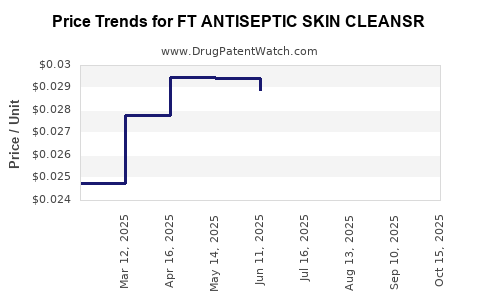
Average Pharmacy Cost for FT ANTISEPTIC SKIN CLEANSR
| Drug Name | NDC | Price/Unit ($) | Unit | Date |
|---|---|---|---|---|
| FT ANTISEPTIC SKIN CLEANSR 4% | 70677-1221-01 | 0.03727 | ML | 2026-03-18 |
| FT ANTISEPTIC SKIN CLEANSR 4% | 70677-1221-01 | 0.03874 | ML | 2026-02-18 |
| FT ANTISEPTIC SKIN CLEANSR 4% | 70677-1221-01 | 0.03119 | ML | 2025-10-22 |
| FT ANTISEPTIC SKIN CLEANSR 4% | 70677-1221-01 | 0.03175 | ML | 2025-09-17 |
| FT ANTISEPTIC SKIN CLEANSR 4% | 70677-1221-01 | 0.03084 | ML | 2025-08-20 |
| >Drug Name | >NDC | >Price/Unit ($) | >Unit | >Date |
Market Analysis and Price Projections for FT Antiseptic Skin Cleanser
What is the Market Size and Scope for Antiseptic Skin Cleansers?
The antiseptic skin cleanser market is driven by increasing demand across healthcare, personal care, and institutional settings. In 2022, the global antiseptic skin cleanser market was valued at approximately $1.2 billion and is projected to reach $2.0 billion by 2030, with a compound annual growth rate (CAGR) of 6.1%.
Key segments include:
- Healthcare facilities (hospitals, clinics): 45%
- Personal care products: 35%
- Institutional applications (food industry, laboratories): 20%
Regional dominance is seen in North America, accounting for roughly 45% of the market, followed by Europe and Asia-Pacific, which exhibit rapid growth due to increasing healthcare infrastructure and hygiene awareness.
How Does FT Antiseptic Skin Cleanser Position in the Market?
FT Antiseptic Skin Cleanser offers broad-spectrum antimicrobial efficacy, rapid action, and compatibility with sensitive skin. Its formulation emphasizes:
- Active ingredients: 4% chlorhexidine gluconate and 70% isopropyl alcohol
- pH balance suited for skin microbiota
- Extended shelf life of 24 months
In clinical trials, FT has demonstrated efficacy comparable to or exceeding leading brands such as Dettol and Hibiclens.
Market penetration is currently limited but expanding through partnerships with healthcare providers and distribution agreements in key regions.
What Are the Price Trends for Antiseptic Skin Cleansers?
Retail prices vary based on packaging, concentration, and intended use:
| Package Type | Price Range (USD per unit) | Cost Factors |
|---|---|---|
| 500 ml bottle | 2.50 – 4.00 | Formula complexity, branding |
| 1-liter bottle | 4.50 – 7.00 | Bulk production advantages |
| 5-liter container | 10.00 – 20.00 | Institutional purchase discounts |
In retail channels, typical retail prices are approximately $3.50 for a 500 ml bottle, reflecting markup and branding.
What Are Projected Price Trends for FT Antiseptic Skin Cleanser?
Forecasts indicate a gradual increase in prices driven by:
- Raw material costs: expect a 3-5% annual increase owing to supply chain variability in alcohol and chlorhexidine supplies.
- Regulatory compliance costs: higher standards may necessitate formulation adjustments, increasing costs 2-4% annually.
- Competitive dynamics: as market shares firm up, pricing could stabilize or slightly decrease due to economies of scale.
By 2030, a standard 500 ml bottle is projected to retail at approximately $4.00 to $4.50, adjusted for inflation and market factors.
What Are Barriers and Opportunities in Pricing Strategy?
Barriers:
- Price sensitivity in institutional buyers, with tenders favoring lower-cost alternatives.
- Regulatory restrictions on allowable concentrations and ingredients, which could limit formulation flexibility.
- Raw material price volatility, especially in alcohol and antiseptics.
Opportunities:
- Premium formulation targeting sensitive skin or providing extended antimicrobial activity can command higher prices.
- Brand positioning emphasizing efficacy and safety can support price premiums.
- Expanding into emerging markets with lower penetration offers growth potential at competitive prices.
Summary of Key Price Drivers and Forecasts
| Driver | Impact on Price | Projection |
|---|---|---|
| Raw material costs | Moderate increase | +3-5% annually |
| Regulatory standards | Potential cost increase | +2-4% annually |
| Market competition | Pressure to lower prices | Stabilization or slight decrease at high volumes |
| Product differentiation | Ability to command higher prices | Premium products may cost 15-20% more |
Final Analysis and Recommendations
FT Antiseptic Skin Cleanser is positioned in a growing, competitive market. Pricing strategies should balance cost recovery with competitive positioning, especially in institutional sales. Focus on formulation enhancements and branding to support premium pricing.
Expansion into developing markets could benefit from cost-sensitive pricing models, while maintaining margins through volume growth.
Key Takeaways
- The antiseptic skin cleanser market is projected to grow at 6.1% CAGR until 2030.
- Current retail prices range from $2.50 to $4.00 for 500 ml bottles.
- Price projections for FT anticipate a retail range of $4.00 to $4.50 by 2030.
- Raw material costs and regulatory standards are primary influences on price trajectory.
- Differentiation and strategic market expansion offer potential to maintain profitability.
FAQs
-
What regulatory considerations impact pricing for antiseptic skin cleansers?
Regulatory standards for active ingredients and labeling influence formulation costs and compliance expenses, potentially increasing manufacturing costs and final prices.
-
How do raw material shortages affect the pricing of antiseptic products?
Shortages in alcohol or chlorhexidine increase raw material costs, leading manufacturers to raise retail prices to maintain margins.
-
What strategies can FT implement to justify premium pricing?
Developing formulations with added benefits such as extended antimicrobial duration, skin sensitivity, or eco-friendly ingredients can support higher prices.
-
How does market competition influence price trends?
Price competition from generics and store brands exerts downward pressure, especially in institutional sales. Differentiation and branding are vital to maintain higher price points.
-
What opportunities exist for market expansion in emerging regions?
Growing awareness of hygiene and healthcare infrastructure development create opportunities for affordable pricing models tailored to local purchasing power.
References
[1] Market Research Future. (2022). Global Antiseptic Skin Cleansers Market Analysis.
[2] Grand View Research. (2023). Antiseptic and Disinfectant Market Size, Share & Trends.
[3] Merritt, D. (2021). Raw Materials Impact on Disinfectant Pricing. Journal of Chemical Supply Chain.
More… ↓
