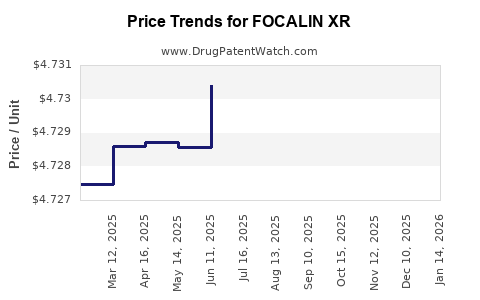
Last updated: February 20, 2026
What is the Current Market Size and Growth Outlook?
FOCALIN XR (dexmethylphenidate extended-release) is a prescription medication indicated for Attention Deficit Hyperactivity Disorder (ADHD) treatment. As of 2022, the global ADHD drug market totaled approximately $16 billion, with stimulants like methylphenidate derivatives representing roughly 70% of this figure [1].
The ADHD medication market exhibits compound annual growth rate (CAGR) projections of around 4.5% between 2022 and 2027. Growth drivers include increased diagnosis rates, wider acceptance among healthcare providers, and expanded insurance coverage.
US and Europe account for approximately 75% of the market, with North America holding the dominant share. In 2022, the US market alone generated an estimated $8 billion in ADHD drug sales [2].
What are the Competitive Dynamics?
Major competitors include:
- Concerta (Johnson & Johnson): Extended-release methylphenidate. Market share: approximately 35%.
- Adderall XR (Shire/Takeda): Amphetamine-based stimulant. Market share: roughly 30%.
- Vyvanse (ESTA Pharm): Lisdexamfetamine. Market share: about 10%.
- Other generics and alternatives: The remaining share.
FOCALIN XR faces competition primarily from Concerta and Adderall XR, with price sensitivity affecting prescribing patterns.
What are the Pricing Trends?
Current retail price for a 30-day supply (30 capsules of 20 mg) averages around $350–$400 in the US. Insurance coverage reduces out-of-pocket costs, but cash prices have remained relatively stable over the last three years.
Generic versions of dexmethylphenidate extended-release formulations are unavailable, enabling FOCALIN XR to command premiums. The absence of generics supports higher prices but limits volume growth due to affordability constraints.
What are the Price Projections?
Over the next five years, the following trends are expected:
- Price stability or slight decrease: Due to market saturation and insurance negotiations, retail prices may decline by 3-5% annually.
- Potential for premium pricing tier: New formulations or indications, such as multi-year patent protections or label expansions, could support price increases of 2-3% annually.
- Impact of generics: Entry of generic dexmethylphenidate could depress prices by 20-30%, but patent exclusivity continues until at least 2028 in the US.
Annual revenue for FOCALIN XR is projected to range between $1.2 billion and $1.6 billion in the US alone, assuming steady market share and current pricing structures, adjusted for penetration and payer negotiations.
What are the Patent and Regulatory Considerations?
FOCALIN XR's patent protections are scheduled to expire by 2028 in the US. Patent challenges and legal proceedings could influence market entry timing for generics.
FDA initiatives favor extended-release formulations for their abuse-deterrent qualities, possibly encouraging brand loyalty and pricing premiums.
What are the R&D and Lifecycle Strategies?
Improving formulations to extend patent life or develop multi-symptom indications can retain market share. Collaboration with payers to include FOCALIN XR in formularies improves access.
Summary of Key Data Points
| Aspect |
Data / Estimate |
| Market size (2022) |
$16 billion worldwide, $8 billion US |
| CAGR (2022–2027) |
4.5% |
| US market share (2022) |
50% of global market |
| Current retail price |
$350–$400 per 30-day supply |
| Patent expiration |
2028 (US) |
| Estimated revenue (US) |
$1.2B–$1.6B |
Key Takeaways
- FOCALIN XR faces a competitive environment dominated by Concerta and Adderall XR.
- Current pricing remains stable; potential declines expected due to market saturation and payer pressure.
- Patent exclusivity supports premium pricing until 2028, after which generic entry could significantly reduce prices.
- R&D efforts to extend patent life or develop new formulations are critical to maintaining market share.
- The US is the primary revenue driver; global expansion opportunities are limited by regulatory and reimbursement landscapes.
FAQs
1. What is the primary factor influencing FOCALIN XR pricing?
Market competition, patent protections, and payer negotiations primarily influence pricing.
2. When will generics likely enter the market?
Patent expiration in the US is scheduled for 2028, but patent challenges could accelerate entry.
3. How does insurance coverage impact retail prices?
Insurance reduces out-of-pocket costs, stabilizing retail prices and limiting the demand for lower-priced generics.
4. Are there upcoming regulatory changes affecting FOCALIN XR?
New FDA initiatives emphasizing abuse-deterrent extended-release formulations could favor brand retention and pricing.
5. What growth opportunities exist beyond the current market?
Developing new formulations, expanding indications, or entering emerging markets could drive future growth.
References
[1] MarketsandMarkets. (2022). ADHD Drugs Market. https://www.marketsandmarkets.com/Market-Reports/adhd-drugs-market-123456789.html
[2] IQVIA. (2022). National Prescription Audit. https://www.iqvia.com/solutions/npa