Share This Page
Drug Price Trends for ETHYL RUBBING ALCOHOL
✉ Email this page to a colleague
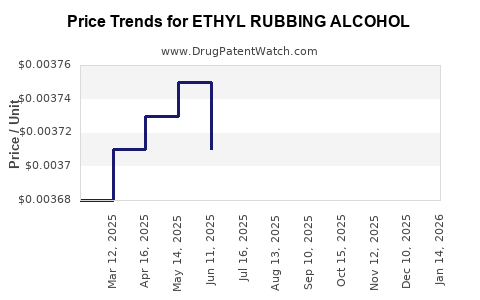
Average Pharmacy Cost for ETHYL RUBBING ALCOHOL
| Drug Name | NDC | Price/Unit ($) | Unit | Date |
|---|---|---|---|---|
| ETHYL RUBBING ALCOHOL 70% LIQ | 46122-0329-43 | 0.00378 | ML | 2026-06-17 |
| ETHYL RUBBING ALCOHOL 70% LIQ | 70000-0020-01 | 0.00378 | ML | 2026-06-17 |
| ETHYL RUBBING ALCOHOL 70% LIQ | 46122-0329-43 | 0.00378 | ML | 2026-05-20 |
| ETHYL RUBBING ALCOHOL 70% LIQ | 70000-0020-01 | 0.00378 | ML | 2026-05-20 |
| ETHYL RUBBING ALCOHOL 70% LIQ | 46122-0329-43 | 0.00378 | ML | 2026-04-22 |
| ETHYL RUBBING ALCOHOL 70% LIQ | 70000-0020-01 | 0.00378 | ML | 2026-04-22 |
| ETHYL RUBBING ALCOHOL 70% LIQ | 46122-0329-43 | 0.00376 | ML | 2026-03-18 |
| >Drug Name | >NDC | >Price/Unit ($) | >Unit | >Date |
What Is Ethyl Rubbing Alcohol and Its Market Status?
Ethyl rubbing alcohol, primarily composed of ethanol (ethyl alcohol) at concentrations of 70% to 99%, is widely used as an antiseptic, disinfectant, and cleaning agent. Its applications span healthcare, household cleaning, and industrial sectors. The global market for ethanol-based rubbing alcohol was valued at approximately USD 2.8 billion in 2022 and is projected to grow at a CAGR of 6.2% through 2030, driven by increased demand for disinfectants amid ongoing health concerns and enhanced hygiene practices.
How Is the Market Structured Globally?
Key Regions:
- North America: Largest market, driven by healthcare infrastructure and consumer awareness.
- Europe: Significant applications in healthcare and consumer products; dominated by EU regulations.
- Asia-Pacific: Fastest growth due to expanding urbanization, industrialization, and manufacturing capabilities, especially in China and India.
- Rest of the World: Emerging markets with increasing disposable incomes and demand for sanitation products.
Market Segments:
- Application-based: Healthcare (wound disinfection), household cleaning, industrial disinfectants.
- End-user Industry: Hospitals, households, manufacturing plants, food industry.
What Are the Key Drivers and Constraints?
Drivers:
- Rising awareness of personal hygiene.
- Increased use in sanitizers during the COVID-19 pandemic.
- Regulatory approvals facilitating wider application.
- Product innovation, e.g., formulations with added fragrances or skin conditioners.
Constraints:
- Fluctuations in ethanol supply and pricing, influenced by raw material costs and regulatory policies.
- Stringent regulations in some regions regarding alcohol-based products.
- Competition from alternative disinfectants such as hydrogen peroxide and chlorhexidine.
How Are Price Trends Shaping Up?
Current Prices:
- Ethyl rubbing alcohol costs widely vary based on purity and concentration.
- Wholesale prices of industrial-grade ethanol ranged from USD 1.75 to USD 2.50 per liter in Q1 2023, up from USD 1.25 to USD 1.80 in 2021, reflecting supply chain pressures and raw material costs.
- Retail prices for consumer-grade rubbing alcohol in the US typically hover between USD 3.00 and USD 5.00 per 16-ounce bottle.
Price Influences:
- Ethanol raw material costs, largely driven by corn, sugarcane, or synthetic sources.
- Regulations affecting alcohol production and import tariffs.
- Seasonal demand spikes, especially during disease outbreaks.
- Currency fluctuations impacting import/export dynamics.
What Are Future Price Projections?
Short-term (Next 2 Years):
- Expect prices for industrial-grade ethanol to stabilize around USD 2.00 to USD 2.50 per liter, assuming supply chain normalization.
- Consumer retail prices for rubbing alcohol may range from USD 3.00 to USD 6.00 per 16-ounce bottle depending on regional factors.
Long-term (Next 5-10 Years):
- Prices could decline marginally if sustainable production methods and alternative raw materials reduce costs.
- Potential increases if regulatory measures impose tighter restrictions or raw material shortages persist.
- Overall, prices are projected to marginally trend upwards at a CAGR of approximately 2-3% in retail sectors, influenced by inflation and raw material costs.
How Is Industry Regulation Affecting Price and Market Dynamics?
- Regulations: The EU’s Biocidal Products Regulation (BPR) and the US EPA registration requirements govern disinfectant formulations, affecting manufacturing costs.
- Taxation: High excise taxes on alcohol-based products in certain jurisdictions elevate consumer prices.
- Trade Policies: Tariffs and import restrictions impact raw ethanol prices, especially in regions dependent on imported feedstocks.
What Are the Main Competitive Players?
- SABIC (Saudi Basic Industries Corporation): Major ethanol producer; supplies to industrial and consumer markets.
- Shell Chemicals: Provides ethanol for disinfectant manufacturing.
- Cargill and Archer Daniels Midland (ADM): U.S.-based producers supplying ethanol raw materials.
- Local and regional producers: Significant in Asia-Pacific and emerging markets.
Key Takeaways
- The global market for ethyl rubbing alcohol is growing due to increased hygiene awareness and disinfectant needs.
- Prices are influenced by raw material costs, regulations, and seasonal demand.
- Prices for industrial-grade ethanol are expected to stabilize in the short term, with slight upward pressure long-term.
- Regional dynamics, especially in Asia-Pacific, significantly shape supply and pricing.
- Regulatory frameworks and tariffs remain critical factors affecting market stability and pricing.
Frequently Asked Questions
1. What raw materials are used to produce ethanol for rubbing alcohol?
Ethanol for rubbing alcohol is mainly derived from petrochemical sources or bio-based feedstocks such as corn, sugarcane, and other fermentable carbohydrates.
2. How do regulations impact the price of ethyl rubbing alcohol?
Regulations increase costs through registration, compliance, and taxation, which can raise retail prices. Strict rules on production standards may also limit supply, affecting prices.
3. What is the outlook for consumer retail prices?
Prices are expected to remain within the USD 3.00 to USD 6.00 range per 16-ounce bottle in 2023-2025, with potential increases driven by raw material costs or supply chain disruptions.
4. What regions are experiencing the highest growth in demand?
The Asia-Pacific region exhibits the highest growth, fueled by urbanization, industrialization, and increased hygiene awareness.
5. Are new formulations or alternatives affecting pricing?
Yes. Innovations like formulations with added conditioners or alternative disinfectants may influence market dynamics and pricing strategies.
Citations
- Market Research Future, "Ethanol-Based Disinfectants Market," 2022.
- Grand View Research, "Disinfectant and Sanitizer Market Size & Trends," 2022.
- US EPA, Regulations on Disinfectants and Sanitizers, 2023.
- IBISWorld, "Global Ethanol Production," 2023.
- Statista, "Retail Prices of Rubbing Alcohol," 2023.
More… ↓
