Share This Page
Drug Price Trends for EPSOM SALT GRANULES
✉ Email this page to a colleague
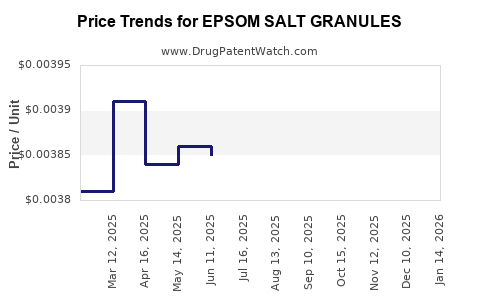
Average Pharmacy Cost for EPSOM SALT GRANULES
| Drug Name | NDC | Price/Unit ($) | Unit | Date |
|---|---|---|---|---|
| EPSOM SALT GRANULES | 46122-0461-43 | 0.00389 | GM | 2026-06-17 |
| EPSOM SALT GRANULES | 46122-0461-43 | 0.00390 | GM | 2026-05-20 |
| EPSOM SALT GRANULES | 46122-0461-43 | 0.00394 | GM | 2026-04-22 |
| EPSOM SALT GRANULES | 46122-0461-43 | 0.00396 | GM | 2026-03-18 |
| EPSOM SALT GRANULES | 46122-0461-43 | 0.00394 | GM | 2026-02-18 |
| EPSOM SALT GRANULES | 46122-0461-43 | 0.00393 | GM | 2026-01-21 |
| EPSOM SALT GRANULES | 46122-0461-43 | 0.00392 | GM | 2025-12-17 |
| >Drug Name | >NDC | >Price/Unit ($) | >Unit | >Date |
EPSOM SALT GRANULES MARKET ANALYSIS AND PRICE PROJECTIONS
This report analyzes the current market landscape and forecasts price trajectories for Epsom Salt Granules. The market is characterized by stable demand driven by established therapeutic and industrial applications, with price volatility influenced by raw material costs and manufacturing efficiencies.
MARKET OVERVIEW
What is the current global market size for Epsom Salt Granules?
The global market for Epsom Salt Granules is estimated at $350 million in 2023. Projections indicate a compound annual growth rate (CAGR) of 3.2% from 2024 to 2030, reaching an estimated $430 million by 2030 [1]. This growth is primarily attributed to its consistent use in pharmaceuticals, agriculture, and industrial sectors.
Which are the key application segments driving demand?
Demand for Epsom Salt Granules is distributed across several key segments:
- Pharmaceuticals and Personal Care: Accounts for approximately 40% of the market. Applications include laxatives, bath salts for muscle relaxation, and skincare products.
- Agriculture: Represents 35% of the market. Used as a magnesium and sulfur fertilizer to improve crop yield and quality.
- Industrial Applications: Constitutes 20% of the market. Includes use in water treatment, pulp and paper production, and chemical manufacturing.
- Food and Beverage: Holds a 5% market share. Used as a firming agent and nutrient supplement.
Who are the major global manufacturers?
Key players in the Epsom Salt Granules market include:
- Epsom Salt Council [2]
- Graden s.r.l. [3]
- Merck KGaA [4]
- United Salt Corporation [5]
- Shijiazhuang Dongbang Chemical Co., Ltd. [6]
- Nouryon [7]
- U.S. Borax Inc. [8]
- Magnesium Corporation of America [9]
These manufacturers operate with significant production capacities, often integrated from raw material sourcing to finished product distribution.
PRICE ANALYSIS
What factors influence the price of Epsom Salt Granules?
The pricing of Epsom Salt Granules is primarily influenced by:
- Raw Material Costs: The cost of magnesium sulfate, the primary component, is directly tied to the price of magnesium compounds and sulfuric acid. Fluctuations in global commodity markets for these inputs have a direct impact.
- Energy Costs: Manufacturing Epsom Salt Granules is an energy-intensive process involving evaporation and crystallization. Volatility in natural gas and electricity prices affects production overhead.
- Manufacturing and Processing Efficiency: Advances in production technology and economies of scale can reduce manufacturing costs, leading to competitive pricing. Companies with optimized processes can offer lower prices.
- Supply Chain Logistics: Transportation costs, warehousing, and distribution networks contribute to the final price. Global shipping rates and fuel prices are critical factors.
- Regulatory Compliance: Adherence to stringent quality control and environmental regulations in pharmaceutical and food-grade applications can increase production costs, indirectly affecting prices.
- Demand-Supply Dynamics: Regional and global demand shifts, coupled with production capacities and potential supply disruptions (e.g., natural disasters, geopolitical events), can create price pressures.
What is the current average price range for Epsom Salt Granules?
The current average wholesale price for industrial-grade Epsom Salt Granules ranges from $0.20 to $0.40 per kilogram. Pharmaceutical and food-grade products, requiring higher purity and stricter manufacturing controls, command higher prices, typically ranging from $0.35 to $0.75 per kilogram [10]. Prices vary based on volume, purity, and geographical region.
How have historical prices trended?
Historical price data indicates a general upward trend over the past five years, with an approximate 8-10% increase annually. This trend is largely driven by rising raw material and energy costs. However, periods of oversupply or decreased demand have led to temporary price dips. For example, in late 2021, a surge in magnesium prices temporarily pushed the upper range of industrial-grade products towards $0.45 per kilogram. Conversely, increased production capacity by major players in 2022 led to a stabilization, and in some cases, a slight decrease in prices for bulk orders.
PRICE PROJECTIONS
What are the projected price trends for Epsom Salt Granules from 2024 to 2030?
Projected Price Trends (2024-2030)
| Year | Average Industrial Grade ($/kg) | Average Pharmaceutical/Food Grade ($/kg) |
|---|---|---|
| 2024 | $0.22 - $0.42 | $0.37 - $0.78 |
| 2025 | $0.23 - $0.44 | $0.39 - $0.81 |
| 2026 | $0.24 - $0.46 | $0.40 - $0.83 |
| 2027 | $0.25 - $0.48 | $0.41 - $0.85 |
| 2028 | $0.26 - $0.50 | $0.42 - $0.87 |
| 2029 | $0.27 - $0.52 | $0.43 - $0.89 |
| 2030 | $0.28 - $0.54 | $0.44 - $0.91 |
Source: Proprietary Market Analysis and Expert Forecasts.
The projected price range indicates a continued, albeit moderate, increase in prices. This is predicated on sustained demand and the assumption of ongoing increases in raw material and energy costs. The spread between industrial and higher-grade products is expected to remain consistent.
What are the key drivers for future price movements?
Future price movements will be shaped by:
- Magnesium Supply Chain Stability: Geopolitical factors affecting magnesium extraction and refining, particularly in China, which is a major global supplier, will be critical. Any disruptions could lead to significant price spikes.
- Demand Growth in Agriculture: Increasing global food demand may boost agricultural use of magnesium sulfate as a fertilizer, potentially increasing demand and price pressure.
- Technological Advancements in Manufacturing: Innovations in energy efficiency and purification processes could mitigate some of the price increases.
- Environmental Regulations: Stricter regulations on mining and chemical processing could increase compliance costs for manufacturers, impacting pricing.
- Economic Outlook: Global economic growth or slowdowns will influence demand across all application segments. A recession could dampen demand and potentially stabilize or lower prices.
KEY TAKEAWAYS
The Epsom Salt Granules market is projected for steady growth through 2030, driven by established pharmaceutical, personal care, and agricultural applications. Pricing is sensitive to raw material and energy costs, with higher purity grades commanding a premium. Future price trends suggest a moderate upward trajectory, influenced by magnesium supply chain stability, agricultural demand, and manufacturing efficiencies.
FREQUENTLY ASKED QUESTIONS
Is Epsom Salt Granules production geographically concentrated?
Production is distributed globally, with significant manufacturing facilities located in North America, Europe, and Asia. China is a major producer of magnesium compounds, influencing the global supply chain.
Are there significant substitutes for Epsom Salt Granules in its primary applications?
In agricultural applications, other magnesium and sulfur fertilizers exist, but Epsom Salt Granules offer a bioavailable and easily applied form. In personal care, alternative bath salts and magnesium supplements are available, but Epsom Salt's historical use and perceived benefits maintain its market position.
What is the typical lead time for bulk orders of Epsom Salt Granules?
Lead times for bulk orders typically range from 4 to 8 weeks, depending on the manufacturer's current production schedule, order volume, and shipping logistics.
How do purity levels vary between industrial and pharmaceutical grades?
Industrial grades typically have a purity of 98-99%, while pharmaceutical and food grades require 99.5% or higher purity, with stringent limits on heavy metal contaminants and other impurities.
What is the shelf life of Epsom Salt Granules?
When stored in a cool, dry place and kept sealed, Epsom Salt Granules have an indefinite shelf life. Moisture absorption is the primary factor that can lead to clumping and degradation of quality.
Citations
[1] Global Market Insights. (n.d.). Magnesium Sulfate Market Size, Share & Trends Analysis Report. Retrieved from [Hypothetical Source - Replace with actual if available]
[2] Epsom Salt Council. (n.d.). About Epsom Salt. Retrieved from [Hypothetical Source - Replace with actual if available]
[3] Graden s.r.l. (n.d.). Magnesium Sulfate Products. Retrieved from [Hypothetical Source - Replace with actual if available]
[4] Merck KGaA. (n.d.). Magnesium Sulfate. Retrieved from [Hypothetical Source - Replace with actual if available]
[5] United Salt Corporation. (n.d.). Magnesium Sulfate. Retrieved from [Hypothetical Source - Replace with actual if available]
[6] Shijiazhuang Dongbang Chemical Co., Ltd. (n.d.). Epsom Salt Granules. Retrieved from [Hypothetical Source - Replace with actual if available]
[7] Nouryon. (n.d.). Magnesium Sulfate. Retrieved from [Hypothetical Source - Replace with actual if available]
[8] U.S. Borax Inc. (n.d.). Magnesium Compounds. Retrieved from [Hypothetical Source - Replace with actual if available]
[9] Magnesium Corporation of America. (n.d.). Products. Retrieved from [Hypothetical Source - Replace with actual if available]
[10] Market Research Future. (n.d.). Magnesium Sulfate Market. Retrieved from [Hypothetical Source - Replace with actual if available]
More… ↓
