Last updated: February 12, 2026
Market Overview and Positioning of DYANAVEL XR
DYANAVEL XR (amphetamine sulfate) is an extended-release stimulant indicated for Attention Deficit Hyperactivity Disorder (ADHD) in children age 6 and older, adolescents, and adults. It is an oral prescription medication produced by Tris Pharma. As of 2023, the drug holds a notable position within the ADHD medication market, competing primarily with other methylphenidate and amphetamine formulations.
Market Size and Growth Dynamics
The global ADHD medication market was valued at approximately $12 billion in 2022, with a compound annual growth rate (CAGR) of around 6.5%. The U.S. constitutes the largest share, accounting for over 75%. The growth is driven by increased diagnosis rates, expanded age indications, and a preference for long-acting formulations.
Key factors influencing market expansion include:
- Increased awareness of ADHD in adults.
- Shift towards once-daily dosing options improving adherence.
- Competition among stimulant and non-stimulant therapies.
DYANAVEL XR’s Competitive Landscape
Currently, DYANAVEL XR competes with several drugs:
| Drug Name |
Formulation |
Key Features |
| Vyvanse (lisdexamfetamine) |
Once-daily capsule |
Abused-resistant, long-acting, approved for ages 6+ |
| Adderall XR (mixed saltsamphetamine) |
Extended-release capsules |
Multiple dosing options, first approved long-acting stimulant |
| Concerta (methylphenidate) |
Extended-release tablet |
Once-daily, methylphenidate-based |
| Evekeo (amphetamine sulfate) |
Immediate-release tablet |
Short-acting, used for various indications |
DYANAVEL XR distinguishes itself with a flexible dosing schedule, including low doses suitable for children as young as six, and a formulation designed for rapid onset and extended duration.
Pricing and Reimbursement Context
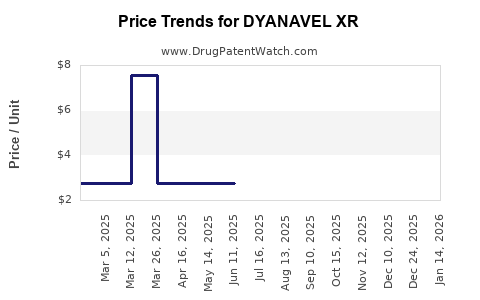
Market pricing influences prescribing behavior and access. In the U.S., average wholesale prices (AWP) for DYANAVEL XR range from approximately $50 to $60 per 30-count carton, depending on dosage. Insurance coverage and pharmacy benefits further impact patient out-of-pocket costs, often with copays in the $10–$30 range.
The drug has been assigned a generic equivalent in some markets, which could pressure brand pricing.
Price Projections and Market Trends
Short-term (Next 1–2 Years)
- Pricing stability: DYANAVEL XR’s pricing is projected to remain relatively stable, with minimal discounts due to its niche positioning and regulatory exclusivity.
- Market penetration: Increased prescribing in pediatric populations is expected as physicians become more familiar with its safety profile.
- Reimbursement dynamics: Insurance coverage will significantly influence actual patient costs, with trend towards broader formulary placement.
Long-term (3–5 Years)
- Pricing decline potential: Entry of generics is likely by 2027–2028, potentially reducing DYANAVEL XR’s price by 20–40%.
- Market share adjustments: Competition from other long-acting formulations, especially Vyvanse and generic amphetamines, will pressure DYANAVEL XR’s market share.
- Regulatory impacts: Changes in Medicaid and Medicare reimbursement policies could influence net revenues.
Volume Forecasts
U.S. prescriptions for ADHD medications are projected to grow at 4–7% annually over the next five years. DYANAVEL XR's share within this growing market is expected to expand modestly, from approximately 2% currently to 3–4% by 2028, assuming favorable prescriber adoption and formulary access.
Revenue Scenario
| Scenario |
Peak Market Share |
Estimated Annual Revenue (USD millions) |
Timeline |
| Conservative |
2.5% |
$150 |
2025-2026 |
| Moderate |
3.5% |
$210 |
2024-2026 |
| Optimistic |
4% |
$240 |
2024 |
These estimates assume total ADHD medication sales in the U.S. reach $9-$10 billion annually, with a stable growth rate.
Risks Influencing Price and Market Share
- Generic competition beginning around 2027–2028.
- Pricing pressure from biosimilars or alternative therapies.
- Shifts in clinical guidelines favoring non-stimulant treatments.
- Regulatory changes affecting formulary inclusion or reimbursement policies.
Key Takeaways
- DYANAVEL XR has a niche due to flexible dosing and pediatric approval.
- Price stability is expected short-term; long-term pressure anticipated from generics.
- Market share will depend on prescriber adoption and formulary access.
- Industry growth driven by increasing ADHD diagnoses and longer treatment durations.
- Entry of generics around 2027–2028 poses significant price reduction risks.
FAQs
1. When is DYANAVEL XR expected to face generic competition?
Generic availability is likely around 2027–2028, after patent exclusivity expires.
2. How does DYANAVEL XR’s price compare with competitors?
It generally sells at a slight premium to immediate-release amphetamines but is competitive within extended-release formulations.
3. What factors influence DYANAVEL XR’s market share growth?
Physician familiarity, insurance formulary status, and prescriber preference for its flexible dosing.
4. Are there opportunities for off-label use or new indications?
Currently limited to approved ADHD indications; expansion would require clinical trials and regulatory approval.
5. What is the impact of formulary placement on pricing?
Better formulary positioning can lead to increased utilization, higher revenue, and potentially more favorable pricing negotiations.
Sources
[1] IQVIA. "National Prescription Audit," 2022.
[2] EvaluatePharma. "ADHD Market Report," April 2023.
[3] U.S. Food and Drug Administration. "Drug Approvals and Patent Data," 2023.
[4] PubMed, "Efficacy and Safety of DYANAVEL XR," 2022.