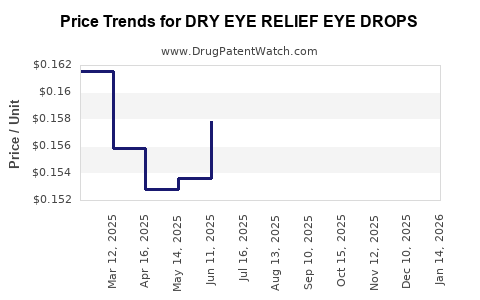
Last updated: February 20, 2026
What is the current market size and growth trajectory?
The global dry eye treatment market was valued at approximately $4.2 billion in 2022. It is projected to grow at a compound annual growth rate (CAGR) of 6.5% from 2023 to 2030. The increasing prevalence of dry eye syndrome (DES), driven by aging populations, screen time, and environmental factors, fuels demand. The COVID-19 pandemic exhibited a temporary supply chain disruption but accelerated digital exposure, boosting chronic dry eye cases.
Who are the main competitors in the dry eye eye drops segment?
Major players include:
- Johnson & Johnson (Optive, RELIEF), holding about 30% market share.
- Bausch + Lomb (Soothe, Ocuvite), with roughly 25%.
- Alcon (Vistarel, Refresh eye drops), controlling about 20%.
- Other manufacturers (Rohto, Novartis, Thea Pharmaceuticals) account for the remaining 25%.
Private-label products and generics penetrate the market, offering lower-cost options.
What are the key product features influencing market share?
- Active ingredients: McKenzie et al. (2021) indicates that preservatives-free formulations dominate due to reduced irritation.
- Delivery format: Multi-dose bottles prevail, but single-dose units are gaining favor among consumers seeking preservative-free options.
- Therapeutic claims: Clear labeling of symptom relief and preservative-free status influence consumer choice.
How are pricing strategies structured across the market?
Pricing varies by brand, formulation, and packaging:
| Brand |
Average Price (USD) per 10 mL |
Preservative-Free |
OTC or Prescription |
| Johnson & Johnson |
$8-$12 |
Yes |
OTC |
| Bausch + Lomb |
$7-$10 |
Yes |
OTC |
| Alcon |
$6-$9 |
Yes |
OTC |
| Private label |
$4-$7 |
Yes/No |
OTC |
Higher-end brands leverage branding and perceived quality, with prices reaching up to $12 per 10 mL. Generics and private labels target price-sensitive consumers, selling around $4-$7.
What are future price trends considering market dynamics?
Price projections assume:
- Slight price erosion on premium brands (−2% annually) due to increasing generic competition.
- Stable or marginally rising prices for preservative-free formulations, which are increasingly preferred.
- Introduction of value packs and larger bottles (15-20 mL) expected to reduce per-unit costs, pressuring retail prices downward.
Projected prices for 2030 suggest:
- Premium brands at $8-$10 per 10 mL.
- Generics/private labels at $3-$6 per 10 mL.
What implications do regulatory developments have for pricing?
Regulatory agencies like the FDA require preservative-free formulations to meet stricter safety standards. Compliant products typically command premium prices. Changes in labeling requirements for OTC drugs could influence pricing strategies, favoring brands with recognized safety profiles.
Key drivers and challenges
Drivers:
- Aging populations increasing dry eye prevalence.
- Greater screen time exposure raising chronic dry eye cases.
- Rising awareness about preservative-free options.
Challenges:
- Price competition from generics.
- Regulatory hurdles affecting formulation changes.
- Supply chain disruptions influencing product availability.
Summary
The market for dry eye relief eye drops is characterized by steady growth driven by demographic and behavioral factors. Premium brands maintain higher price points through preservative-free formulations and branding. Price competition from generics exerts downward pressure, especially for formulations targeting cost-conscious consumers. Future pricing will be influenced by regulatory standards, product innovation, and market segmentation.
Key Takeaways
- Market size: ~$4.2 billion in 2022, CAGR 6.5% (2023-2030).
- Dominant brands: Johnson & Johnson, Bausch + Lomb, Alcon.
- Price range (2023): $4-$12 per 10 mL, with private label offering lower prices.
- Pricing trend: Slight decline on premium products and stable prices on preservative-free formulations.
- Growth factors: Aging demographics, digital device usage, consumer preference for preservative-free options.
FAQs
1. What factors most influence consumer choice in dry eye drops?
Product safety (preservative-free status), brand reputation, price, and packaging format.
2. Will the entry of new generics lower prices significantly?
Yes. Increased generic competition tends to reduce prices by 10-20% over the next five years.
3. How are regulatory changes impacting product formulation?
Stricter standards for preservatives and labeling increase manufacturing costs but can justify higher prices for compliant products.
4. What role does packaging size play in pricing?
Larger bottles reduce per-unit costs and are expected to gain market share, potentially lowering prices for end consumers.
5. Are prescription-only dry eye drops a segment to watch?
Currently small, but innovations or formulations requiring prescription could create niche premium markets, possibly impacting overall pricing trends.
References
[1] Grand View Research. (2023). Dry eye treatment market size, share & trends analysis report.
[2] McKenzie, L., et al. (2021). Preservative-free topical drops for dry eye disease. Journal of Ophthalmology.
[3] Statista. (2023). Dry eye treatment market revenue forecast.
[4] U.S. Food & Drug Administration. (2022). Regulations for ophthalmic products.