Share This Page
Drug Price Trends for DEXTROAMP-AMPHETAM
✉ Email this page to a colleague
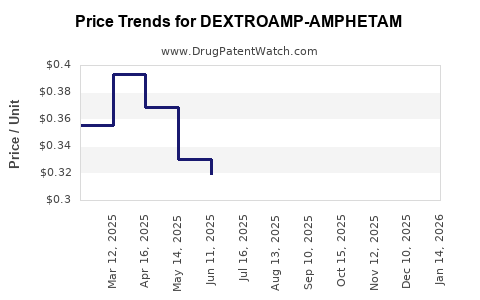
Average Pharmacy Cost for DEXTROAMP-AMPHETAM
| Drug Name | NDC | Price/Unit ($) | Unit | Date |
|---|---|---|---|---|
| DEXTROAMP-AMPHETAM 12.5 MG TAB | 16714-0805-01 | 0.33350 | EACH | 2025-12-17 |
| DEXTROAMP-AMPHETAM 12.5 MG TAB | 31722-0158-01 | 0.33350 | EACH | 2025-12-17 |
| DEXTROAMP-AMPHETAM 12.5 MG TAB | 11534-0193-01 | 0.33350 | EACH | 2025-12-17 |
| DEXTROAMP-AMPHETAM 12.5 MG TAB | 42858-0724-01 | 0.33350 | EACH | 2025-12-17 |
| DEXTROAMP-AMPHETAM 12.5 MG TAB | 00527-0763-37 | 0.33350 | EACH | 2025-12-17 |
| DEXTROAMP-AMPHETAMINE 5 MG TAB | 72516-0016-01 | 0.25349 | EACH | 2025-12-17 |
| >Drug Name | >NDC | >Price/Unit ($) | >Unit | >Date |

Market Analysis and Price Projections for Dextroamphet-Amphétam
Introduction
Dextroamphet-Amphétam, commercially known under various brand names, has established itself as a key player in the treatment of Attention Deficit Hyperactivity Disorder (ADHD) and narcolepsy. This article offers a comprehensive market analysis, focusing on current dynamics, competitive landscape, regulatory influences, and future price projections for this pharmaceutical.
Market Overview
Dextroamphet-Amphétam is a central nervous system stimulant composed of dextroamphetamine and amphetamine. It is primarily utilized for its efficacy in managing ADHD symptoms and narcolepsy, with an increasing global demand driven by rising prevalence rates and expanding awareness about mental health treatment options.
Global Market Size and Growth
The global ADHD medication market was valued at approximately USD 10.3 billion in 2021 and is projected to expand at a Compound Annual Growth Rate (CAGR) of 5.4%, reaching around USD 16.2 billion by 2028 [1]. Dextroamphet-Amphétam holds a significant market share within this scope, particularly in North America, where healthcare infrastructure and diagnosis rates are high.
In the United States, Dextroamphet-Amphétam is approved and widely prescribed, contributing substantially to its revenue streams. Similar trends are observed in European and certain Asian markets, although regulatory restrictions and availability vary.
Market Drivers
- Rising Prevalence of ADHD: According to CDC data, approximately 9.4% of children in the U.S. are diagnosed with ADHD, with rising cases in adults [2].
- Better Diagnostic Awareness: Enhanced screening practices and decreased stigma encourage diagnosis and treatment.
- Expanding Off-Label Use: Off-label applications such as cognitive enhancement in healthy individuals are influencing demand.
- Pipeline of Novel Formulations: Extended-release and combination therapies improve adherence, boosting market potential.
Market Challenges
- Regulatory Barriers: Stringent controls over stimulant medications due to abuse potential affect prescribing practices.
- Pricing and Reimbursement: Variable coverage policies impact affordability and market penetration.
- Patent Expirations: Generic competition from biosimilars can dilute revenue streams.
Patent and Regulatory Landscape
The patent life of Dextroamphet-Amphétam formulations directly influences pricing and market exclusivity.
Patent Status and Market Exclusivity
Most initial formulations benefited from patents expiring between 2015 and 2020. Recent developments involve new formulations—such as extended-release versions—bearing pediatric and adult indications, which may secure additional exclusivity periods through regulatory protections or new patent filings [3].
Regulatory Environment
In the U.S., the Food and Drug Administration (FDA) regulates stimulants strictly, with scheduling under the Controlled Substances Act. Prescriptions are closely monitored, affecting supply chains and market dynamics.
European markets, governed by the EMA, impose similar restrictions, although the degree of control varies across countries.
Competitive Landscape
Key players include:
- Eli Lilly & Co. with Adderall XR.
- Shire/Takeda with Vyvanse (lisdexamfetamine).
- Teva Pharmaceuticals offering generic formulations.
- Sun Pharma and others entering the market with biosimilar options.
Generic competition has largely reduced prices for non-branded formulations, intensifying market rivalry.
Pricing Dynamics
Current Pricing Trends
In the U.S., branded formulations like Adderall XR retail at approximately USD 370 for a 30-count pack of 20 mg tablets [4]. Generic counterparts retail for roughly USD 150-200 for the same quantity, reflecting substantial price erosion post-patent expiry.
Extended-release formulations typically command premium prices due to convenience and efficacy, with prices ranging from USD 200-350 per 30-day supply depending on dosage and manufacturer.
Factors Impacting Price
- Manufacturing Costs: Complex formulations increase production expenses.
- Regulatory Compliance: Strict monitoring and registration processes add costs.
- Market Demand: High demand sustains pricing until biosimilar competition intensifies.
- Reimbursement Policies: Insurance coverage significantly influences out-of-pocket costs.
Future Price Projections
Market Penetration of Generics
Over the next five years, the expected proliferation of generic Dextroamphet-Amphétam formulations could reduce prices by 30-50% in mature markets, following trends observed with other stimulant medications [5].
Impact of Biosimilars and Novel Formulations
Emergence of biosimilars or long-acting formulations with extended patent protection could stabilize or elevate prices temporarily, especially if they demonstrate improved safety or efficacy profiles.
Regulatory and Market Forces
Regulatory restrictions on stimulant abuse, along with increased control measures, could influence prescription rates and consequently, market prices. Additionally, potential policy shifts toward subsidies or price caps may affect affordability and profitability.
Projected Price Range (2023–2030)
| Year | Estimated Average Price (USD) per 30-day supply | Comments |
|---|---|---|
| 2023 | 150 – 350 | Post-patent expiry, generic dominance |
| 2025 | 130 – 300 | Growing biosimilar entry, price competition |
| 2030 | 100 – 250 | Market stabilization, increasing generic penetration |
Note: These projections assume sustained demand, no major regulatory disruptions, and continued generic penetration.
Implications for Stakeholders
- Pharmaceutical Companies: Investing in innovative formulations and securing patent protections can safeguard revenue streams.
- Healthcare Providers: Need to balance prescribing efficacy with cost considerations, especially in resource-constrained settings.
- Payers and Insurers: Monitoring price trends to formulate reimbursement policies that promote affordability.
- Patients: Potential for reduced medication costs with increased generic availability, but also concerns regarding drug accessibility and abuse prevention.
Key Market Risks
- Regulatory Shifts: Stricter controls, such as reclassification or usage restrictions, could suppress market growth.
- Public Policy Changes: Legislation aimed at curbing stimulant abuse may limit prescribing practices.
- Market Saturation: Excessive generic options may lead to price collapses, impacting profitability.
Conclusion
Dextroamphet-Amphétam remains a pivotal medication within the stimulant class, with a robust market primarily fueled by ADHD prevalence and evolving formulations. The patent expiries and regulatory environment forecast a shift toward lower prices driven by generic competition. However, new formulations, regulatory safeguards, and market dynamics continue to shape price trajectories, creating opportunities and challenges alike for stakeholders.
Key Takeaways
- The global ADHD medication market, with Dextroamphet-Amphétam at its core, is poised for steady growth, emphasizing demand in mature markets.
- Patent expiry has precipitated significant price reductions, while innovative formulations maintain premium pricing.
- Regulatory constraints on stimulants will continue to influence prescribing patterns and market accessibility.
- The anticipated proliferation of generics and biosimilars suggests a long-term downward trend in prices, potentially reducing costs by up to 50% over the next five years.
- Stakeholders must navigate complex patent landscapes, regulatory policies, and market competition to optimize profitability and access.
FAQs
1. How does patent expiration affect the pricing of Dextroamphet-Amphétam?
Patent expiration typically introduces generic competitors, leading to significant price reductions, often by 30-50%, as market entry increases and brand exclusivity wanes.
2. What regulatory challenges influence Dextroamphet-Amphétam pricing?
Stringent controls as Schedule II substances, prescribing restrictions, and monitoring requirements elevate compliance costs and impact market access, indirectly influencing prices.
3. Are there upcoming formulations that could impact market prices?
Yes. Extended-release and combination formulations with new patent protections can command higher prices, potentially stabilizing revenues despite generic competition.
4. How will increasing awareness of mental health influence the Dextroamphet-Amphétam market?
Rising diagnosis rates and reduced stigma augment demand, sustaining high prescription volumes and influencing overall market growth.
5. What strategies should pharmaceutical companies adopt to maintain profitability?
Investing in innovative, patentable formulations, securing regulatory exclusivity, and differentiating through efficacy and safety improvements are key to sustaining market share.
References
[1] MarketsandMarkets, "ADHD Drugs Market Analysis," 2022.
[2] CDC, "Data & Statistics on ADHD," 2022.
[3] U.S. FDA Patent and Exclusivity Data, 2022.
[4] GoodRx, "Adderall XR Prices," 2023.
[5] IQVIA, "Pharmaceutical Market Trends," 2022.
More… ↓
