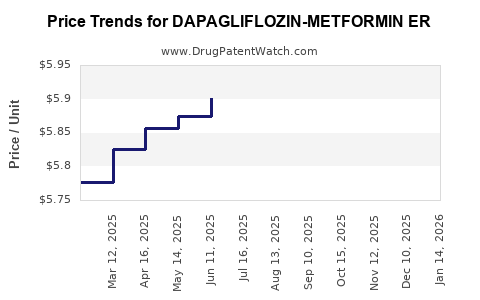
Last updated: February 19, 2026
What is Dapagliflozin-Metformin ER?
Dapagliflozin-Metformin extended-release (ER) combines two antidiabetic agents: dapagliflozin, a sodium-glucose cotransporter 2 (SGLT2) inhibitor, and metformin, a biguanide. It is approved for managing type 2 diabetes mellitus in adults as a fixed-dose combination tablet.
Regulatory Status
- Approved by the U.S. Food and Drug Administration (FDA) in July 2019.
- Approved in the European Union (EU) as of 2020.
- Available in multiple markets globally, with regional variations in approval status.
Market Overview
Size and Growth
- Global type 2 diabetes market estimated at USD 90 billion in 2022 according to Evaluate Pharma.
- Dapagliflozin-based products, including fixed-dose combinations (FDCs), represented a significant portion, with the SGLT2 inhibitor segment growing at approximately 15% CAGR from 2018 to 2022.
- FDCs for type 2 diabetes, including dapagliflozin-metformin ER, gained prevalence due to improved adherence and simplified regimens.
Key Competitors
- Glucophage XR (metformin)
- Jardiance (empagliflozin)
- Invokana (canagliflozin)
- Xigduo XR (dapaglifulozin/metformin)
- Synjardy (empagliflozin/metformin)
Dapagliflozin-Metformin ER competes mainly with Xigduo XR, which is marketed by AstraZeneca.
Market Penetration
- Dapagliflozin-Metformin ER's market share initially lagged behind Xigduo XR, due to later approval and limited regional availability.
- Controlled distribution channels in the US, EU, and select emerging markets.
- Prescriptions primarily driven by clinicians seeking combination therapy with proven efficacy and safety profiles.
Pricing Analysis
Current Price Points
- US retail prices range from USD 300 to USD 400 per month, depending on dosage and insurance coverage.
- EU pricing varies from EUR 70 to EUR 120 per pack for a 30-day supply.
- Generic versions, where available, reduce costs by 20-50%.
Cost Drivers
- Patents on dapagliflozin expired in Europe in 2021 but remain in force in the US until 2024.
- Manufacturing costs are influenced by formulation complexity and regulatory compliance.
- Marketing expenditures contribute significantly to initial price setting.
Reimbursement Policies
- US: Covered under Medicare Part D and private insurance; formulary placement influences patient access.
- Europe: Reimbursement negotiated at national or regional levels; price controls more aggressive in markets like Germany and France.
Price Projections (2023-2028)
Market Dynamics Impacting Prices
- Patent expiries lead to increased generics, reducing retail prices.
- Rising demand for combination therapies sustains premium pricing in certain markets.
- Introduction of biosimilars or alternative therapies could compress pricing.
| Year |
US Average Price (USD) |
EU Average Price (EUR) |
Notable Factors |
| 2023 |
350 |
90 |
Patent enforcement, steady demand |
| 2024 |
250 |
60 |
First generics entering, price competition begins |
| 2025 |
200 |
50 |
Wider generic availability, pricing stabilizes |
| 2026 |
180 |
45 |
Increased biosimilar options, market saturation |
| 2027 |
160 |
40 |
Continued price erosion, regional variations |
| 2028 |
150 |
35 |
Market maturity, price stabilization |
Factors Influencing Future Prices
- Patent litigation outcomes extending exclusivity.
- Impact of biosimilar entrants or alternative therapies.
- Regulatory changes affecting drug pricing and reimbursement.
- Market uptake trends driven by clinical guidelines and physician preferences.
Strategic Insights
- Industry leaders will focus on patent litigation outcomes to delay generic entry in key markets.
- Market expansion into Asia-Pacific, Latin America, and Africa presents opportunities, albeit with pricing sensitivity.
- Cost reduction strategies via manufacturing efficiencies and scale could sustain profitability amidst declining prices.
Key Takeaways
- Dapagliflozin-Metformin ER holds a growing share in the fixed-dose combination market for type 2 diabetes.
- Prices are expected to decline as generic versions launch post-patent expiry, with US prices dropping faster due to patent enforcement.
- Competitive pressure from similar products and biosimilars will further compress pricing.
- Payers’ formulary decisions and regional price controls significantly influence actual transaction prices.
- Market growth hinges on increasing global diabetes prevalence and clinician adoption of combination therapies.
FAQs
1. When do patent protections for dapagliflozin expire in key markets?
In the US, patent protections expire in 2024; in Europe, patents expired in 2021.
2. What are the main competitors to Dapagliflozin-Metformin ER?
Xigduo XR (empagliflozin/metformin), Glucophage XR (metformin alone), Jardiance (empagliflozin).
3. How does the price of Dapagliflozin-Metformin ER compare across regions?
US prices range from $300-$400 per month, while EU prices are about EUR 70-120 for a 30-day supply. Prices are generally lower in emerging markets.
4. What factors could accelerate price declines?
Patent expiry, increased generic competition, regional price controls, and market saturation.
5. What is the outlook for market penetration?
Market penetration will increase as generic options expand, but it remains dependent on regional regulatory and reimbursement policies.
References
[1] Evaluate Pharma. (2022). Global diabetes market report.
[2] FDA. (2019). Approval of dapagliflozin/metformin ER.
[3] AstraZeneca. (2020). Xigduo XR product details.
[4] European Medicines Agency. (2021). Dapagliflozin patent status.
[5] IQVIA. (2023). U.S. prescription data for diabetes therapies.