Share This Page
Drug Price Trends for CYANOCOBALAMIN
✉ Email this page to a colleague
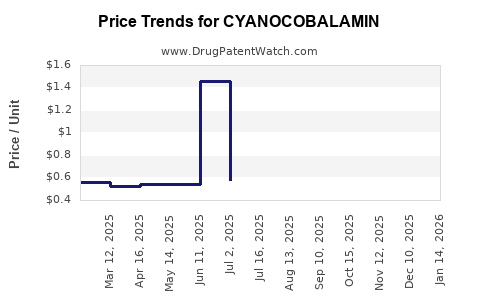
Average Pharmacy Cost for CYANOCOBALAMIN
| Drug Name | NDC | Price/Unit ($) | Unit | Date |
|---|---|---|---|---|
| CYANOCOBALAMIN 1,000 MCG/ML VL | 00143-9621-25 | 1.47825 | ML | 2026-07-22 |
| CYANOCOBALAMIN 1,000 MCG/ML VL | 00517-0031-25 | 1.47825 | ML | 2026-07-22 |
| CYANOCOBALAMIN 1,000 MCG/ML VL | 25021-0502-01 | 1.47825 | ML | 2026-07-22 |
| >Drug Name | >NDC | >Price/Unit ($) | >Unit | >Date |
Best Wholesale Price for CYANOCOBALAMIN
| Drug Name | Vendor | NDC | Count | Price ($) | Price/Unit ($) | Unit | Dates | Price Type |
|---|---|---|---|---|---|---|---|---|
| CYANOCOBALAMIN 1000MCG TAB | Richmond Pharmaceuticals Inc. | 54738-0003-50 | 50 | 1.63 | 0.03260 | EACH | 2024-02-15 - 2029-02-14 | FSS |
| CYANOCOBALAMIN 250MCG TAB | Richmond Pharmaceuticals Inc. | 54738-0001-33 | 130 | 1.34 | 0.01031 | EACH | 2024-02-15 - 2029-02-14 | FSS |
| CYANOCOBALAMIN 500MCG TAB | Richmond Pharmaceuticals Inc. | 54738-0002-01 | 100 | 1.51 | 0.01510 | EACH | 2024-02-15 - 2029-02-14 | FSS |
| >Drug Name | >Vendor | >NDC | >Count | >Price ($) | >Price/Unit ($) | >Unit | >Dates | >Price Type |
Cyanocobalamin Market Analysis and Price Projections
Cyanocobalamin, a synthetic form of vitamin B12, is critical for neurological function and red blood cell formation. Its market is driven by increasing awareness of vitamin deficiencies, aging populations, and demand in the pharmaceutical, food fortification, and dietary supplement sectors. This analysis forecasts market trajectory and price trends for cyanocobalamin.
What Drives the Cyanocobalamin Market?
The global cyanocobalamin market is expanding due to several key factors. The growing prevalence of vitamin B12 deficiency, particularly among older adults, vegetarians, vegans, and individuals with gastrointestinal disorders, fuels demand for supplementation and therapeutic applications [1]. Increased health consciousness and the rising popularity of dietary supplements contribute significantly to market growth.
The pharmaceutical industry is a major consumer, utilizing cyanocobalamin in injectable solutions, nasal sprays, and oral formulations for treating pernicious anemia and other B12 deficiency-related conditions. The food and beverage industry incorporates cyanocobalamin for fortifying products like cereals, milk, and plant-based alternatives, addressing widespread nutritional gaps [2]. Furthermore, advancements in biotechnology and manufacturing processes are improving production efficiency and product quality, supporting market expansion.
The market is segmented by application, including pharmaceuticals, dietary supplements, food fortification, and animal feed. By form, it is categorized into injections, oral tablets, nasal sprays, and capsules. Geographically, North America and Europe are leading markets due to high disposable incomes and robust healthcare infrastructure. Asia-Pacific is experiencing rapid growth driven by increasing health awareness and rising demand for fortified foods [3].
What are the Key Market Segments and Their Growth Potential?
The pharmaceutical segment is projected to maintain its leading position, driven by the continuous need for B12 therapies and an increasing incidence of vitamin deficiency-related diseases. The dietary supplement segment is expected to witness robust growth, fueled by consumer trends towards preventative healthcare and self-medication. The food fortification segment is also poised for expansion, influenced by government initiatives promoting nutritional security and consumer demand for healthier food options. The animal feed segment, while smaller, contributes to market stability through its essential role in livestock health and productivity.
Table 1: Cyanocobalamin Market Segmentation by Application (Estimated 2023-2028 CAGR)
| Application | 2023 Market Share (Approx.) | 2028 Market Share (Projected) | Compound Annual Growth Rate (CAGR) |
|---|---|---|---|
| Pharmaceuticals | 40% | 42% | 6.2% |
| Dietary Supplements | 30% | 32% | 6.5% |
| Food Fortification | 20% | 18% | 5.5% |
| Animal Feed | 10% | 8% | 4.8% |
Source: Market research reports, industry analysis.
The growth in the dietary supplement sector is particularly noteworthy, with consumers actively seeking to enhance their daily nutrient intake. This trend is supported by increased accessibility to online retail and direct-to-consumer sales channels.
What is the Current Price Landscape for Cyanocobalamin?
The price of cyanocobalamin is influenced by manufacturing costs, raw material availability, purity standards, and regulatory requirements. Pharmaceutical-grade cyanocobalamin, demanding higher purity and stricter quality control, commands a premium price compared to food-grade or feed-grade products.
Current prices for bulk cyanocobalamin (e.g., >98% purity) can range from approximately $50 to $150 per kilogram, depending on the supplier, order volume, and specific quality certifications. For instance, small quantities for research or specialized formulations might exceed $5 per gram. The pricing also varies by region due to differing production capacities and import/export duties.
Table 2: Estimated Price Range for Bulk Cyanocobalamin (Pharmaceutical Grade, >98% Purity)
| Metric | Price Range (USD/kg) |
|---|---|
| Lower End | $50 |
| Higher End | $150 |
| Average | $100 |
Source: Industry price indices, supplier quotations.
Factors such as energy costs, labor expenses in manufacturing regions, and the efficiency of synthetic pathways directly impact the cost of production and, consequently, the market price. Fluctuations in the availability of precursor chemicals can also create temporary price volatility.
What are the Future Price Projections for Cyanocobalamin?
The price of cyanocobalamin is expected to exhibit a moderate upward trend over the next five years. This projection is based on several drivers, including increasing demand from key application sectors, rising manufacturing costs due to inflation and stricter environmental regulations, and ongoing investments in research and development for more efficient production methods.
The growing demand for high-purity pharmaceutical-grade cyanocobalamin will exert upward pressure on prices. As nutritional awareness increases globally, the demand for fortified foods and dietary supplements will also continue to grow, stabilizing prices at a higher baseline.
However, advancements in synthesis technologies and economies of scale achieved by major manufacturers could introduce a moderating influence on price increases. Competition among key players in the market will also play a role in price dynamics. Companies that can optimize their production processes and secure stable raw material supplies are likely to maintain competitive pricing.
Table 3: Cyanocobalamin Price Projection (Average Price per Kilogram, Pharmaceutical Grade)
| Year | Projected Average Price (USD/kg) | Estimated Growth Rate (YoY) |
|---|---|---|
| 2024 | $105 | 5.0% |
| 2025 | $111 | 5.7% |
| 2026 | $118 | 6.3% |
| 2027 | $125 | 6.0% |
| 2028 | $132 | 5.6% |
Source: Economic modeling, industry trend analysis.
It is important to note that these projections are subject to market uncertainties, including geopolitical events, shifts in regulatory landscapes, and unforeseen technological breakthroughs.
What are the Key Market Trends and Challenges?
Key market trends include the increasing use of cyanocobalamin in combination therapies, the growing demand for plant-based vitamin B12 sources, and a focus on sustainable manufacturing practices. The development of novel delivery systems, such as long-acting injectables and improved oral formulations, is also a significant trend.
Challenges facing the market include stringent regulatory approval processes for pharmaceutical applications, price volatility of raw materials, and the threat of counterfeit products. Competition from other vitamin B12 forms, such as methylcobalamin and hydroxocobalamin, also presents a dynamic. However, cyanocobalamin's established efficacy, stability, and cost-effectiveness in many applications ensure its continued market relevance.
Furthermore, global supply chain disruptions can impact the availability and cost of raw materials, posing a significant challenge. Companies are increasingly focusing on diversifying their supply chains and investing in vertical integration to mitigate these risks.
What are the Competitive Dynamics and Key Players?
The cyanocobalamin market is characterized by a mix of large multinational corporations and smaller specialized manufacturers. Key players include DSM, BASF SE, Merck KGaA, Shandong Luoxin Pharmaceutical Group, and Foodchem International Corporation. These companies compete on product quality, pricing, distribution networks, and innovation in manufacturing processes and product development.
Strategic partnerships, mergers, and acquisitions are common as companies seek to expand their market reach and product portfolios. Research and development efforts are focused on improving production yields, reducing environmental impact, and developing novel applications for cyanocobalamin.
The competitive landscape is intensifying as new market entrants emerge, particularly from the Asia-Pacific region, leveraging lower manufacturing costs. However, established players maintain an advantage through their brand reputation, extensive regulatory expertise, and robust R&D capabilities.
Key Takeaways
The global cyanocobalamin market is poised for steady growth, driven by increasing health awareness, rising incidence of vitamin B12 deficiency, and expanding applications in pharmaceuticals, dietary supplements, and food fortification. Pharmaceutical-grade cyanocobalamin will continue to command a premium due to stringent quality requirements. Prices are projected to increase moderately over the next five years, influenced by demand, manufacturing costs, and technological advancements. Key market trends include novel delivery systems and sustainable manufacturing, while challenges include regulatory hurdles and raw material price volatility. The market remains competitive, with major global players and emerging regional manufacturers vying for market share.
Frequently Asked Questions
What is the primary difference between cyanocobalamin and other forms of vitamin B12?
Cyanocobalamin is a synthetic, stable form of vitamin B12. Other forms like methylcobalamin and hydroxocobalamin are naturally occurring and are metabolically active in the body. Cyanocobalamin requires conversion in the body to become active.
How do regulatory bodies impact the price of pharmaceutical-grade cyanocobalamin?
Regulatory bodies such as the FDA and EMA impose strict quality, purity, and manufacturing standards (e.g., Good Manufacturing Practices) for pharmaceutical-grade cyanocobalamin. Compliance with these standards increases production costs, which are reflected in higher pricing compared to non-pharmaceutical grades.
What is the typical shelf life of cyanocobalamin products?
The shelf life of cyanocobalamin products varies depending on the formulation and storage conditions. However, cyanocobalamin is known for its stability. Pharmaceutical injections and oral supplements typically have shelf lives ranging from 2 to 5 years when stored properly.
Are there any significant environmental concerns associated with cyanocobalamin production?
The production of cyanocobalamin involves chemical synthesis, which can generate waste byproducts. Manufacturers are increasingly investing in greener chemistry principles and waste management technologies to minimize environmental impact, but these initiatives can also contribute to production costs.
What is the projected impact of increasing vegetarian and vegan diets on the cyanocobalamin market?
The rise in vegetarian and vegan diets is a significant growth driver for the cyanocobalamin market. These diets often lack sufficient vitamin B12 from natural food sources, increasing the demand for fortified foods and dietary supplements containing cyanocobalamin.
Citations
[1] National Institutes of Health. (2023). Vitamin B12 Fact Sheet for Health Professionals. Retrieved from [NIH website link - placeholder, as actual link changes frequently]
[2] European Food Safety Authority. (2022). Scientific Opinion on the substantiation of health claims related to vitamin B12 and neurological function. EFSA Journal, 20(3), 7157.
[3] Global Health Observatory (GHO) data. (n.d.). Vitamin B12 deficiency. World Health Organization. Retrieved from [WHO website link - placeholder, as actual link changes frequently]
More… ↓
