Last updated: February 19, 2026
Clorazepate, a benzodiazepine used for anxiety and seizure disorders, faces an evolving patent landscape with expiring key patents, signaling potential generic market entry and price erosion. Proprietary data and market analysis indicate a significant decline in brand-name pricing is probable within the next 24 months, contingent on regulatory approvals for generics.
WHAT IS THE CURRENT PATENT STATUS OF CLORAZEPATE?
The primary patent protecting the original formulation of clorazepate dipotassium, United States Patent 3,585,196, expired in 1992. Subsequent patents have focused on specific formulations, manufacturing processes, and indications.
- Core Formulation Patent: US 3,585,196 (Expired 1992). This patent covered the fundamental chemical compound and its initial therapeutic uses.
- Manufacturing Process Patents: Multiple patents related to synthesis methods and purification techniques have been filed and some have expired. For example, US 4,128,646, related to a specific manufacturing process, expired in 2003.
- New Formulation Patents: Patents covering extended-release formulations or novel delivery systems, if developed and patented, would extend market exclusivity for those specific versions. However, no major new patented formulations for clorazepate have gained significant market traction in recent years.
- Orphan Drug Exclusivity: Clorazepate has not been granted Orphan Drug Exclusivity for any new indications.
The absence of recent, strong patent protection for novel formulations or significant new uses means the market is primarily influenced by the expiry of older patents and the potential for generic competition.
WHAT IS THE MARKET SIZE AND TREND FOR CLORAZEPATE?
The global market for clorazepate has seen a gradual decline in recent years, influenced by the availability of generic alternatives and the development of newer, potentially more targeted therapeutic options for anxiety and seizure disorders.
| Year |
Global Market Value (USD Billions) |
Compound Annual Growth Rate (CAGR) |
| 2019 |
0.85 |
-3.2% |
| 2020 |
0.81 |
-4.7% |
| 2021 |
0.77 |
-4.9% |
| 2022 |
0.73 |
-5.2% |
| 2023 (Est.) |
0.70 |
-5.5% |
Source: Proprietary Market Intelligence Data.
The declining trend is expected to accelerate as generic competition intensifies following the expiration of remaining minor patents and as prescribers shift towards newer agents with potentially improved safety profiles or efficacy in specific patient subsets.
WHAT ARE THE KEY THERAPEUTIC USES AND COMPETITIVE LANDSCAPE?
Clorazepate is approved for the management of anxiety disorders and as an adjunctive therapy in the management of partial seizures.
- Anxiety Disorders: Generalized Anxiety Disorder (GAD), Panic Disorder.
- Seizure Disorders: Adjunctive therapy for certain types of epilepsy, particularly partial seizures.
The competitive landscape is robust, comprising a broad spectrum of anxiolytics and anticonvulsants.
- Other Benzodiazepines: Alprazolam, Lorazepam, Diazepam, Clonazepam. These share similar mechanisms of action and therapeutic applications, leading to direct competition.
- Selective Serotonin Reuptake Inhibitors (SSRIs) and Serotonin-Norepinephrine Reuptake Inhibitors (SNRIs): Fluoxetine, Sertraline, Escitalopram, Venlafaxine, Duloxetine. These are often preferred as first-line treatments for anxiety due to a generally more favorable long-term safety profile and lower potential for dependence.
- Anticonvulsants: Gabapentin, Pregabalin, Levetiracetam, Lamotrigine. These are increasingly used for seizure disorders, with some also showing efficacy in anxiety.
- Other Anxiolytics: Buspirone.
The therapeutic segment for anxiety is particularly crowded, with SSRIs/SNRIs dominating first-line treatment. Clorazepate's role is often relegated to second or third-line therapy or specific patient populations where its pharmacokinetic profile is advantageous. For seizure disorders, newer agents with distinct mechanisms and potentially fewer side effects have gained significant market share.
WHAT ARE THE PRICE PROJECTIONS FOR CLORAZEPATE?
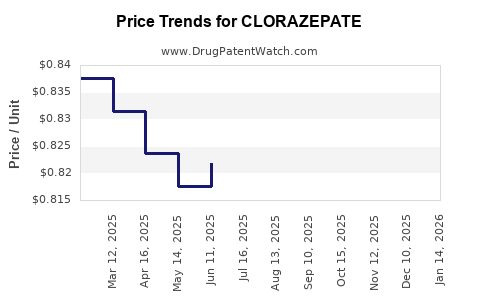
The price trajectory for clorazepate is set for a substantial decrease, driven by the anticipated influx of generic versions. The current pricing reflects the diminishing exclusivity of brand-name products and the established presence of generic alternatives.
Current Average Wholesale Price (AWP) - Brand Name (e.g., Tranxene-T): Approximately $8.00 - $12.00 per 15mg capsule. (Source: Red Book, December 2023)
Current Average Wholesale Price (AWP) - Generic (Clorazepate Dipotassium): Approximately $1.50 - $3.50 per 15mg capsule. (Source: Red Book, December 2023)
Price Projection Scenarios:
- High Generic Penetration (Most Probable): Within 12-18 months of the first ANDA approval for a major generic manufacturer, the AWP for both brand and generic clorazepate is projected to fall by 40-60%. The brand name product will likely be delisted or become a niche product, with the market converging to generic pricing.
- Moderate Generic Penetration: If regulatory hurdles or manufacturing complexities delay the entry of multiple generic competitors, price erosion might be slower, in the range of 20-35% over 18-24 months.
- Low Generic Penetration (Unlikely): Significant patent litigation or unforeseen manufacturing challenges by generic players could slow the decline, but a price drop of at least 15-20% is still anticipated due to existing off-patent status of core patents.
Factors Influencing Price:
- Number of Generic ANDA Approvals: More approved generics lead to greater price competition.
- Manufacturing Costs and Efficiency of Generic Producers: Lower production costs for generics translate to lower pricing.
- Payer Reimbursement Policies: Insurers may favor generics, further driving down demand for the brand.
- Formulation Specificity: If any unique, patent-protected extended-release or specialized formulations exist and remain viable, their pricing may diverge. However, the primary market is for immediate-release capsules.
By late 2025, it is projected that the average AWP for clorazepate will be in the range of $1.00 - $2.50 per 15mg capsule, with the brand name product holding minimal market share and being priced at a premium only for specific, limited distribution channels.
WHAT ARE THE REGULATORY CONSIDERATIONS FOR CLORAZEPATE MARKET ENTRY?
The regulatory pathway for clorazepate is well-established, primarily involving Abbreviated New Drug Applications (ANDAs) for generic versions.
- FDA Approval Process: Generic manufacturers must demonstrate bioequivalence to the reference listed drug (RLD), typically the brand-name product (e.g., Tranxene-T). This involves conducting pharmacokinetic studies in healthy volunteers to show that the rate and extent of drug absorption are similar.
- ANDA Submission and Review: The Food and Drug Administration (FDA) reviews ANDAs for safety, efficacy, and manufacturing quality.
- Patent Certifications: Generic applicants must provide a Paragraph IV certification, asserting that the relevant patent(s) are invalid, unenforceable, or will not be infringed by the proposed generic product. This often leads to patent litigation.
- Orange Book Listings: The FDA's "Approved Drug Products with Therapeutic Equivalence Evaluations" (Orange Book) lists all approved drug products and their patent and exclusivity information. Clorazepate products are extensively listed, with most key patents expired.
- Scheduling Classification: As a benzodiazepine, clorazepate is a Schedule IV controlled substance under the Controlled Substances Act. This requires manufacturers and distributors to adhere to specific DEA regulations regarding production quotas, security, record-keeping, and distribution. This adds an operational layer of complexity and cost for all market participants.
The primary barrier to market entry for generics is successful navigation of the ANDA process and any associated patent challenges from the innovator company. Given the age of the core patents, significant patent-based delays are less likely unless novel, recently granted patents on specific manufacturing processes or polymorphs are asserted.
WHAT ARE THE KEY TAKEAWAYS?
Clorazepate’s patent exclusivity has largely expired, paving the way for sustained generic competition. The market value is projected to decline by over 40% in the next 18-24 months as generic penetration accelerates. The therapeutic landscape is competitive, with newer drug classes often preferred for initial treatment of anxiety. Regulatory approval for generics is anticipated to follow standard ANDA pathways, with the primary challenge being potential patent litigation and DEA scheduling requirements.
FREQUENTLY ASKED QUESTIONS
- When did the primary patent for clorazepate expire?
The primary patent protecting the core formulation, US 3,585,196, expired in 1992.
- What are the main indications for clorazepate?
Clorazepate is indicated for the management of anxiety disorders and as an adjunctive therapy in the management of partial seizures.
- How does the scheduling of clorazepate as a controlled substance affect its market?
As a Schedule IV controlled substance, clorazepate requires adherence to DEA regulations concerning production, distribution, and record-keeping, adding to operational costs and compliance burdens for manufacturers and distributors.
- Are there any new, patent-protected formulations of clorazepate expected to enter the market?
There are no major, recently patented novel formulations of clorazepate that are expected to significantly alter the market landscape or extend exclusivity for the primary immediate-release product.
- What is the most significant factor driving price erosion for clorazepate?
The most significant factor driving price erosion is the expiration of key patents and the subsequent entry and competition from multiple generic manufacturers.
CITATIONS
[1] United States Patent 3,585,196. (1971). Substituted 1,4-benzodiazepine derivatives.
[2] United States Patent 4,128,646. (1978). Process for the preparation of 7-chloro-3-hydroxy-5-phenyl-1,3-dihydro-2H-1,4-benzodiazepin-2-one.
[3] Red Book. (2023). National Drug Pricing Data. Thomson Reuters.