Share This Page
Drug Price Trends for CITALOPRAM HBR
✉ Email this page to a colleague
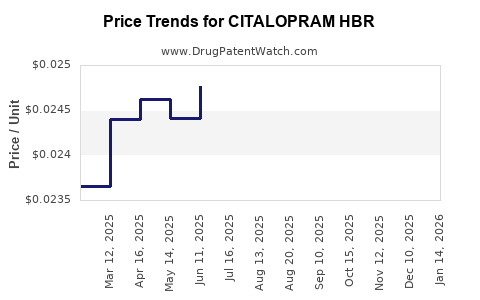
Average Pharmacy Cost for CITALOPRAM HBR
| Drug Name | NDC | Price/Unit ($) | Unit | Date |
|---|---|---|---|---|
| CITALOPRAM HBR 40 MG TABLET | 82009-0108-05 | 0.04431 | EACH | 2026-03-18 |
| CITALOPRAM HBR 10 MG TABLET | 00378-6231-01 | 0.02581 | EACH | 2026-03-18 |
| CITALOPRAM HBR 10 MG TABLET | 00378-6231-05 | 0.02581 | EACH | 2026-03-18 |
| CITALOPRAM HBR 10 MG TABLET | 13668-0009-01 | 0.02581 | EACH | 2026-03-18 |
| >Drug Name | >NDC | >Price/Unit ($) | >Unit | >Date |

Citalopram HBr Market Analysis and Price Projections
Citalopram hydrobromide (HBr) is a selective serotonin reuptake inhibitor (SSRI) used to treat major depressive disorder and panic disorder. The market for citalopram HBr is characterized by established generic competition and the presence of branded alternatives. Price trends are primarily influenced by manufacturing costs, patent expirations of originator products, generic entry, and formulary decisions by payers.
Market Landscape for Citalopram HBr
What is the current global market size for citalopram HBr?
The global market for citalopram HBr, as a component of antidepressant drug sales, is substantial but fragmented due to genericization. While specific figures for citalopram HBr alone are not always isolated in market reports, the broader SSRI market, where citalopram plays a role, is valued in the billions of dollars. For example, the global antidepressants market was estimated at USD 14.6 billion in 2022 and is projected to reach USD 19.9 billion by 2030, growing at a compound annual growth rate (CAGR) of 3.9% from 2023 to 2030 [1]. Citalopram HBr's market share within this segment is influenced by its established efficacy and cost-effectiveness compared to newer agents.
Who are the key manufacturers and suppliers of citalopram HBr?
The manufacturing of citalopram HBr is dominated by generic pharmaceutical companies. Key players involved in the production and supply of citalopram HBr active pharmaceutical ingredient (API) and finished dosage forms include:
- Teva Pharmaceutical Industries Ltd.
- Mylan N.V. (now part of Viatris Inc.)
- Sun Pharmaceutical Industries Ltd.
- Lupin Limited
- Dr. Reddy's Laboratories Ltd.
- Aurobindo Pharma Ltd.
- Zydus Lifesciences Ltd.
- Torrent Pharmaceuticals Ltd.
These companies operate globally, supplying citalopram HBr to various regulated and semi-regulated markets.
What is the regulatory status and patent expiry for citalopram HBr?
Citalopram was originally patented by Lundbeck under the brand name Celexa. The primary patents for citalopram HBr have long expired in major markets. For instance, the U.S. patent for citalopram expired in the early 2000s, leading to widespread generic entry. Regulatory approval for citalopram HBr products is granted by agencies such as the U.S. Food and Drug Administration (FDA) and the European Medicines Agency (EMA). Manufacturers must adhere to stringent Good Manufacturing Practices (GMP) and demonstrate bioequivalence for generic versions.
What are the primary indications and patient populations for citalopram HBr?
Citalopram HBr is prescribed for:
- Major Depressive Disorder (MDD): This is its primary indication. It is used to alleviate symptoms such as persistent sadness, loss of interest, changes in sleep and appetite, and feelings of worthlessness.
- Panic Disorder: Citalopram HBr is also indicated for the treatment of panic disorder with or without agoraphobia.
The patient population includes adults diagnosed with these conditions. It is prescribed across a wide age range, though caution is exercised in certain populations, such as adolescents and the elderly, due to specific risk profiles.
Price Analysis and Projections
What are the current price ranges for citalopram HBr?
The price of citalopram HBr varies significantly based on formulation (tablets, oral solution), dosage strength (10 mg, 20 mg, 40 mg), quantity, and geographic market. As a well-established generic medication, citalopram HBr is competitively priced.
- Typical retail prices for a 30-day supply of 20 mg citalopram HBr tablets can range from $10 to $30 USD without insurance, depending on the pharmacy and manufacturer.
- Wholesale prices for API will be considerably lower, often in the range of $50 to $200 per kilogram, subject to bulk purchase volumes and supplier contracts.
These prices reflect the intense competition among generic manufacturers and the availability of multiple bioequivalent products.
What factors influence citalopram HBr pricing?
Several factors drive the pricing of citalopram HBr:
- Manufacturing Costs: The cost of raw materials, synthesis complexity, energy, labor, and quality control contribute to the base cost of the API and finished product.
- Generic Competition: The presence of numerous generic manufacturers creates a price ceiling. Companies compete on cost and market access.
- Supply Chain Dynamics: Disruptions in the supply of API or excipients, geopolitical events, or logistics challenges can impact availability and prices.
- Formulary Placement: Inclusion on insurance formularies and the negotiated rebates by pharmacy benefit managers (PBMs) significantly affect the net price paid by payers and out-of-pocket costs for patients.
- Regulatory Compliance: Costs associated with maintaining GMP standards and regulatory filings add to overall expenses.
- Market Demand: While stable for an established drug, fluctuations in prescribing patterns can indirectly influence pricing.
What are the projected price trends for citalopram HBr over the next five years?
Given its status as a mature generic drug with expired patents, significant price increases for citalopram HBr are unlikely. Projections indicate a continuation of price stability with potential for minor fluctuations.
- Price Stability: The market is expected to remain highly competitive, preventing substantial price hikes. Average Selling Prices (ASPs) are likely to remain within their current general range.
- Slight Declines: Incremental price erosion may occur due to ongoing efforts by manufacturers to optimize production costs and gain market share through aggressive pricing.
- Volume-Driven Growth: Growth in the citalopram HBr market will likely be driven by volume increases due to its cost-effectiveness and continued physician preference for established SSRIs, rather than price appreciation.
- Impact of New Therapies: The introduction of novel antidepressants with different mechanisms of action could, over the long term, marginally reduce demand for older generics like citalopram HBr, potentially exerting slight downward pressure on prices in specific segments. However, its low cost is a strong counter-argument for its continued use.
Table 1: Projected Annual Price Change for Citalopram HBr (2024-2028)
| Year | Projected % Change | Primary Drivers |
|---|---|---|
| 2024 | -1% to 0% | Stable competition, manufacturing cost pressures |
| 2025 | -1% to 0% | Ongoing generic market dynamics |
| 2026 | -1% to 0% | Potential for minor cost-saving innovations |
| 2027 | -1% to 0% | Sustained competition, stable demand |
| 2028 | -1% to 0% | Maturing market, continued cost-efficiency focus |
Source: Analyst projections based on market trends.
How do citalopram HBr prices compare to other SSRIs and newer antidepressants?
Citalopram HBr is among the most cost-effective SSRIs available.
- Comparison to other SSRIs: Prices for generic fluoxetine, sertraline, and escitalopram are broadly comparable to citalopram HBr, with minor variations depending on specific product formulations and manufacturer contracts. Escitalopram, the S-enantiomer of citalopram, was branded for longer and may command slightly higher prices in its generic form, though the gap is narrowing.
- Comparison to newer antidepressants: Novel antidepressants, including those with SNRI mechanisms (e.g., duloxetine, venlafaxine) or atypical mechanisms (e.g., bupropion, vortioxetine), are generally more expensive. Branded versions of these drugs are significantly higher in cost. Even their generic equivalents can be 1.5x to 3x more expensive than citalopram HBr on a per-day basis, depending on the specific drug and dosage.
This cost differential ensures that citalopram HBr remains a preferred option for cost-sensitive patient populations and healthcare systems.
Market Dynamics and Future Outlook
What are the primary drivers of demand for citalopram HBr?
The enduring demand for citalopram HBr is driven by:
- Proven Efficacy: Decades of clinical use have established its efficacy in treating MDD and panic disorder.
- Cost-Effectiveness: Its low price point makes it accessible to a broad patient base, especially those with high-deductible plans or without comprehensive insurance.
- Physician Familiarity: Healthcare providers are well-versed in its prescribing guidelines, side effect profiles, and drug interactions.
- Broad Prescribing: It is a first-line or second-line treatment option recommended by major clinical guidelines for depression and anxiety.
What are the potential challenges or risks facing the citalopram HBr market?
Potential challenges include:
- Competition from Newer Antidepressants: While citalopram HBr remains a cost-effective choice, newer agents may offer different efficacy profiles or tolerability for specific patient subgroups, potentially diverting market share over time.
- Side Effect Profiles: Like all SSRIs, citalopram HBr has known side effects (e.g., nausea, insomnia, sexual dysfunction) that can lead to patient non-adherence or switching to alternative treatments.
- Regulatory Scrutiny: Ongoing pharmacovigilance and potential for label changes based on new safety data could impact prescribing.
- Supply Chain Vulnerabilities: Reliance on global API manufacturers can expose the market to disruptions from geopolitical events or manufacturing issues.
What is the outlook for citalopram HBr in emerging markets?
Emerging markets represent a significant growth opportunity for citalopram HBr.
- Increasing Healthcare Access: As healthcare infrastructure improves and access to medications expands in developing economies, demand for affordable and effective treatments for mental health conditions is rising.
- Cost-Sensitive Populations: Citalopram HBr's low price point makes it an ideal candidate for widespread adoption in markets where out-of-pocket healthcare expenses are a major consideration.
- Generic Dominance: The regulatory pathways for generic drugs in many emerging markets are often more streamlined, facilitating faster market entry for citalopram HBr from various suppliers.
The key is ensuring consistent quality and reliable supply chains to these regions.
Key Takeaways
- Citalopram HBr is a mature generic antidepressant facing intense price competition.
- Its market is characterized by numerous suppliers and expired originator patents.
- Pricing is expected to remain stable, with potential for minor declines driven by cost optimization and competitive pressures.
- The drug's cost-effectiveness is a primary driver of its continued demand, particularly against newer, more expensive antidepressants.
- Emerging markets present a growth avenue due to increasing healthcare access and the need for affordable mental health treatments.
Frequently Asked Questions
1. Will the price of citalopram HBr significantly increase due to demand for mental health treatment?
No, significant price increases are unlikely. While demand for mental health treatments is rising, citalopram HBr is a generic drug with established manufacturing capacity. The competitive generic market typically prevents substantial price inflation for such medications.
2. Are there any specific safety concerns that might impact citalopram HBr pricing or availability?
While citalopram HBr has a well-defined safety profile, ongoing pharmacovigilance may identify new or clarify existing risks. However, such developments are more likely to lead to label updates or prescribing guidelines rather than direct price hikes or significant supply disruptions, unless a major safety recall occurs.
3. How does the formulation (e.g., tablet vs. oral solution) affect the price of citalopram HBr?
Oral solutions or suspensions are typically priced higher than tablets due to more complex manufacturing processes, specialized packaging, and potentially higher API concentration per unit volume. However, the price difference is generally modest for generics.
4. What is the impact of payer negotiations and formulary decisions on citalopram HBr pricing?
Payer negotiations and formulary placement are critical. PBMs and insurance companies negotiate prices with manufacturers, often securing lower net prices through volume commitments and rebates. This contributes to the competitive pricing observed in the market.
5. Can citalopram HBr be manufactured cost-effectively at scale, and what does this imply for its future price?
Yes, citalopram HBr can be manufactured cost-effectively at scale. The established synthesis routes and economies of scale achieved by multiple large generic manufacturers ensure that its production remains efficient. This bodes well for continued price stability and affordability.
Citations
[1] Grand View Research. (2023). Antidepressants Market Size, Share & Trends Analysis Report By Drug Type (SSRIs, SNRIs, Tricyclics, MAOIs, Others), By Application (Depression, Anxiety Disorders, OCD, PTSD, Others), By Distribution Channel, By Region, And Segment Forecasts, 2023 - 2030. Retrieved from https://www.grandviewresearch.com/industry-analysis/antidepressants-market
More… ↓
