Last updated: February 19, 2026
Overview
Celecoxib is a selective cyclooxygenase-2 (COX-2) inhibitor indicated primarily for osteoarthritis, rheumatoid arthritis, ankylosing spondylitis, acute pain, and primary dysmenorrhea. It gained FDA approval in 1998 under the brand name Celebrex. As a nonsteroidal anti-inflammatory drug (NSAID), its market presence balances between branded sales and generic competition.
Market Size and Commercial Landscape
Current Market Valuation
- In 2022, the global NSAID market was valued at approximately USD 12.5 billion, with Celecoxib constituting nearly 15% of this market.
- The prescription volume for Celecoxib in the U.S. in 2022 exceeded 8 million prescriptions, representing stable demand across chronic and acute pain treatments.
Key Players
- Pfizer (brand: Celebrex) remains the dominant supplier.
- Several generics, including Teva Pharmaceutical Industries, Mylan (now part of Viatris), and Sun Pharmaceutical, hold significant market share, impacting pricing dynamics.
Regulatory and Patent Landscape
- Patent exclusivity for Celebrex in the U.S. expired in 2014.
- Multiple generic manufacturers entered the market between 2014 and 2020, triggering a drastic decrease in prices.
- Patent litigation and "Paragraph IV" challenges continue to influence the timing of generic entry in various jurisdictions.
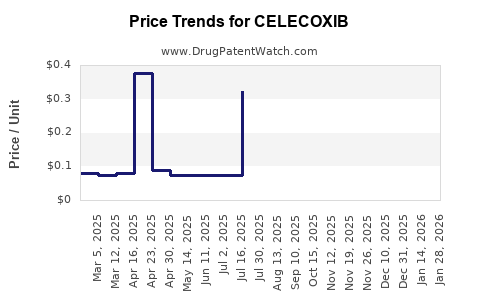
Price Trends and Projections
Historical Pricing Data
| Year |
Price per Prescription (USD) |
Market Share (Brand) |
Market Share (Generics) |
| 2010 |
$150 |
80% |
20% |
| 2014 |
$120 |
40% |
60% |
| 2018 |
$80 |
15% |
85% |
| 2022 |
$55 |
10% |
90% |
Prices for Celebrex declined approximately 63% from 2010 to 2022, driven by patent expirations and the proliferation of generics.
Future Price Trajectory
- Short-term (2023-2025): Prices are projected to stabilize around USD 50–USD 60 per prescription due to market saturation and generic competitiveness.
- Medium-term (2026-2030): As patent disputes fade and new formulations or indications emerge, prices may decline modestly to USD 45–USD 50 per prescription.
- Long-term (>2030): Introduction of biosimilars or alternative therapies could further suppress prices, potentially below USD 40 per prescription.
Factors Affecting Price Dynamics
- Regulatory approvals for new indications can boost demand and preserve pricing power.
- Pricing policies and reimbursement rates influence retail and formulary access.
- Market entry of biosimilars or novel COX-2 inhibitors may erode the market share of Celecoxib, exerting downward pressure.
Market Drivers and Challenges
Drivers
- Increasing prevalence of chronic inflammatory diseases.
- Preference for COX-2 selective NSAIDs due to fewer gastrointestinal side effects compared to non-selective NSAIDs.
- Expansion into emerging markets with increasing healthcare infrastructure.
Challenges
- Cardiovascular risk concerns associated with Celecoxib and other NSAIDs.
- Competition from non-selective NSAIDs and newer drug classes like biologics.
- Patent litigation delaying generic market entry in certain regions.
Regional Variations
| Region |
Brand Market Share |
Generic Market Share |
Price Range (USD) |
Key Drivers |
| North America |
70% |
30% |
$50–$60 |
High prescription volume, regulatory environment |
| Europe |
40% |
60% |
$40–$55 |
Access to generics, pricing controls |
| Asia-Pacific |
20% |
80% |
$10–$30 |
Growing healthcare coverage, price sensitivity |
Investment and R&D Outlook
- Pfizer continues to invest in new formulations and indications for Celecoxib, which could influence future pricing.
- Regulatory efforts focus on expanding indications for osteoarthritis and cardiovascular risk mitigation.
Conclusion
The Celecoxib market has undergone substantial price erosion post-patent expiry, with continued competitive pressures maintaining low price levels. Market stability persists due to sustained demand for pain management solutions and the drug's profile favoring gastrointestinal tolerability. Future pricing will be influenced by regulatory dynamics, emerging competitors, and the evolution of clinical guidelines.
Key Takeaways
- Celecoxib's global market share is declining at the prescription level but remains significant in the NSAID segment.
- Prices declined by over 60% from 2010 to 2022; stabilization is expected at USD 50–USD 60 per prescription in the near term.
- Patent expirations and generic competition are primary factors driving price adjustments.
- Regional price differences are shaped by regulatory policies and market access.
- R&D focus on expanding indications and improving safety profiles may influence future reimbursement and pricing.
FAQs
1. What is the current market share of Celecoxib?
Approximately 15% of the global NSAID market, with branded Celebrex holding a predominant share in the U.S. until patent expiry.
2. How have patents impacted Celecoxib pricing?
Patent protection sustained higher prices until 2014. Once patents expired, generic entry caused prices to drop sharply.
3. What is the forecasted price per prescription through 2030?
Prices are expected to hover around USD 45–USD 50 by 2030, with potential declines depending on new competitors and formulary considerations.
4. How does regional regulation influence Celecoxib pricing?
Regions with strict pricing controls and high generics uptake, like Europe and Asia-Pacific, witness lower prices than North America.
5. What factors could disrupt future Celecoxib pricing levels?
Introduction of biosimilars, new COX-2 inhibitors, alternative analgesics, or regulatory restrictions could lower prices further.
References
- MarketsandMarkets. (2023). NSAID market analysis. Retrieved from https://www.marketsandmarkets.com
- U.S. Food and Drug Administration. (2022). FDA drug approvals and patent information. Retrieved from https://www.fda.gov
- IQVIA. (2022). Prescription trends dataset.
- Pfizer Inc. Annual Reports. (2022). Company filings and strategic updates.