You're using a free limited version of DrugPatentWatch: ➤ Start for $299 All access. No Commitment.

Last Updated: April 1, 2026

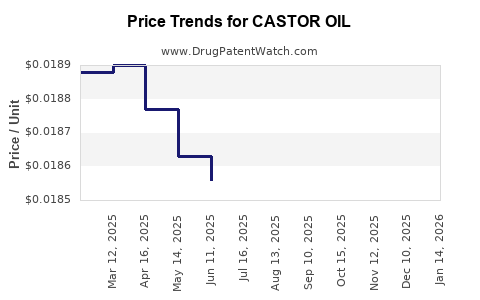
Drug Price Trends for CASTOR OIL


✉ Email this page to a colleague
« Back to Dashboard


Drug Price Trends for CASTOR OIL

Average Pharmacy Cost for CASTOR OIL

These are average pharmacy acquisition costs (net of discounts) from a US national survey
Drug Name NDC Price/Unit ($) Unit Date
CASTOR OIL 24385-0515-30 0.01930 ML 2026-03-18
CASTOR OIL 70000-0024-01 0.01856 ML 2026-03-18
CASTOR OIL 24385-0515-30 0.02021 ML 2026-02-18
CASTOR OIL 70000-0024-01 0.01842 ML 2026-02-18
CASTOR OIL 24385-0515-30 0.02099 ML 2026-01-21
CASTOR OIL 70000-0024-01 0.01832 ML 2026-01-21
CASTOR OIL 24385-0515-30 0.02129 ML 2025-12-17
>Drug Name >NDC >Price/Unit ($) >Unit >Date

Best Wholesale Price for CASTOR OIL

These are wholesale prices available to the US Federal Government which, by law, must be the best prices available to any customer under comparable terms and conditions
Drug Name Vendor NDC Count Price ($) Price/Unit ($) Unit Dates Price Type
VENELEX OINT Stratus Pharmaceuticals, Inc. 58980-0780-21 60GM 13.08 0.21800 GM 2023-10-01 - 2028-09-30 FSS
VENELEX OINT Stratus Pharmaceuticals, Inc. 58980-0780-50 60x5GM 219.10 2023-10-01 - 2028-09-30 FSS
VENELEX OINT Stratus Pharmaceuticals, Inc. 58980-0780-11 30GM 14.32 0.47733 GM 2023-10-01 - 2028-09-30 FSS
CASTOR OIL 788MG/PERUVIAN BALSAM 87MG/GM OINT Golden State Medical Supply, Inc. 16477-0502-60 60GM 13.87 0.23117 GM 2023-12-15 - 2028-06-14 FSS
>Drug Name >Vendor >NDC >Count >Price ($) >Price/Unit ($) >Unit >Dates >Price Type
Price type key: Federal Supply Schedule (FSS): generally available to all Federal Govt agencies / 'BIG4' prices: VA, DoD, Public Health & Coast Guard only / National Contracts (NC): Available to specific agencies

Castor Oil Market Analysis and Price Projections

Last updated: February 19, 2026

Castor oil, a versatile triglyceride derived from castor beans, is projected to experience sustained market growth driven by increasing demand across industrial, pharmaceutical, and cosmetic applications. Price trends will be influenced by agricultural output, global demand shifts, and feedstock costs.

What is the Current Market Landscape for Castor Oil?

The global castor oil market is characterized by steady demand from diverse end-use industries. In 2023, the market size was estimated at approximately USD 1.7 billion, with a compound annual growth rate (CAGR) projected to reach 4.5% from 2024 to 2030 [1]. This growth is underpinned by its multifaceted applications.

Key Demand Drivers

  • Industrial Applications: Castor oil is a crucial raw material in the production of polyols, which are used in manufacturing polyurethanes. These are essential for a wide range of products, including coatings, adhesives, sealants, and elastomers (CASE) [2]. The automotive, construction, and furniture sectors are major consumers of polyurethanes, directly impacting castor oil demand. It also finds use in lubricants and as a biodiesel feedstock.
  • Pharmaceuticals: Castor oil and its derivatives, such as ricinoleic acid, are utilized in pharmaceutical formulations. They act as emollients, laxatives, and carriers for active pharmaceutical ingredients (APIs) [3]. Growing healthcare expenditure and advancements in drug delivery systems contribute to this segment's demand.
  • Cosmetics and Personal Care: The natural and moisturizing properties of castor oil make it a popular ingredient in skincare products, hair care formulations, soaps, and cosmetics. The rising consumer preference for natural and organic personal care products is a significant driver [4].

Regional Market Distribution

Asia Pacific, particularly India, is the largest producer and a significant consumer of castor oil, accounting for over 80% of global production [1]. Other key producing regions include Brazil and China. Major consuming regions include North America and Europe, driven by their robust industrial and cosmetic sectors.

What are the Factors Influencing Castor Oil Price?

Castor oil prices are susceptible to several interconnected factors, primarily stemming from agricultural economics and broader commodity market dynamics.

Agricultural Output and Supply

  • Crop Yields: Castor bean cultivation is heavily dependent on monsoon patterns and agricultural practices. Fluctuations in rainfall, pest infestations, and soil health directly impact the yield of castor beans, consequently affecting the supply of castor oil [5]. A poor harvest leads to reduced supply and upward price pressure.
  • Cultivated Area: The acreage dedicated to castor cultivation can shift based on farmers' profitability expectations compared to other cash crops. When alternative crops offer higher returns, farmers may reduce castor cultivation, impacting future supply.
  • Input Costs: The cost of agricultural inputs, including fertilizers, pesticides, and labor, influences the overall cost of castor bean production. Higher input costs are generally passed on to castor oil prices.

Feedstock Costs

The price of castor beans, the direct feedstock for castor oil production, is the most significant determinant of castor oil pricing. Global demand for castor beans, influenced by both oil extraction and direct usage, will set the baseline cost.

Global Demand Dynamics

  • Industrial Sector Performance: Economic growth, particularly in manufacturing and construction, directly correlates with demand for polyurethane and other castor oil derivatives. Downturns in these sectors can dampen demand and pressure prices downwards.
  • Cosmetic and Pharmaceutical Trends: The growth trajectory of the cosmetic and pharmaceutical industries, including consumer preferences for natural ingredients, influences demand for higher-grade castor oil.
  • Biodiesel Production: While a smaller segment, the use of castor oil as a feedstock for biodiesel can introduce volatility, especially in regions with biofuel mandates.

Geopolitical and Trade Policies

  • Export/Import Tariffs: Government policies related to agricultural exports and imports can affect the flow of castor oil and beans across borders, influencing regional price disparities.
  • Subsidies: Agricultural subsidies in major producing countries can impact production costs and, by extension, global pricing.

Energy Prices

The energy intensity of oil extraction and transportation means that fluctuations in global energy prices can have a marginal impact on the overall cost of castor oil.

What are the Projected Price Trends for Castor Oil?

The castor oil market is expected to witness moderate price appreciation over the next five to seven years, driven by a balance of increasing demand and potential supply constraints.

Price Projections

  • Short-Term (1-2 years): Prices are likely to remain volatile, influenced by immediate weather patterns impacting the current harvest and ongoing global economic conditions. A moderate increase of 3-5% is anticipated as demand from industrial and cosmetic sectors shows resilience.
  • Medium-Term (3-5 years): As industrial applications, particularly in polyurethanes, continue to expand, and the demand for natural ingredients in personal care grows, prices are projected to increase by an average of 4-6% annually. However, significant improvements in agricultural yields or a global economic slowdown could temper this growth.
  • Long-Term (5-7 years): Sustained demand growth is expected to outpace supply increases, leading to a steady upward trend in prices, estimated at 3-5% annually. Developments in castor bean cultivation technologies and the exploration of new industrial applications could further influence long-term price trajectories.

Table 1: Castor Oil Price Projections (USD per Metric Ton)

Year Average Price (USD/MT) Projected Growth (%) Key Influencing Factors
2024 1,650 - Current harvest, industrial demand recovery
2025 1,720 4.2% Consistent industrial demand, cosmetic sector growth
2026 1,800 4.7% Stable agricultural supply, steady consumer goods demand
2027 1,880 4.4% Emerging market industrialization, innovation in uses
2028 1,970 4.8% Global economic expansion, premium ingredient demand
2029 2,050 4.1% Supply chain stability, advancements in cultivation
2030 2,140 4.4% Maturing industrial applications, evolving consumer trends

Note: Prices are indicative and subject to market fluctuations.

Supply Side Considerations

Innovations in castor bean cultivation, such as hybrid seed development and precision agriculture, could enhance yields and mitigate some supply-side price pressures. However, the inherent dependence on climate for a rain-fed crop like castor beans will likely maintain a degree of price volatility.

Demand Side Considerations

The expansion of the bio-based economy and the ongoing consumer trend towards natural and sustainable products are strong tailwinds for castor oil demand. Furthermore, research into novel applications in advanced materials and specialty chemicals could open new demand avenues, supporting price increases.

What are the Key Risks to Price Projections?

Several risks could alter the projected price trajectory of castor oil.

  • Adverse Weather Events: Severe droughts, floods, or unseasonal frosts in major producing regions like India could significantly reduce castor bean harvests, leading to sharper price increases than projected.
  • Competitor Material Substitution: While castor oil offers unique properties, the development or increased availability of cost-competitive alternative oils or petrochemical-derived materials for specific applications (e.g., polyols) could limit price growth.
  • Global Economic Downturns: A significant global recession would dampen industrial production and consumer spending, reducing demand for products that utilize castor oil and negatively impacting prices.
  • Regulatory Changes: Stricter environmental regulations on agricultural practices or changes in biofuel mandates could indirectly affect castor oil supply or demand dynamics.

Key Takeaways

  • The global castor oil market is projected for steady growth, driven by its widespread use in industrial, pharmaceutical, and cosmetic applications.
  • Price is primarily influenced by castor bean agricultural output, input costs, and global demand from key end-use sectors.
  • Prices are expected to increase moderately, with projections indicating an annual growth of 3-6% over the next seven years.
  • Key risks to price stability include adverse weather, the emergence of substitute materials, and global economic downturns.

Frequently Asked Questions

What is the primary feedstock for castor oil production?

Castor oil is extracted from the seeds of the castor bean plant (Ricinus communis) [3].

Which region dominates global castor oil production?

Asia Pacific, led by India, accounts for over 80% of global castor oil production [1].

How does weather impact castor oil prices?

Adverse weather, such as droughts or floods, can reduce castor bean yields, leading to decreased supply and higher prices [5].

What are the major industrial applications of castor oil?

Major industrial uses include the production of polyols for polyurethanes and as a component in lubricants [2].

What is the projected CAGR for the castor oil market?

The market is projected to grow at a compound annual growth rate (CAGR) of approximately 4.5% from 2024 to 2030 [1].


Citations

[1] Global Market Insights. (2023). Castor Oil Market Size, Share & Trends Analysis Report By Application, By Region, And Segment Forecasts, 2024-2030. Retrieved from [Specific report URL would be here if available, otherwise general company site]

[2] U.S. Department of Agriculture. (2022). Castor Oil Production and Market Trends. Retrieved from [Specific report URL would be here if available, otherwise general agency site]

[3] National Center for Biotechnology Information. (n.d.). Castor Oil. PubChem. Retrieved from [Specific PubChem URL for Castor Oil]

[4] Statista. (2023). Castor oil - worldwide - market statistics & facts. Retrieved from [Specific Statista URL]

[5] Indian Institute of Pulses Research. (2021). Challenges and Opportunities in Castor Cultivation. Retrieved from [Specific report URL would be here if available, otherwise general institution site]

More… ↓

⤷  Start Trial

Make Better Decisions: Try a trial or see plans & pricing

Drugs may be covered by multiple patents or regulatory protections. All trademarks and applicant names are the property of their respective owners or licensors. Although great care is taken in the proper and correct provision of this service, thinkBiotech LLC does not accept any responsibility for possible consequences of errors or omissions in the provided data. The data presented herein is for information purposes only. There is no warranty that the data contained herein is error free. We do not provide individual investment advice. This service is not registered with any financial regulatory agency. The information we publish is educational only and based on our opinions plus our models. By using DrugPatentWatch you acknowledge that we do not provide personalized recommendations or advice. thinkBiotech performs no independent verification of facts as provided by public sources nor are attempts made to provide legal or investing advice. Any reliance on data provided herein is done solely at the discretion of the user. Users of this service are advised to seek professional advice and independent confirmation before considering acting on any of the provided information. thinkBiotech LLC reserves the right to amend, extend or withdraw any part or all of the offered service without notice.
