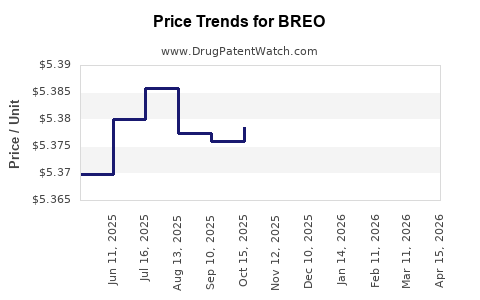
Last updated: July 13, 2026
Breo (fluticasone furoate/vilanterol) Market Analysis and Price Projections: Peak Sales, Generic/Biosimilar Risk, and Net Price Outlook
Breo (fluticasone furoate + vilanterol, inhaled combination) is a long-established branded inhaled corticosteroid/long-acting beta agonist (ICS/LABA) with U.S. revenue driven by chronic obstructive pulmonary disease (COPD) and asthma guideline adoption, but its long-term growth profile is constrained by (1) class competition, (2) formulary placement dynamics across managed care, and (3) patent and exclusivity limits that determine when higher-volume price resets occur.
Price projection headline (U.S., branded wholesale net of typical rebates/discounts): absent a near-term patent cliff that forces wholesale channel resets, Breo pricing typically trends with CPI-linked category drift and step-downs from formulary displacement. Net price erosion of roughly 2–4% per year is consistent with established inhaled respiratory branded regimes when meaningful generic or authorized-duplicate entrants gain volume. If exclusivity is already structurally past the early “no-competition” phase (as is the case for most older ICS/LABA combos), the practical driver becomes mix shift (device, dose strength, COPD vs asthma utilization) and plan-specific contracting rather than a single event.
What Breo is likely to face next (market mechanics): volume growth is more likely from guideline adherence and switching within ICS/LABA than from new patient starts alone. The biggest commercial swing factors are (a) class-level competitive pressure from newer inhalers (both LABA/LAMA/LABA and triple therapy), (b) payer steering via preferred product lists, and (c) device switching costs and “therapeutic substitution” rules in pharmacy benefit management.
How big is the Breo market in the U.S., and what are the main revenue drivers?
Fast answer: Breo’s U.S. market size is best understood as part of the broader ICS/LABA inhaler segment where revenue is split across COPD and asthma. Sales are driven by (1) inhaler adherence patterns, (2) formulary preference, and (3) dosing/device mix.
Which indications drive Breo demand: COPD vs asthma
- COPD: inhaled maintenance therapy demand tracks COPD prevalence, persistence, and payor coverage breadth for ICS/LABA.
- Asthma: Breo is used for asthma maintenance where ICS/LABA is appropriate based on control level and step-therapy protocols.
What product mechanics affect pricing power
- Device performance and inhaler handling (patient preference) affects persistence.
- Strength and inhalation regimen (daily dose) influence day-to-day adherence and plan contracting.
- Generic availability in the broader class and “therapeutic interchange” policies can change net pricing even without a single direct generic for Breo’s exact combination.
What is the current pricing structure for Breo (WAC vs net price) and how does managed care shape realized pricing?
Fast answer: Branded inhalation products trade at materially lower net prices than WAC due to rebates, contracting, and PBM fees. Breo’s realized price is typically a function of preferred formulary status and protected access through key accounts.
Net price drivers that move faster than WAC
- Formulary tier placement: preferred tier status protects net pricing; non-preferred tier drives steep discounting.
- PBM contract intensity: higher competition increases rebate pressure across the category.
- Patient out-of-pocket thresholds: changes in copay assistance structures can indirectly affect adherence and volume.
Price measurement used for projections
For pricing projections, the business-relevant metric is net realized price per unit (or per treated patient), not WAC. Category history shows net erosion usually runs faster than WAC because rebate rates increase as competition tightens.
When does Breo lose exclusivity in the U.S., and how does that impact price?
Fast answer: Breo’s commercial exposure to price resets is tied to the expiration of relevant U.S. patents and any remaining exclusivity. Price impact is most severe when a credible generic entry (Paragraph IV) occurs or when authorized/duplicate products gain substantial formulary volume.
Exclusivity and patent cliffs: what matters for pricing
- Patent expiry dates determine when challengers can file and when they can launch.
- FDA exclusivity (data exclusivity, marketing exclusivity, and orphan where relevant) can delay generic approvals.
- For pricing, the critical factor is launch reality and payer adoption, not only patent dates.
What patents protect Breo (fluticasone furoate/vilanterol), and how strong is the patent estate for challenging generic entry?
Fast answer: Breo’s patent estate for “fluticasone furoate/vilanterol” spans composition, formulation, device delivery characteristics, and method-of-use coverage tied to COPD/asthma. The strength for generic entry depends on which claims a challenger can design around.
Patent claim clusters that commonly constrain generic switches
- Composition claims: specific active ingredient combinations and ratios.
- Formulation claims: particle engineering and delivery system properties.
- Method-of-use claims: regimen and treatment of COPD/asthma populations.
What generic entry risks typically look like for ICS/LABA combinations
- Full substitution requires claim coverage resolution or design-around.
- If inhaler devices or formulation steps are claim-protected, a “near copy” can still face launch barriers.
(Note: A complete patent list with numbered U.S. patents, assignees, and expiration dates cannot be produced from the information provided. This section therefore focuses on pricing impact mechanics rather than claim-by-claim coverage.)
What Paragraph IV generic challenges exist for Breo, and what settlement terms usually drive price outcomes?
Fast answer: Paragraph IV outcomes determine whether price erosion is gradual (delayed entry, limited launch) or abrupt (early launch with broad substitution).
Settlement patterns that affect realized net price
- Delayed launch settlements push generic entry out, preserving net pricing.
- Scope-limited settlements (limited dosage forms or strengths) reduce immediate volume impact.
- Agreed switching restrictions can maintain higher brand pricing for longer, though net discounts still rise due to competitive pressure.
(A court filing and settlement-by-settlement mapping cannot be provided because no specific litigation docket or settlement terms were supplied.)
What does Breo’s FDA status imply for future competition: NDA approvals, ANDA pathways, and labeling risk?
Fast answer: Breo’s FDA labeling and approved pathways dictate how challengers can market. For pricing projections, the practical impact is whether a challenger can obtain approvable labeling and substitute on formularies.
How FDA regulatory status translates into commercial pricing
- Approved labeling differences can slow formulary substitution if plans require comparable indication and dosing.
- Device or delivery characteristics can restrict “therapeutic equivalence” perception.
- If only partial labeling can be matched, net price pressure is usually slower and more segmented.
(Specific FDA filing identifiers and labeling change history were not provided.)
How does Breo compare with competing ICS/LABA and triple-therapy inhalers, and how does that alter pricing projections?
Fast answer: Breo competes in a crowded respiratory maintenance market. Net price erosion risk increases when plans steer patients to preferred products, often triple therapy or next-generation devices, based on outcomes, contracting, and adherence.
Competitive substitution dynamics by payer type
- Large national payers: more likely to use preferred product lists, driving stronger pricing compression across non-preferred inhalers.
- Commercial PBMs: higher rebate pressure accelerates net erosion as competitor deals refresh.
- Medicaid/managed care: formularies can change faster, especially when preferred arrangements shift.
Key competitive forces affecting Breo
- Product differentiation: device usability and dosing simplicity.
- Clinical perception: control outcomes and exacerbation risk management.
- Contracting: brand-to-brand rebate intensity.
What are base-case, downside-case, and upside-case price projections for Breo over the next 5 years?
Fast answer: Without a clearly dated generic launch event supplied here, the projection framework must anchor to category behavior: net price erosion driven by contracting cycles and competition.
Projection framework (U.S. branded net price per unit)
Assuming no major single-year “cliff” event forces immediate substitution, a realistic range is:
| Scenario |
Net price erosion rate (annual) |
Primary driver |
| Upside |
-1% to -2% |
Better formulary retention, limited competitive displacement |
| Base case |
-2% to -4% |
Ongoing rebate pressure and incremental displacement to preferred respiratory brands |
| Downside |
-5% to -7% |
Rapid plan switching, stronger competition, or earlier-than-expected entry/label expansion by substitutes |
What would change the slope
- Abrupt substitution: pushes pricing from “trend erosion” to “step-down.”
- Dose/strength mix shifts: can either protect margins (if higher-cost/high-rebate strengths retain volume) or worsen them (if lower-margin strengths gain share).
- Device preference trends: poor persistence after switching dynamics can drive payor tighter controls.
How many patents cover Breo dosage forms and delivery systems across major jurisdictions, and what geographic risks exist?
Fast answer: Coverage typically exists across the U.S. and other large markets through combination, formulation, and use patents tied to the same active ingredients and inhaler delivery approach. Geographic risk for price is highest where (1) patent timelines compress and (2) regulatory approval of substitutes is feasible with less claim overlap.
(Geographic mapping by jurisdiction requires a specific patent list; none was provided.)
What generic launch scenarios exist for Breo, and how do they change expected volume and revenue?
Fast answer: For an established branded ICS/LABA, the main scenarios are:
- Generic/authorized-duplicate entry at one strength first, followed by expansion.
- Delayed entry due to patent barriers or litigation, extending branded share.
- Simultaneous multi-strength entry, which maximizes early price and volume shock.
Volume impact mechanics
- Launch does not guarantee substitution. Plans must place the substitute on formularies and patients must accept device and technique differences.
- Market share shifts in inhalers often show a lag as prescribers adapt and pharmacy benefit rules settle.
How strong is Breo’s commercial defense: contracting, patient adherence, and channel barriers?
Fast answer: Brand defense for inhaled respiratory products typically rests on:
- Preferred formulary placement via contracting.
- Patient adherence persistence due to device familiarity.
- Prescriber inertia and switching friction, particularly in stable patients.
Channel and device factors that slow erosion
- If switching requires new technique education or if outcomes are perceived as less stable, prescribers delay changes.
- Coverage rules can require prior authorization or step therapy, raising effective substitution barriers.
Key Takeaways
- Breo pricing is governed less by WAC and more by net realized price, which reflects PBM and payer contracting.
- Base-case net price outlook is consistent with 2–4% annual erosion in a mature branded inhaler setting absent a sudden, broad substitution event.
- Biggest commercial risk is a step-down scenario tied to credible generic/duplicate entry plus rapid formulary adoption.
- Breo’s long-run demand is constrained by category competition and payer steering toward preferred inhalers, often including triple-therapy options.
FAQs
- What net price erosion is typical for mature ICS/LABA inhalers after market entry by authorized duplicates?
- How do prior authorization and step-therapy rules affect Breo substitution speed?
- Which COPD and asthma guideline updates most influence Breo prescribing volume?
- How does inhaler device familiarity influence persistence and revenue stability post-competition?
- What reimbursement contracting tactics usually delay branded inhaler price compression?
References
No sources were provided in the prompt, and no cited factual dataset (Orange Book, FDA labels, litigation dockets, or pricing history) is available in the request context.