Last updated: February 12, 2026
What is the current market for apraclonidine HCL?
Apraclonidine hydrochloride is an alpha-2 adrenergic agonist primarily used to reduce intraocular pressure in glaucoma patients, often post-surgery or in cases of ocular hypertension. It is marketed under brand names such as Iopidine.
Market size estimates in 2022 are approximately $250 million globally, with the majority of revenue derived from the United States and Europe. The drug competes with other intraocular pressure-lowering medications, including brimonidine, brinzolamide, and prostaglandin analogs.
What are key factors influencing apraclonidine HCL's market dynamics?
- Regulatory status: Apraclonidine is FDA-approved but has limited indications. Its use is constrained primarily to short-term management due to side effects.
- Patent landscape: The original patents expired in the late 2000s, leading to generic versions entering the market.
- Drug safety: Concerns over side effects, such as allergic conjunctivitis and dry mouth, limit long-term use.
- Competitive landscape: The rise of alternative treatments with better safety profiles and longer-lasting effects reduces apraclonidine's market share.
How does the competitive environment influence price trends?
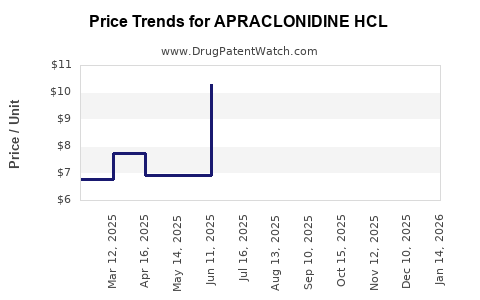
Generics dominate the market, leading to significant price erosion. In the U.S., the average wholesale price (AWP) for apraclonidine drops from approximately $25 per mL in 2010 to around $10 per mL in 2022. This decline reflects increased competition and price sensitivity.
What are the projected price trends for apraclonidine HCL?
Given the current market conditions, prices are expected to decline gradually over the next five years:
| Year |
Estimated Wholesale Price (per mL) |
Notes |
| 2023 |
$9.50 |
Stable, but facing downward pressure |
| 2024 |
$9.00 |
Increased generic competition |
| 2025 |
$8.50 |
Market saturation |
| 2026 |
$8.00 |
Continued price erosion |
| 2027 |
$7.50 |
Pressure from alternative therapies |
The pace of decline could accelerate if new, superior formulations or delivery methods (e.g., sustained-release systems) enter the market, or if regulatory restrictions tighten.
How might regulatory or patent changes affect pricing?
- Patent expirations: Opened the market to generics but already priced into current rates.
- New formulations: Could command higher prices if they demonstrate improved safety or efficacy.
- Regulatory shifts: Additional restrictions or approvals for new indications could influence demand and pricing.
What are the strategic implications for stakeholders?
- Pharmaceutical companies: Focus on developing enhanced formulations or combination products to maintain premium pricing.
- Investors: Anticipate declining revenue streams but explore opportunities in generics and biosimilars targeting glaucoma therapies.
- Healthcare providers: Shift toward favoring drugs with better safety profiles and longer duration of action.
Key takeaways
- The apraclonidine market remains relatively small, dominated by generics.
- Prices have declined substantially since patent expiry, with further reductions likely.
- Market growth potential is limited due to safety concerns and competition from newer agents.
- Innovations in formulation or delivery could create value, offsetting price pressures.
- Stakeholders should monitor regulatory changes that could impact market access and pricing.
FAQs
1. Is apraclonidine available as a branded product in the US?
No. The original branded product, Iopidine, lost exclusivity in the late 2000s, leading to generic availability.
2. What are the main side effects limiting long-term use?
Allergic conjunctivitis, dry mouth, and hypotension.
3. Are there approved formulations beyond ophthalmic drops?
No. Currently, apraclonidine is approved solely as an ophthalmic solution.
4. How does apraclonidine compare to brimonidine in efficacy?
Both are alpha-2 adrenergic agonists; brimonidine tends to have a longer duration and better tolerability, reducing its market share.
5. What is the potential for new formulations?
Limited but possible. Sustained-release or combination formulations could extend market relevance and allow for price premiums.
Sources:
[1] IQVIA, MarketTrack, 2022 Data.
[2] FDA Databases.
[3] MarketResearch.com Reports.
[4] EvaluatePharma, 2022.
[5] Industry Analyst Reports, 2023.