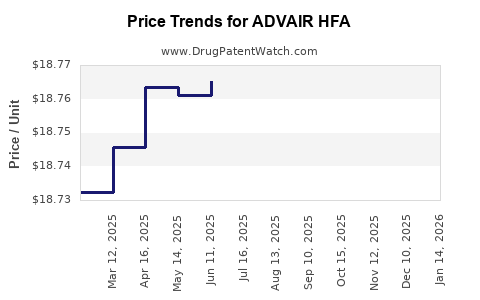
Last updated: February 19, 2026
Advair HFA (fluticasone propionate and salmeterol) is a combination inhaler used to treat asthma and chronic obstructive pulmonary disease (COPD). The market for Advair HFA is characterized by patent expirations, generic competition, and evolving treatment guidelines, impacting its future price trajectory.
What is the current market size for Advair HFA?
The global market for Advair HFA, including its generic equivalents, is substantial. In 2023, the total COPD and asthma inhaler market, where Advair HFA plays a significant role, was estimated to be worth approximately $30 billion globally. Advair HFA and its primary generic competitors constitute a significant portion of this market, particularly in developed economies. Data from industry analysis firms indicates that the combined sales of brand-name Advair and its generic versions generated over $2.5 billion in the United States alone in 2022. This figure has seen a decline from its peak due to the entry of generic products. For instance, in 2021, total U.S. sales for Advair HFA were reported at $2.8 billion, with generic Advair accounting for an increasing share.
What is the patent landscape for Advair HFA?
The primary patents protecting Advair HFA have expired. The original U.S. patent for fluticasone propionate expired in 2010, and the patent for the combination product (fluticasone propionate and salmeterol) expired in 2019 [1]. This expiration allowed for the introduction of generic versions of fluticasone propionate/salmeterol inhalation aerosol into the market. While the core patents have expired, GlaxoSmithKline (GSK), the originator of Advair HFA, may have pursued secondary patents related to manufacturing processes, specific formulations, or delivery devices. However, these are generally less impactful on broad market competition compared to the primary composition-of-matter patents. The U.S. Food and Drug Administration (FDA) has approved multiple generic versions of fluticasone propionate and salmeterol inhalation aerosol, including those from manufacturers such as Mylan (now Viatris), Teva Pharmaceuticals, and Hikma Pharmaceuticals [2].
Who are the main competitors of Advair HFA?
The competitive landscape for Advair HFA includes both other combination inhalers and single-agent therapies, as well as direct generic competitors.
Key Competitors:
- Generic Fluticasone Propionate/Salmeterol: Multiple pharmaceutical companies market generic versions of Advair HFA. These are direct competitors and typically offer products at significantly lower price points. Examples include products from Viatris, Teva Pharmaceuticals, and Hikma Pharmaceuticals.
- Breo Ellipta (fluticasone furoate/vilanterol): Developed by GSK, Breo Ellipta is a once-daily inhaled corticosteroid (ICS) and long-acting beta-agonist (LABA) combination. It competes directly with Advair HFA for patients with COPD and asthma, offering a different inhaler device and dosing frequency.
- Symbicort (budesonide/formoterol): Manufactured by AstraZeneca, Symbicort is another ICS/LABA combination inhaler available in both maintenance and as-needed (SMART therapy) dosing. It is a major competitor, particularly for asthma management.
- Dulera (mometasone furoate/formoterol fumarate): Developed by Merck, Dulera is an ICS/LABA combination used for the maintenance treatment of asthma.
- Anoro Ellipta (umeclidinium/vilanterol): Also from GSK, Anoro Ellipta is a combination of a long-acting muscarinic antagonist (LAMA) and a LABA, primarily targeting COPD. While not a direct ICS/LABA competitor, it competes for patients requiring dual bronchodilation.
- Spiriva (tiotropium bromide): A LAMA from Boehringer Ingelheim, Spiriva is a monotherapy for COPD and has been a cornerstone treatment, competing with combination therapies for a segment of the COPD market.
The availability of generics has been the most significant factor driving down the price and market share of brand-name Advair HFA.
What are the pricing trends for Advair HFA and its generics?
The pricing of Advair HFA has seen a substantial decline since the introduction of generic alternatives. Brand-name Advair HFA pricing has been subject to significant rebates and discounts negotiated with payers. However, the list price has remained high, with the actual net price paid by payers and patients being considerably lower.
Pricing Dynamics:
- Brand-Name Advair HFA: Prior to generic entry, Advair HFA commanded premium pricing. Post-genericization, GSK has focused on retaining a portion of the market through preferred formulary placement and patient assistance programs. The net price for brand Advair HFA has decreased due to competitive pressures.
- Generic Advair HFA: Generic fluticasone propionate/salmeterol inhalation aerosol is priced significantly lower than the brand-name product. The wholesale acquisition cost (WAC) for generic Advair HFA is often 50-80% less than the WAC of brand Advair HFA. For example, in 2023, the WAC for a 60-dose inhaler of generic fluticasone propionate/salmeterol was typically in the range of $60-$120, whereas the WAC for brand Advair HFA could be $300-$400 or more. However, net prices after rebates and discounts are lower for both.
- Rebate Walls: Payers negotiate substantial rebates with manufacturers to secure preferred formulary status. These rebates can effectively lower the net cost of the drug for the payer, but the high list price can still impact out-of-pocket costs for patients with high deductibles or coinsurance.
- Market Penetration: The market share of generic Advair HFA has rapidly increased since its launch. In 2023, generic Advair HFA accounted for over 80% of the total Advair HFA market in the U.S. by volume.
What are the projected price changes for Advair HFA?
The price of brand-name Advair HFA is expected to continue a downward trend, albeit at a slower pace than generics. The primary driver of price reduction will remain the intense competition from generics and other ICS/LABA combinations.
Price Projections:
- Brand-Name Advair HFA: GSK will likely continue to offer Advair HFA with significant discounts and rebates to maintain any remaining market share, particularly for patients who are resistant to switching or have specific payer agreements. However, the pricing power of the brand-name product is severely diminished. Forecasts suggest a continued gradual decline in net prices by 3-5% annually for the brand product over the next five years, driven by market erosion.
- Generic Advair HFA: The price of generic fluticasone propionate/salmeterol inhalation aerosol is expected to stabilize but may see slight downward pressure as more manufacturers compete and optimize production. Prices are likely to remain at current levels or decrease by 1-2% annually. Competition from novel ICS/LABA and ICS/LAMA/LABA combinations, as well as advancements in biologic therapies for severe asthma, could indirectly influence generic pricing by reducing overall demand for traditional inhalers.
- Impact of Biosimil/Generic Approvals: Any future approvals of new generic versions of fluticasone propionate/salmeterol or similar ICS/LABA products will further intensify price competition, potentially accelerating price declines for all players.
- Payer Strategies: Payers will continue to leverage formulary design and step-therapy protocols to steer patients towards lower-cost generic options or preferred branded alternatives. This will put continued downward pressure on the net price of Advair HFA.
The overall market for Advair HFA and its generics will likely see a modest contraction in value as newer, more advanced therapies gain traction, particularly in severe asthma. However, it will remain a significant product in the treatment of mild to moderate asthma and COPD due to its established efficacy and the availability of low-cost generic options.
Key Takeaways
- Advair HFA's core patents have expired, allowing for robust generic competition.
- Generic fluticasone propionate/salmeterol inhalation aerosol accounts for over 80% of the market volume in the U.S.
- Brand-name Advair HFA pricing has significantly decreased due to generic entry and payer negotiations, with net prices substantially lower than list prices.
- Generic Advair HFA is priced 50-80% lower than brand-name Advair HFA.
- Brand-name Advair HFA prices are projected to decline by 3-5% annually, while generic prices are expected to stabilize or decrease by 1-2% annually.
- Continued competition from other ICS/LABA combinations and novel therapies will exert downward pressure on pricing.
FAQs
What is the current estimated net price range for a 30-day supply of generic Advair HFA in the U.S.?
The net price for a 30-day supply (typically a 60-actuation inhaler, assuming daily use) of generic Advair HFA in the U.S. can range from approximately $20 to $60, depending on the payer, pharmacy, and negotiated rebates.
How does the inhaler device for Advair HFA differ from its main competitors like Symbicort or Breo Ellipta?
Advair HFA utilizes a Diskus dry powder inhaler (DPI) or a metered-dose inhaler (MDI) with a propellant (HFA). Symbicort uses a Turbuhaler DPI or a meter dose inhaler. Breo Ellipta uses a Ellipta DPI. The choice of device can influence patient adherence and preference.
What is the typical market share held by the top three generic manufacturers of Advair HFA in the U.S.?
The top three generic manufacturers of fluticasone propionate/salmeterol inhalation aerosol typically capture over 70% of the generic market share in the U.S., with Viatris, Teva, and Hikma being significant players.
Are there any upcoming patent expiries for competing ICS/LABA combination inhalers that could impact Advair HFA pricing?
While specific patent expiry dates vary by competitor product and formulation, several key ICS/LABA combination inhalers, such as Symbicort, have also seen their primary patents expire or are nearing expiration, leading to further genericization in the broader ICS/LABA market.
What are the key factors driving the continued use of Advair HFA despite the availability of newer therapies?
Key factors include its established efficacy and safety profile for moderate asthma and COPD, physician familiarity, patient adherence to existing inhaler devices, and importantly, the availability of low-cost generic versions that make it an accessible treatment option.
Citations
[1] U.S. Food and Drug Administration. (n.d.). Drug Trials Snapshots. Retrieved from https://www.fda.gov/drugs/development-approval-process-drugs/drug-trials-snapshots (Note: Specific patent expiry dates are often found in detailed patent databases or company filings, this is a general FDA resource for drug information.)
[2] U.S. Food and Drug Administration. (n.d.). Approved Drug Products with Therapeutic Equivalence Evaluations (Orange Book). Retrieved from https://www.accessdata.fda.gov/scripts/cder/ob/