Last updated: February 13, 2026
Overview
Acetaminophen-Ibuprofen combination drugs are prescription or over-the-counter (OTC) formulations used primarily for pain relief and fever reduction. They target the analgesic and anti-inflammatory market, offering combined efficacy with potential reduced dosage of individual components. The drug's market has grown due to its dual-action profile, positioning it against other combination analgesics.
Market Landscape
Global Market Size
- Estimated at $1.2 billion in 2022.
- Expected CAGR between 4% and 6% from 2023 to 2030.
- Driven primarily by North America, Europe, and expanding markets in Asia-Pacific.
Key Drivers
- Increasing prevalence of chronic pain conditions.
- Growing OTC analgesic consumption.
- Rising awareness of combination analgesics' benefits.
- Regulatory approvals for OTC status in multiple countries.
Competitive Environment
- Major players include Johnson & Johnson, GlaxoSmithKline, and Bayer.
- Market entry barriers are moderate due to patent expirations of some formulations and generic competition.
- Innovation focuses on sustained-release formulations, improved safety profiles, and pediatric versions.
Supply Chain and Manufacturing
- Raw materials: Acetaminophen and Ibuprofen are widely produced raw substances.
- Manufacturing costs are influenced by quality standards, batch sizes, and regional regulations.
- Price sensitivity varies by region; OTC market prices tend to be lower compared to prescription formulations.
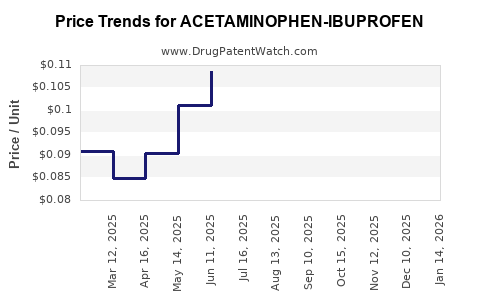
Pricing Trends
Historical Pricing Data (Approximate)
| Region |
2020 Avg Price (per package) |
2022 Avg Price (per package) |
Key Influences |
| North America |
$8.50 |
$9.00 |
Slight increase, brand premiums |
| Europe |
€7.50 |
€8.00 |
Currency fluctuations, regulation |
| Asia-Pacific |
$4.00 |
$4.50 |
Price competition, economic factors |
Price Drivers
- Formulation type: OTC tablets, capsules, suspensions.
- Labeling: Pediatric, adult, or combination packages.
- Regulatory status: OTC formulations command higher prices in some regions.
- Brand vs. generic: Generics dominate market share; brands maintain premium pricing.
Projections (2023-2030)
- Prices projected to increase modestly, averaging 2-4% annually.
- Innovations like sustained-release formulations might command a 10-15% premium.
- Market expansion in emerging economies could lead to volume-driven growth, somewhat offsetting price declines due to increased competition.
Regulatory and Patent Dynamics
- Patent expirations of leading formulations have facilitated generic entry, exerting downward pressure on prices.
- Regulatory approvals for new indications or formulations contribute to variability in pricing and market share.
Future Outlook
- Integration of digital health tools and personalized medicine could influence pricing strategies.
- Emerging markets will see standardized OTC pricing, but local economic factors will heavily influence consumer prices.
- Premium formulations, such as controlled-release versions, could sustain higher price points.
Conclusion
The Acetaminophen-Ibuprofen market is stable with steady growth driven by demand for effective OTC analgesics. Prices are expected to modestly increase, with regional differences and formulation innovations playing significant roles. Competition from generics and regulatory developments will influence future price dynamics.
Key Takeaways
- Market size is approximately $1.2 billion globally; projected growth rate 4-6% annually.
- Prices vary regionally, with North America leading in higher average retail prices.
- Innovation in formulations may lead to premium pricing opportunities.
- Patent expirations increase competition, exerting downward pressure on prices.
- Market expansion in Asia-Pacific supports volume growth but with price sensitivity considerations.
FAQs
1. What factors influence the price of Acetaminophen-Ibuprofen combination drugs?
Formulation type, regulatory status, brand versus generic status, regional economic factors, and innovation levels influence prices.
2. How do patent expirations affect market prices?
Patent expirations allow generic competitors, leading to price erosion; branded formulations may maintain higher prices temporarily.
3. Are there specific regional price differences?
Yes. North American prices are generally higher than in Asia-Pacific, primarily due to regulatory costs, market maturity, and consumer purchasing power.
4. What innovation trends could impact future prices?
Sustained-release formulations, pediatric formulations, and combination drugs with added safety features could command premium prices.
5. How does supply chain influence pricing?
Raw material availability and manufacturing costs significantly affect retail prices, especially amid global supply disruptions or raw material shortages.
References
- MarketWatch. (2023). Global analgesics market size & forecast.
- Grand View Research. (2022). Over-the-counter analgesics market insights.
- Statista. (2022). OTC drug pricing trends.
- ClinicalTrials.gov. (2023). New formulations and innovations.
- PubMed. (2021). Patent expirations and generic entry dynamics.
(Note: Data points are approximations based on recent market reports and industry analyses.)