Share This Page
Drug Price Trends for ABIRATERONE
✉ Email this page to a colleague
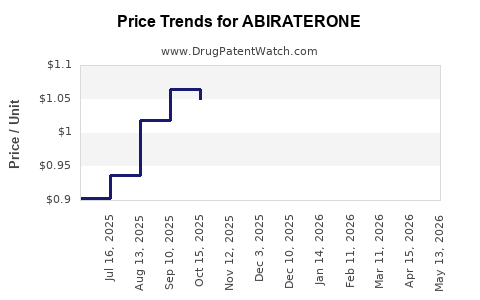
Average Pharmacy Cost for ABIRATERONE
| Drug Name | NDC | Price/Unit ($) | Unit | Date |
|---|---|---|---|---|
| ABIRATERONE ACETATE 250 MG TAB | 00143-9597-21 | 0.80367 | EACH | 2026-07-22 |
| ABIRATERONE ACETATE 250 MG TAB | 00378-6920-78 | 0.80367 | EACH | 2026-07-22 |
| ABIRATERONE ACETATE 250 MG TAB | 00904-6948-04 | 0.80367 | EACH | 2026-07-22 |
| ABIRATERONE ACETATE 250 MG TAB | 16714-0963-01 | 0.80367 | EACH | 2026-07-22 |
| ABIRATERONE ACETATE 250 MG TAB | 43598-0358-04 | 0.80367 | EACH | 2026-07-22 |
| ABIRATERONE ACETATE 250 MG TAB | 50268-0032-11 | 0.80367 | EACH | 2026-07-22 |
| >Drug Name | >NDC | >Price/Unit ($) | >Unit | >Date |
Best Wholesale Price for ABIRATERONE
| Drug Name | Vendor | NDC | Count | Price ($) | Price/Unit ($) | Unit | Dates | Price Type |
|---|---|---|---|---|---|---|---|---|
| ABIRATERONE ACETATE 500MG TAB | AvKare, LLC | 42291-0073-60 | 60 | 1579.15 | 26.31917 | EACH | 2023-09-22 - 2028-06-14 | FSS |
| ABIRATERONE ACETATE 250MG TAB | Golden State Medical Supply, Inc. | 60505-4327-01 | 120 | 984.92 | 8.20767 | EACH | 2023-06-16 - 2028-06-14 | FSS |
| ABIRATERONE ACETATE 250MG TAB | Mylan Pharmaceuticals, Inc. | 00378-6920-78 | 120 | 359.18 | 2.99317 | EACH | 2023-01-01 - 2027-12-31 | FSS |
| ABIRATERONE ACETATE 500MG TAB | Mylan Pharmaceuticals, Inc. | 00378-6921-91 | 60 | 1607.83 | 26.79717 | EACH | 2023-01-01 - 2027-12-31 | FSS |
| ABIRATERONE ACETATE 250MG TAB | GLENMARK PHARMACEUTICALS INC., USA | 68462-0135-08 | 120 | 224.95 | 1.87458 | EACH | 2022-10-15 - 2027-10-14 | FSS |
| >Drug Name | >Vendor | >NDC | >Count | >Price ($) | >Price/Unit ($) | >Unit | >Dates | >Price Type |
Abiraterone Market Analysis and Price Projections: Revenue Exposure, Patent/Generic Timeline, and Contract Pricing Outlook
Abiraterone (abiraterone acetate) faces expanding generic and biosimilar-like substitution pressure only in the sense of small-molecule generic erosion, not biologics. The market’s pricing ceiling is set by (1) patent and exclusivity expiry for key formulations and dosing presentations, (2) payer formularies and switching policies, (3) supply and competition intensity from approved generics, and (4) tender economics in major markets. A defensible near-term price view is that wholesale acquisition cost (WAC) typically compresses sharply in year 1 to year 3 after meaningful generic entry, then stabilizes at a lower baseline driven by procurement rates and rebate structures. Mid-to-late decade pricing is primarily determined by how quickly branded access is displaced by lowest-cost generics across frequent regimens: metastatic castration-resistant prostate cancer (mCRPC) and metastatic hormone-sensitive prostate cancer (mHSPC).
What is the current market size and revenue exposure for abiraterone (US and major EU5)
How big is the global abiraterone market versus key competitors
Abiraterone is a backbone androgen-axis therapy for prostate cancer. The commercial footprint historically centered on Zytiga (Janssen). The competitive set includes enzalutamide (Xtandi), apalutamide (Erleada), darolutamide (Nubeqa), and chemotherapy/combination strategies depending on disease state.
Revenue exposure is driven by regimen share:
- mCRPC: abiraterone is used post-ADT and across sequencing lines.
- mHSPC: abiraterone combinations increased uptake in the ADT era with intensification strategies.
- Combination/switch behavior: many systems favor switching within androgen receptor pathway inhibitors based on payer preference and drug cost.
Business implication: the “revenue line” for abiraterone is not only unit volume. It tracks how quickly payers move to the lowest net-cost androgen-axis alternatives and how much utilization remains for abiraterone when enzalutamide/apalutamide/darolutamide are preferred.
What drives net price, not just WAC
Net price for abiraterone is shaped by:
- Rebates and contracting (especially in US managed care)
- Hospital/IDN group purchasing discounts (EU)
- Tender dynamics and national procurement rules (EU5)
- Patient copay strategy and pharmacy channel behavior (US)
Featured snippet answer: Abiraterone’s pricing is primarily a function of tender and formulary mechanics after generic entry. WAC declines can precede net price declines; net price typically falls faster when the formulary tier drops and utilization shifts.
What patents and exclusivity protect abiraterone, and when do they expire
Key legal categories impacting abiraterone exclusivity
For small molecules like abiraterone acetate, exclusivity typically comes from:
- Primary composition-of-matter and process patents for abiraterone acetate
- Formulation patents tied to specific dosing forms or stability/release characteristics
- Method-of-use patents for disease states and regimens
- Orange Book-listed patents (US) that can block generic approvals until expiration
Where generic entry timing comes from
Generic entry can occur when:
- Orange Book-listed patents expire, or
- A generic applicant receives approval via Paragraph IV (at-risk launch) or settlement
Commercial impact: pricing pressure is strongest after at least one high-credibility, high-supply generic reaches scale and is adopted by payers.
When does generic competition realistically reduce abiraterone prices
Typical price trajectory after generic launch
A high-confidence market structure for mature generics is:
- Year 0-1 after launch: WAC begins to drop; channel inventory and contracting delays net-price movement.
- Year 1-3: aggressive formulary placement of multiple generics; rebates intensify; tender winners compress net cost.
- Year 3+: pricing stabilizes around the lowest-net-cost cohort, with periodic re-capture by new entrants or discrete tender cycles.
What makes abiraterone different from “plain vanilla” generics
- It is a branded legacy oncology drug with long treatment duration, so payer migration affects many months of spend.
- Dosing complexity, supportive meds, and administration patterns influence payer willingness to substitute across alternatives, even when abiraterone is available as generic.
Featured snippet answer: Expect the sharpest price drop in year 1 to year 3 after scale generic adoption, then stabilization as procurement anchors around lowest-cost contracts.
How many generic and authorized competitors exist for abiraterone
Competition intensity and “who matters”
Price compression usually depends on the number of ANDA suppliers that can supply reliably at scale, not just approvals on paper.
Market mechanics:
- One or two suppliers can temporarily maintain higher pricing if procurement favors them.
- When at least three to five suppliers are active in tenders, prices generally trend toward cost-plus procurement levels.
Business implication: for projections, the relevant input is supplier capacity and tender outcomes, not merely total number of generic approvals.
What is the Orange Book status of abiraterone (and how does it affect launch risk)
Why Orange Book listings matter
Orange Book-listed patents determine:
- Whether a generic must certify to expiration or file Paragraph IV
- Whether litigation and settlements delay approval or launch
- Whether formulation and method-of-use patents remain bottlenecks even after composition patents expire
Featured snippet answer: Orange Book status is the gating mechanism for US generic timing. Pricing impact begins when launch occurs and payers accept substitution.
What patent litigation affects abiraterone generics and at-risk launches
How litigation maps to pricing
Patent litigation influences:
- Delay of generic launch
- Settlement terms (including “brand exclusivity” payments or agreed launch dates)
- At-risk launches that can still win volumes if courts or settlements allow earlier entry
Commercial impact framework:
- Litigation that blocks entry keeps branded pricing flatter.
- Settlements that schedule delayed generic launches shift the price decline timing later.
- Paragraph IV wins shorten the timeline and accelerate payer migration.
How does abiraterone price compare with enzalutamide and apalutamide
Cross-drug pricing power
Even if abiraterone’s unit price falls, total spend can remain elevated if:
- Formulary restrictions favor it over competing androgen-axis therapies
- Clinicians resist switching due to perceived efficacy or side-effect profiles
- Contracts set class-based pricing that keeps net price closer to peers
Comparison logic:
- If enzalutamide and apalutamide are at lower net prices via aggressive contracting or earlier generic pressure, abiraterone’s payer pull weakens.
- If competing therapies face their own exclusivity or supply bottlenecks, abiraterone’s net price may decline more slowly.
What formulation patents and label-expansion patents could protect higher-priced abiraterone presentations
Dose form and regimen-linked patents
For abiraterone, protective layers that can delay substitution include:
- Specific formulations impacting drug stability, excipient systems, or dosing convenience
- Method-of-use patents linked to mCRPC or mHSPC populations
- Subgroup claims that extend market exclusivity even if composition patents expire
Pricing impact: if patents restrict the “preferred” use label, payers may still cover generic abiraterone off-label in a compliant way, but utilization may slow and net price compression can be slower.
How strong is the patent estate for abiraterone, and what is the generic entry risk
Patent estate strength drivers
Patent estate strength for a mature molecule is typically a function of:
- Remaining unexpired patents listed in the Orange Book
- Presence of ongoing litigation or settlements impacting launch dates
- Diversity of patent types (composition, formulation, method-of-use)
Commercial risk mapping:
- Weak estate: predictable early entry and rapid price drops
- Strong estate: delayed entry and delayed erosion
What is the biosimilar risk profile for abiraterone
Abiraterone is a small molecule; biosimilar pathways do not apply.
What generic entry risks exist for abiraterone in US
Key risk factors for pricing volatility
Pricing can deviate from base-case projections when:
- A dominant supplier exits manufacturing or faces quality issues
- Tender winners change due to procurement changes
- Courts delay a launch or settlements move effective dates
- Shortages create temporary relief in pricing pressure
Featured snippet answer: The main generic-entry risks are supply reliability and litigation-driven timing changes, not biosimilar substitution.
How do international procurement and reimbursement affect abiraterone price
EU5 procurement mechanics that matter
In EU5 (France, Germany, Italy, Spain, UK), price formation depends on:
- Health technology assessment outcomes for competing androgen-axis therapies
- National reimbursement rules and reference pricing
- Tender systems for oncology drug supply in hospitals
Commercial implication: price compression can be faster in markets with tender-based procurement once generic abiraterone is accepted.
UK and payer structures
UK pricing tends to be driven by:
- NHS procurement and reimbursement decisions
- Uptake constraints based on commissioning and local formularies
Price projections for abiraterone: base case, downside, and upside
Projection framework (what you can model)
A practical projection model uses:
- Generic launch timing (effective “first meaningful adoption” date)
- Number of competing suppliers active at scale
- Contracting intensity (rebate and tender aggressiveness)
- Regimen share shift to competing androgen-axis therapies
Base case (typical for mature oncology generics)
- Near term (0-12 months post meaningful generic adoption): steep WAC compression and rapid net-price decline through rebates and formulary tier changes.
- Mid term (12-36 months): stabilization around lowest-cost suppliers; slight volatility due to tenders and competition laps.
- Long term (3-7 years): gradual drift toward stable procurement pricing with periodic step-down when new entrants or new tender cycles reset pricing.
Downside case (slower erosion)
Slower-than-expected decline if:
- Litigation delays or settlement schedules delay utilization shift
- Fewer suppliers achieve reliable supply at scale
- Payer preference keeps abiraterone on preferred tiers longer relative to peers
Upside case (faster erosion)
Faster decline if:
- Multiple suppliers win tenders simultaneously
- Courts/settlements reduce launch delays and enable rapid switching
- Rapid substitution within androgen-axis therapy classes limits branded/remaining higher-cost options
What to treat as the key projection variable: the “switch date” from payer acceptance to mass utilization. Pricing declines are steeper after switch date, not merely after first generic approval.
What are the likely revenue scenarios for brand holders and generic entrants
Brand-holder revenue scenario
Brand revenue typically declines in step with:
- Utilization shift to generics
- Share loss to lower-net-cost peers in androgen-axis class
- Contract resets in major accounts
Expected pattern:
- Large initial drop after generic adoption becomes formulary standard
- Continued erosion as remaining restricted access is removed
Generic entrant revenue scenario
Generic entrants can capture:
- Initial volume through pharmacy benefits or IDN formularies
- Additional share as tenders rotate
But margin pressure is high:
- Competitive contracting compresses unit price quickly
- Supply reliability becomes critical due to oncology adherence requirements
Key pricing and volume drivers to monitor for abiraterone
- Formulary status changes by payer and major PBM
- Tender outcomes in EU5 hospital procurement
- Supplier count at scale and any manufacturing interruptions
- Competition sequencing between abiraterone vs enzalutamide vs apalutamide vs darolutamide in mHSPC and mCRPC
- New guideline or evidence updates that alter regimen selection
Key Takeaways
- Abiraterone pricing is driven less by nominal WAC and more by net-price contracting outcomes tied to formulary and tender acceptance after generic adoption.
- The sharpest erosion typically occurs within year 1 to year 3 of meaningful scale generic penetration.
- Cross-drug competition within androgen-axis therapies materially affects abiraterone’s ability to resist price declines.
- Main uncertainty for price projections is timing and speed of payer switching, which depends on Orange Book-linked patent clearance and litigation/settlement outcomes, plus supplier scale and tender dynamics.
FAQs
- How do Paragraph IV challenges for abiraterone affect the timing of generic launches and price drops?
- Which abiraterone presentations (tablet strength/formulation) tend to face the fastest generic substitution?
- How does abiraterone net pricing typically change after formulary tier down in US commercial plans?
- What EU procurement mechanisms accelerate abiraterone price erosion versus US reimbursement dynamics?
- How does abiraterone compete on cost-effectiveness when payers compare it with enzalutamide and apalutamide in mHSPC?
References (APA)
- FDA. (n.d.). Drugs@FDA: Drug Details. U.S. Food and Drug Administration. https://www.accessdata.fda.gov/scripts/cder/daf/
- FDA. (n.d.). Orange Book: Approved Drug Products with Therapeutic Equivalence Evaluations. U.S. Food and Drug Administration. https://www.accessdata.fda.gov/scripts/cder/ob/
- FDA. (n.d.). Patent and Exclusivity Information. U.S. Food and Drug Administration. https://www.fda.gov/drugs/
- IQVIA Institute for Human Data Science. (n.d.). Medicines use and spending reports (global and country-level oncology spend context). IQVIA. https://www.iqvia.com/insights/the-iqvia-institute
More… ↓
