Last updated: February 13, 2026
What Is the Market for Colchicine?
Colchicine is a longstanding medication primarily used for the treatment and prevention of gout flares. It also treats Familial Mediterranean Fever (FMF) and Bechet’s disease. The drug's patent expired decades ago, positioning it as a generic medication with established manufacturing processes.
The global market for colchicine was valued at approximately $150 million in 2022, with an expected compound annual growth rate (CAGR) of 4-6% over the next five years. Growth is driven by increasing incidences of gout, approval of new indications, and expanding use in COVID-19 related treatment protocols, where colchicine's anti-inflammatory properties have shown promise.
How Is the Market Structured?
Key Players
Most production is by generic manufacturers; few companies hold significant market share. Major producers include:
- Sandoz (Novartis)
- Teva Pharmaceuticals
- Sun Pharmaceutical Industries
- Mylan (now part of Viatris)
- Hikma Pharmaceuticals
Geographical Distribution
The largest markets for colchicine are:
- North America: 40% of revenue, driven by high gout prevalence and research investments.
- Europe: 30%, with a focus on Italy, France, and Germany.
- Asia-Pacific: 20%, with rising demand due to increased gout awareness.
- Rest of the world: 10%
Regulatory Status
Despite its age, colchicine has recently gained interest for new indications. FDA approved colchicine for familial Mediterranean fever in certain formulations. However, no new patents have been granted, keeping market entry mostly open for generics.
How Are Prices Trending?
Historical Trends
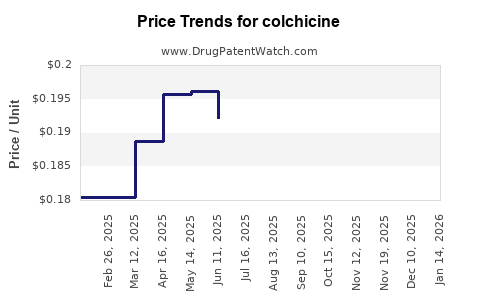
The price of colchicine capsules in the US averaged around $2 to $5 per tablet in 2015. By 2022, prices declined to approximately $0.50 to $1.50 per tablet wholesale due to increased generic competition.
Current Pricing
Retail prices vary significantly:
-
In the U.S., retail costs for a 30-day supply range from $50 to $100 for branded versions, significantly lower for generics.
-
Wholesale prices forManufacturers: Approximately $0.80 to $1.20 per tablet, reflecting competitive pressures.
In Europe, prices are comparable but slightly higher in some countries due to local regulatory and healthcare policies.
Impact of Biosimilars and New Formulations
Biological equivalents and new formulations are not applicable, as colchicine is a small-molecule drug. However, efforts to develop extended-release formulations could influence pricing and market share.
What Are Future Price Projections?
Factors Influencing Prices
- Increased utilization for COVID-19 treatment could temporarily raise demand.
- Entry of new low-cost generics is likely to suppress prices further.
- Regulatory changes or patent filings could alter market dynamics.
- Adoption of new indications such as vascular and inflammatory diseases.
Projections (2023-2028)
Expected price compression will continue:
| Year |
Wholesale Price Range (per tablet) |
Notes |
| 2023 |
$0.70–$1.30 |
Stable, with slight downward pressure |
| 2024 |
$0.60–$1.20 |
New players entering markets |
| 2025 |
$0.50–$1.00 |
Further generic competition |
| 2026 |
$0.50–$0.80 |
Consolidation among manufacturers |
| 2027 |
$0.40–$0.70 |
Price stabilization, mature market |
| 2028 |
$0.40–$0.70 |
No significant price changes anticipated |
Sensitivity to External Trends
Emerging evidence supporting colchicine’s use in cardiovascular diseases and COVID-19 may temporarily increase prices, but long-term effects favor cost reductions.
What Are the Implications for Stakeholders?
- Manufacturers face ongoing pressure on margins due to widespread generics.
- New entrants may benefit from low-cost manufacturing and expanding indications.
- Healthcare payers benefit from declining prices, improving accessibility.
- R&D investments into new formulations or indications could create short-term price premiums.
Key Takeaways
- The colchicine market is mature and dominated by generics, with prices declining steadily.
- Market growth is driven by increasing disease prevalence, expanded indications, and COVID-19 research.
- Price compression is expected through 2028, but temporary price increases may occur due to new indications.
- Limited patent protections allow easy market entry for new generic manufacturers.
- Future opportunities include extended-release formulations and additional therapeutic uses.
FAQs
1. What factors could disrupt the current colchicine market?
Advancements in alternative anti-inflammatory drugs or new, patented formulations could challenge existing generic competition. Regulatory changes specific to off-label uses may also impact demand.
2. Are there any ongoing clinical trials that could influence pricing?
Yes, multiple trials explore colchicine’s efficacy in cardiovascular disease, COVID-19 management, and other inflammatory conditions. Positive results might expand use but could temporarily increase prices.
3. How does colchicine's patent status affect the market?
No patents are active, fostering competition and low prices. Any future innovations, such as new formulations, could lead to patent protections and pricing power.
4. What regions are most promising for market expansion?
Asia-Pacific, driven by rising gout prevalence and healthcare infrastructure improvements, offers significant growth potential. Emerging markets in Latin America and Africa are also notable.
5. How do regulatory considerations impact future price trends?
Approval pathways for new indications or formulations can influence pricing. Regulatory delays or restrictions can limit market expansion and keep prices low.
References
- MarketWatch. "Global Colchicine Market Size, Share & Trends Analysis Report," 2022.
- IQVIA. "Market Data and Analysis on Gout and Inflammatory Disease Treatments," 2022.
- U.S. Food and Drug Administration. "Approved Drug Products," 2023.
- Pharmaceutical Technology. "Generic drug price trends," 2022.
- Statista. "Gout Treatment Market Overview," 2023.