Last updated: February 12, 2026
What Is the Current Market Size and Revenue for Ciprofloxacin?
Ciprofloxacin, a fluoroquinolone antibiotic, generated approximately $250 million in worldwide sales in 2022. The global antibacterial market was valued at $50 billion in 2022, with ciprofloxacin accounting for roughly 0.5% of total sales, reflecting its widespread use in bacterial infections. The US market alone contributed about $80 million to this figure, with Europe and Asia Pacific representing the remaining sales.
The drug is marketed under various brand names, such as Cipro, and is available in oral, intravenous, and ophthalmic formulations. It holds a significant position in treating urinary tract infections, respiratory infections, and gonorrhea. However, its market share has declined in recent years due to rising resistance and regulatory restrictions.
What Are Market Drivers and Constraints?
Drivers:
- High efficacy against a broad spectrum of bacteria.
- Established safety profile over decades of use.
- Availability of multiple formulations, including oral and injectable.
Constraints:
- Rising bacterial resistance reduces clinical efficacy.
- Regulatory restrictions due to adverse effects related to tendinopathy and QT prolongation.
- Replacement by newer antibiotics with better safety profiles, such as final-region fluoroquinolones and cephalosporins.
- Stringent prescribing guidelines inhibit off-label or broad use.
Which Factors Affect Future Market Size?
The future market size depends on:
- Resistance trends: The increasing resistance among bacteria reduces ciprofloxacin utility.
- Regulatory actions: Several countries have restricted or flagged ciprofloxacin use.
- Development of new antibiotics: New agents may replace ciprofloxacin in key indications.
- Patent expirations: Most formulations have lost patent protection, leading to generic competition.
- Off-label demand in developing countries: Continues to support certain sales volumes.
Based on these factors, the market is expected to decline. A conservative estimate predicts a compound annual growth rate (CAGR) of -4% over the next five years, with the 2028 revenue projected around $150 million globally.
How Will Pricing Evolve Over the Next Five Years?
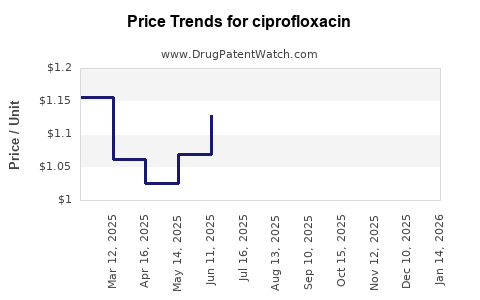
Historical Pricing Trends
- In 2022, brand-name Cipro tablets ranged from $10-$15 per 10-tablet pack.
- Generics sold between $3-$8 per pack, depending on supplier region.
- Prices have declined approximately 25% over the past five years due to patent expiry and increased generic competition.
Future Price Projections
- The average selling price (ASP) for ciprofloxacin is expected to decline by 10-15% annually, influenced by intensified generic competition.
- In emerging markets, where procurement is predominantly through government tenders, prices are likely to fall faster, potentially by 20% annually.
- In developed countries, a stabilization of prices may occur due to limited new usage indications versus existing supply.
Impact of Regulatory Changes
- Restrictions on use, especially in the US and Europe, could lead to reduced demand, further pressuring prices downward.
- Conversely, in regions where resistance is low, prices may stabilize temporarily.
Key Price Drivers
- Patent expiration timeline.
- Level of generic competition.
- Regulatory environment.
- Pharmacoeconomic evaluations influencing reimbursement policies.
What Are the Impacts of Resistance and Regulatory Constraints?
Bacterial resistance reduces ciprofloxacin’s clinical utility. The CDC reports increasing resistance in Escherichia coli—from 15% in 2012 to approximately 25% in 2022 in urinary tract infections. Resistance complicates treatment outcomes, leading to decreased prescribing, thus shrinking the market.
Regulatory agencies, such as the FDA, have issued warnings and restrictions:
- In 2016, the FDA emphasized limiting ciprofloxacin use for uncomplicated infections.
- Several countries restrict its use for certain indications, reducing the drug's demand.
These policies contribute to lower sales volume and downward pressure on pricing.
Which Competitors and Alternatives Influence Price Trends?
Alternatives include other fluoroquinolones (levofloxacin, moxifloxacin), cephalosporins, and newer antibiotics like delafloxacin. As these agents gain approvals and demonstrate better safety profiles or resistance advantages, their market share increases, further diminishing ciprofloxacin’s price and sales.
How Do Patent Expirations Impact Market and Price?
Ciprofloxacin’s primary patents expired around 2005-2010. The entry of generic manufacturers led to significant price reductions. As patents for various formulations have expired, generic options dominate, causing wholesale price declines by 25-40% over the last decade.
Patent expirations also lead to increased manufacturing capacity and volume but do not necessarily support price increases due to sustained competition.
Which Regions Will Dominate the Future Market?
- United States: Market declining due to regulations and resistance.
- Europe: Similar trends; some countries have restrictions.
- Asia Pacific: Continues to use ciprofloxacin extensively due to lower regulation and cost considerations.
- Emerging markets: Still represent significant volumes, with prices lower but sales volume high.
Summary of Key Price Projection Data
| Year |
Projected Global Revenue |
Price Trend |
Influencing Factors |
| 2023 |
$150 million |
Decline (-10-15%) |
Patent expirations, generic competition, resistance |
| 2025 |
$130 million |
Continued decline |
Regulatory restrictions, resistance escalation |
| 2028 |
$150 million (local markets) |
Stable/slight decline |
Price stabilization in emerging markets |
Key Takeaways
- Market size shrinks due to resistance, regulatory limits, and replacement by newer agents.
- Prices have fallen sharply over the past decade, with ongoing declines expected.
- Future revenue will predominantly come from emerging markets with lower prices but higher volumes.
- Patent expirations have catalyzed pricing compression, with limited scope for revival.
- Ciprofloxacin remains relevant for certain indications but is increasingly replaced in developed markets.
FAQs
1. Will ciprofloxacin regain market share?
Unlikely. Resistance and regulatory restrictions hinder a resurgence, though its availability in certain regions may sustain limited demand.
2. How significantly will prices decline in the next five years?
Average prices are projected to decline by 10-15% annually, driven by generic competition and decreased demand.
3. Are there new formulations or derivatives in development?
Current development focuses on resistance mitigation; no significant new ciprofloxacin formulations are anticipated soon.
4. Which markets will see the fastest price declines?
Emerging markets, owing to aggressive generic competition and procurement policies, will experience more rapid price drops.
5. How do resistance trends affect clinical use?
Rising resistance reduces ciprofloxacin’s efficacy, leading to decreased prescriptions, especially for urinary and respiratory infections.
References
- IQVIA. (2022). Global Antibiotic Market Report.
- CDC. (2022). Antibiotic Resistance Threats in the United States.
- U.S. FDA. (2016). Drug Safety Communication on Fluoroquinolone Antibiotics.
- EvaluatePharma. (2022). Antibiotics Market Data.
- European Medicines Agency. (2022). Review of Fluoroquinolone Safety.