Share This Page
Drug Price Trends for ZIPRASIDONE
✉ Email this page to a colleague
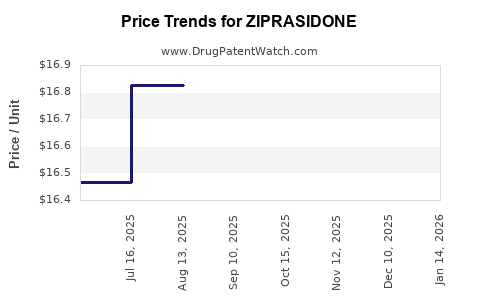
Average Pharmacy Cost for ZIPRASIDONE
| Drug Name | NDC | Price/Unit ($) | Unit | Date |
|---|---|---|---|---|
| ZIPRASIDONE 20 MG/ML VIAL | 43598-0061-58 | 21.80740 | EACH | 2026-07-22 |
| ZIPRASIDONE 20 MG/ML VIAL | 43598-0848-58 | 21.80740 | EACH | 2026-07-22 |
| ZIPRASIDONE 20 MG/ML VIAL | 72205-0205-07 | 21.80740 | EACH | 2026-07-22 |
| ZIPRASIDONE 20 MG/ML VIAL | 72266-0160-10 | 21.80740 | EACH | 2026-07-22 |
| >Drug Name | >NDC | >Price/Unit ($) | >Unit | >Date |
Market Overview and Price Projections for ZIPRASIDONE
Current Market Size and Sales Data
ZIPRASIDONE (brand name Geodon) is an atypical antipsychotic used to treat schizophrenia and bipolar disorder. As of 2022, the drug generated approximately $300 million in global sales, with the United States accounting for roughly 85% of revenues, driven by its FDA approval in 2001 and preferred use in patients intolerant to other antipsychotics.
The global antipsychotic market reached $12 billion in 2022, growing at an annual rate of approximately 3.5%. ZIPRASIDONE holds a niche position, representing roughly 2.5% of this segment, with market penetration limited by competition, patent exclusivity, and formulary preferences.
Competitive Landscape
ZIPRASIDONE faces competition from:
- Risperidone (Risperdal)
- Aripiprazole (Abilify)
- Olanzapine (Zyprexa)
- Quetiapine (Seroquel)
These drugs account for over 70% of the atypical antipsychotics market. ZIPRASIDONE's patent expiry in 2016 allowed for generic entry, reducing prices and market share. Despite generics, brand retention persists due to physician familiarity and perceived efficacy.
Patent and Regulatory Status
The original patent for ZIPRASIDINE expired in 2016. Several generic manufacturers now produce the drug at significantly lower prices, which impacts branded sales and influences market dynamics.
The drug has no recent patent filings. Current regulatory registrations are stable, with no pending new formulations or indications that could extend its market exclusivity.
Price Trends and Projections
Historical Pricing Data
- Brand-name ZIPRASIDONE (Geodon): The average wholesale price (AWP) in the U.S. was approximately $150 per 30 tablets (20 mg each) in 2015.
- Generic ZIPRASIDONE: Prices declined by nearly 70% post-2016, averaging around $45 per 30 tablets in 2022.
Short-term Price Forecast (Next 2 Years)
- Generics: Prices are expected to stabilize at approximately $40-$50 per 30 tablets, supported by manufacturing efficiencies and existing demand.
- Brand-name: No new formulations or indications signify limited prospects for brand price increases. Any attempts to maintain higher prices face competition and payer pressure.
Long-term Projections (3-5 Years)
- Low-cost generics will dominate, maintaining prices around $40 per 30 tablets.
- The introduction of formulation innovations or new applications remains unlikely given current market trends and patent status.
- The overall price levels for ZIPRASIDONE, especially in generic form, are unlikely to see significant increases absent regulatory or patent developments.
Revenue and Market Share Projections
Assuming stable demand driven by schizophrenia and bipolar disorder treatments and a constant market share of roughly 2.5-3%, revenues are projected to remain in the $250–$350 million annual range over the next five years, primarily shaped by generic pricing stability and rising drug utilization.
Market Drivers and Constraints
Drivers:
- Increasing prevalence of schizophrenia (approximately 1% globally) and bipolar disorder.
- Payer trends favoring cost-effective generics.
- Brand loyalty among prescribers.
Constraints:
- Patent expiry limiting pricing power.
- Competition from newer antipsychotics with novel mechanisms.
- Payer and pharmacy benefit manager (PBM) formulary decisions favoring cost savings.
Key Takeaways
- ZIPRASIDONE's market has stabilized post-patent expiration; sales are primarily generics with prices around $40–$50 per 30 tablets.
- Total revenues are forecasted to hover around $250–$350 million annually over the next five years.
- Competition from established generics limits potential for price increases.
- New formulations or additional indications are unlikely without patent protection or regulatory approval.
FAQs
1. Will ZIPRASIDONE regain market share with new formulations?
No significant pipeline developments are expected that could extend exclusivity or introduce new formulations, limiting potential market share growth.
2. How will pricing evolve for generic ZIPRASIDONE?
Prices will likely remain stable at around $40–$50 per 30 tablets unless manufacturing costs or market dynamics change significantly.
3. What factors could influence ZIPRASIDONE's market in the next five years?
Introduction of biosimilars, regulatory changes, new treatment guidelines, or the development of compelling alternative therapies could impact market share and sales.
4. Are there any unmet needs that ZIPRASIDONE addresses?
Limited unmet needs are identified; its primary role is similar to other atypical antipsychotics, with usage driven by clinician preference and tolerability.
5. What is the potential impact of biosimilars or generics from new entrants?
Additional generics may further lower prices, consolidating market share among cost-advantaged manufacturers but unlikely to influence overall sales volumes substantially.
References
- IQVIA, "Prescription Drug Market Data," 2022.
- U.S. Food and Drug Administration, Drug Approvals and Patent Data, 2022.
- MarketWatch, "Global Antipsychotic Market," Published December 2022.
- Manufacturer disclosures, quarterly earnings reports, 2015–2022.
More… ↓
