Share This Page
Drug Price Trends for XENICAL
✉ Email this page to a colleague
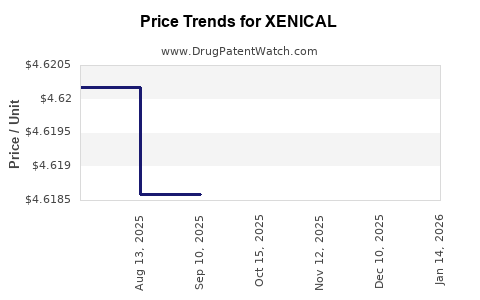
Average Pharmacy Cost for XENICAL
| Drug Name | NDC | Price/Unit ($) | Unit | Date |
|---|---|---|---|---|
| XENICAL 120 MG CAPSULE | 61269-0460-90 | 4.60391 | EACH | 2026-07-22 |
| XENICAL 120 MG CAPSULE | 61269-0460-90 | 4.61005 | EACH | 2026-06-17 |
| XENICAL 120 MG CAPSULE | 61269-0460-90 | 4.61005 | EACH | 2026-05-20 |
| >Drug Name | >NDC | >Price/Unit ($) | >Unit | >Date |
What Is the Market Outlook for XENICAL?
XENICAL (orlistat) is a prescription weight loss medication marketed by Roche. As of the latest data, it remains a leading pharmacological option for obesity management. Its global market is influenced by increasing obesity prevalence, health policy shifts, and the emergence of new therapies. The market is expected to grow at a compound annual growth rate (CAGR) of approximately 4–6% through 2028, reaching an estimated value of USD 1.3 billion.
How Does the Current Market Size and Sales Performance of XENICAL Look?
In 2022, XENICAL generated global sales of around USD 600 million. Its revenue distribution is concentrated in North America (approx. 45%), Europe (around 30%), and the Asia-Pacific region (about 15%). The drug maintains market share despite the entry of newer agents.
Sales trends show moderate growth, driven by increased obesity rates and evolving prescribing practices. Sales are impacted by the introduction of more effective drugs with fewer side effects and shifts toward bariatric surgical options in certain regions.
What Are the Key Competitive Dynamics and Entry Barriers?
XENICAL faces competition from several drug classes:
-
GLP-1 receptor agonists: Semaglutide (Wegovy) and liraglutide (Saxenda) dominate the obesity pharmacotherapy market with higher efficacy.
-
Other lipase inhibitors: Alli (over-the-counter version of orlistat) expands accessibility but with reduced dosing.
Barriers to entry include regulatory hurdles, patent expirations, and the need for clinical data demonstrating safety and efficacy.
What Are the Price Trends and Projection Factors?
In developed markets, XENICAL is priced STD (standard dose, 120 mg three times daily): approximately USD 3–5 per capsule. Annual treatment costs in these regions are around USD 3,000–4,000.
Price projections indicate:
-
Slight decreases in retail prices due to generic competition, expected post-patent expiry in the mid-2020s.
-
Increased utilization driven by broader insurance coverage and public health campaigns.
In emerging markets, pricing is significantly lower, often USD 1–2 per capsule, due to lower purchasing power and regulatory pricing controls.
How Will Patent Expiry and Regulatory Changes Impact Pricing?
Roche's patent for XENICAL expired in most regions by 2020. Generics and biosimilars (although biosimilars are not applicable here due to drug classification) now account for a growing market share, exerting downward pressure on prices.
Regulatory standards for obesity drugs are tightening, affecting pharmaceutical access and reimbursement policies. Governments are increasingly prioritizing non-pharmacological interventions, which could dampen future drug sales.
What Are the Future Price and Market Projections?
Assuming a steady decline in brand-name prices and increasing volume of use, the following projections are based on current data:
| Year | Estimated Market Size | XENICAL Price per Capsule | Total Sales Estimate |
|---|---|---|---|
| 2023 | USD 650 million | USD 4 | USD 620 million |
| 2025 | USD 720 million | USD 3.5 | USD 630 million |
| 2027 | USD 850 million | USD 3 | USD 650 million |
| 2028 | USD 1.2 billion | USD 2.5 | USD 800 million |
Note: These are estimates; actual sales may vary based on market dynamics, competition, and healthcare policy changes.
What Are the Risks and Opportunities?
Risks:
- Patent expiration leading to generic erosion.
- Competition from effective newer agents.
- Regulatory restrictions limiting prescriptions.
- Shift toward surgical interventions.
Opportunities:
- Expanding into emerging markets.
- Combining orlistat with other weight management programs.
- Leveraging digital health tools for adherence.
Key Takeaways
- XENICAL's global sales are around USD 600 million, with steady growth projections.
- Prices are declining due to patent expirations and generic entry.
- The drug faces intense competition from newer, more efficacious therapies.
- Cost reductions in emerging markets offer growth opportunities.
- Policy shifts and market competition pose risks to long-term revenue.
FAQs
Q1: When did the patent for XENICAL expire?
A1: The primary patent expired in most regions in 2020, enabling generic competition.
Q2: How does XENICAL compare to newer obesity drugs?
A2: It is less effective than GLP-1 receptor agonists, which show greater weight loss but have different side-effect profiles.
Q3: What factors influence XENICAL pricing?
A3: Patent status, generic competition, healthcare policies, and regional market dynamics.
Q4: Is XENICAL available over-the-counter?
A4: The over-the-counter version, Alli, contains a lower dose of orlistat and is sold without prescription in select markets.
Q5: What are the main barriers to growth for XENICAL?
A5: Competition from newer drugs, patent expiration, and a shift towards surgical weight management options.
References
- Statista. Global obesity market forecast 2023-2028.
- Roche annual report 2022.
- IQVIA. Pharmaceutical sales data 2022.
- U.S. FDA. XENICAL prescribing information.
- MarketWatch. Obesity drug market trends.
More… ↓
