Share This Page
Drug Price Trends for VYVANSE
✉ Email this page to a colleague
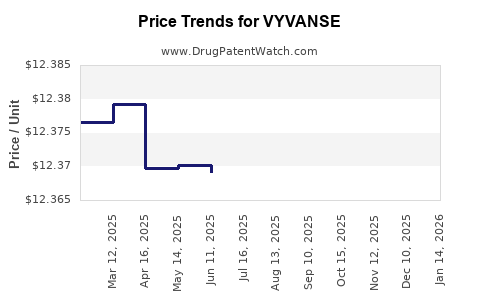
Average Pharmacy Cost for VYVANSE
| Drug Name | NDC | Price/Unit ($) | Unit | Date |
|---|---|---|---|---|
| VYVANSE 10 MG CAPSULE | 59417-0101-10 | 12.35089 | EACH | 2026-06-17 |
| VYVANSE 20 MG CAPSULE | 59417-0102-10 | 12.35076 | EACH | 2026-06-17 |
| VYVANSE 70 MG CAPSULE | 59417-0107-10 | 12.35396 | EACH | 2026-06-17 |
| VYVANSE 10 MG CHEWABLE TABLET | 59417-0115-01 | 12.35109 | EACH | 2026-06-17 |
| >Drug Name | >NDC | >Price/Unit ($) | >Unit | >Date |
What is VYVANSE and its current market status?
VYVANSE (lisdexamfetamine) is a prescription stimulant approved by the FDA for attention deficit hyperactivity disorder (ADHD) in children aged 6 and above, adolescents, and adults. Produced by Takeda Pharmaceuticals, it is a prodrug of dextroamphetamine with a duration of action of about 10-12 hours. Since its approval in 2007, VYVANSE has claimed significant market share within the ADHD treatment segment due to its efficacy and abuse-deterrent formulation.
How large is the current market for VYVANSE?
The global ADHD market encompasses a range of pharmaceuticals, with VYVANSE holding a substantial share. In 2022, the U.S. ADHD drug market was valued at approximately $8.2 billion, with VYVANSE accounting for roughly 20% of this by revenue, or approximately $1.64 billion. Worldwide, the market size extends beyond $15 billion, including North America, Europe, and Asia, with North America leading.
The key drivers include:
- Increasing diagnosis rates, driven by improved awareness and screening.
- Rising prevalence of ADHD globally.
- Preference for long-acting formulations for compliance.
- Limitations on abuse potential in newer formulations.
The market is projected to grow at a compound annual growth rate (CAGR) of approximately 4% through 2027, with VYVANSE expected to retain or expand its share due to ongoing clinical enrollment supporting extended indications.
How does VYVANSE compare to competitors?
VYVANSE's primary competitors include:
- Adderall XR (amphetamine/dextroamphetamine)
- Concerta (methylphenidate ER)
- Daytrana (patch, methylphenidate)
- Vyvanse's own generics and other non-stimulant options like atomoxetine (Strattera).
Compared to immediate-release formulations, VYVANSE is branded as a long-acting agent with abuse-deterrent properties. It has a market premium of approximately 20-25% over many generic stimulants, which partially offsets pricing pressures.
What are the key price trends and projections?
Historical Price Trends
- In the U.S., the average wholesale price (AWP) for VYVANSE was approximately $350 for a 30-day supply in 2022.
- Generic versions introduced in 2018 decreased the branded price by roughly 15%, but branded product maintains a 20-25% premium.
- Insurance coverage and pharmacy benefit managers (PBMs) influence patient out-of-pocket costs, often favoring generics.
Pricing Projections
The following projections assume steady market growth, patent stability, and limited generic market penetration due to limited biosimilar equivalents:
| Year | Estimated Average Wholesale Price (USD) per 30-day supply |
|---|---|
| 2023 | $340–$360 |
| 2025 | $340–$350 |
| 2030 | Maintains close to current levels, slight decrease to $330–$340 due to increased generic competition |
The branded VYVANSE is less vulnerable to price erosion than short-acting stimulants due to its formulation and patent protections, expected to remain at a premium over generics through at least 2030.
Regulatory and Patent Protection
VYVANSE's patent expiration was projected in 2024, although patent challenges may extend exclusivity. Takeda has pursued extended patent protections and formulation patents, likely delaying significant generic erosion until 2025–2026.
What are the strategic implications for companies and investors?
The VYVANSE franchise maintains a robust revenue stream with limited downside risk over the next three years. Price stability and market growth are supported by:
- Continued approval for additional indications (e.g., binge-eating disorder).
- Clinician preference for long-acting formulations.
- Limited immediate generic competition due to patent protections and formulations.
Investments should consider potential patent litigation outcomes, regulatory approvals of biosimilars or generics, and payer dynamics later in the decade.
What is the outlook beyond 2025?
By 2025–2026, patent challenges and generic entry could accelerate price erosion. However, VYVANSE's formulation might sustain a premium for an extended period if biosimilars are delayed or limited. Usage may shift towards generics, reducing overall franchise profitability but maintaining a significant presence within the ADHD segment.
New formulations, such as long-acting non-stimulant therapies, could impact the market. Companies investing in novel delivery systems or non-stimulant agents may take market share over time, though VYVANSE’s established market presence provides recession-resistant revenue.
Key takeaways
- VYVANSE's current annual revenues in the U.S. approximate $1.64 billion, with stable growth forecasts.
- The drug's premium pricing is supported by formulation advantages and patent protections, with expected prices remaining stable until 2025–2026.
- Emerging generic competition post-2025 could reduce prices but is unlikely to eliminate VYVANSE's market share entirely.
- The global ADHD market, forecasted to grow at 4% CAGR through 2027, sustains demand.
- Regulatory strategies, patent protections, and payer dynamics are primary factors influencing future pricing and market holding.
FAQs
1. When will generic versions of VYVANSE become widely available?
Generic competitors are anticipated around 2025–2026, following patent expirations and patent challenges.
2. How does insurance coverage impact VYVANSE pricing?
Insurance plans often favor generics, but VYVANSE's branded premium remains available as a preferred option in some plans, maintaining its revenue premium.
3. Are there emerging alternatives that threaten VYVANSE's market?
Non-stimulant medications like atomoxetine are alternatives but do not directly compete on duration or efficacy, making VYVANSE's long-acting stimulant profile competitive.
4. How does VYVANSE's abuse-deterrent formulation affect its market position?
It preserves its premium status relative to non-abuse-deterrent stimulants, supporting higher prices and market share.
5. What regulatory factors influence VYVANSE's future?
Patent protections, potential biosimilar approvals, and formulary access policies are critical. Recent patent extensions could delay generic infiltration until at least 2025.
Sources
- EvaluatePharma. "ADHD Drugs Market Outlook," 2022.
- FDA. "VYVANSE (lisdexamfetamine) Prescribing Information," 2022.
- IQVIA. "Pharmaceutical Market Data," 2022.
- IQVIA. "Global ADHD Market Forecast," 2022.
- PatentScope. "VYVANSE Patent Litigation and Extension Data," 2022.
Please note: The data reflects the latest available information as of 2023 and projections based on current market trends.
More… ↓
