Last updated: February 15, 2026
What Is the Market Size for Triamterene-Hydrochlorothiazide?
Triamterene-Hydrochlorothiazide (TRI-HCTZ) combines a potassium-sparing diuretic (triamterene) and a thiazide diuretic (hydrochlorothiazide). It is sold primarily for hypertension and edema management. The global prescription diuretics market was valued at approximately $4.5 billion in 2022, with a compounded annual growth rate (CAGR) of around 4% projected until 2030. TRI-HCTZ accounts for roughly 8-10% of this market segment, translating to a current valuation of approximately $360 million to $450 million.
Major markets include the U.S., EU, and Japan. The U.S. represents the largest share, accounting for about 65-70% of the global prescription volume for diuretics, driven by high hypertension prevalence (estimated at 45% of adults [1]) and established prescribing patterns.
Who Are the Key Competitors?
Several formulations of TRI-HCTZ are available globally, including generic and branded products. In the U.S., products like Maxzide and Dyazide dominate, alongside generic equivalents. Other competing drugs in hypertension therapy include chlorthalidone, indapamide, and amiloride-based combinations.
Patent expirations for key branded formulations occurred between 2010 and 2015, leading to increased generic competition. The generic market holds approximately 85-90% of prescriptions for TRI-HCTZ, resulting in low average prices.
What Are the Current Pricing and Cost Trends?
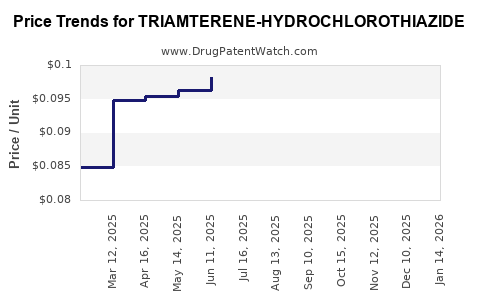
Generic TRI-HCTZ is priced considerably lower than branded counterparts. In the U.S., a month's supply (30 tablets of 37.5/25 mg) costs between $4 and $12, depending on pharmacy and formulation. Branded products can cost upwards of $20-$25 per month.
Pricing in European markets is similar, with variations based on healthcare systems and reimbursement policies. The patent landscape indicates limited patent protections remaining, with expiration dates predominantly between 2014 and 2018, thus suppressing prices through generic entry.
How Do Regulatory and Patent Status Impact Market Potential?
The majority of formulations are off patent, leading to widespread generic availability. No significant new patents or exclusivity rights are active for leading formulations post-2018. This situation constrains price increases and encourages commoditization.
Regulatory agencies like the FDA and EMA have approved multiple bioequivalent generics, intensifying competitive pressure. Despite this, certain markets, such as Japan, have not seen robust generic penetration, offering growth opportunities through market expansion.
What Are Projected Price Trends?
Given current patent expiry and high genericization, prices are unlikely to rise. Penetration of biosimilars or innovative fixed-dose combinations (FDCs) could marginally influence prices, but scope remains limited.
Projected trends from 2023 to 2030:
- United States: Per-month retail prices stagnate around $4-$12 for generics.
- Europe: Similar stability, with minor fluctuations based on rebates and healthcare policies.
- Other Regions: Prices are more variable, often lower due to less regulation and reimbursement constraints.
Any significant price increase would depend on new formulations, patents, or clinical guidelines favoring TRI-HCTZ over competitors. Currently, the outlook favors price stability with slight downward pressure.
What Are Future Market Drivers and Risks?
Key drivers include:
- Increasing hypertension prevalence in developing regions.
- Aging populations requiring long-term treatment.
- Expansion through expanding prescription coverage and healthcare access.
Risks involve:
- Market saturation with generics.
- Entry of fixed-dose combination competitors with improved safety profiles.
- Regulatory changes favoring cost containment.
Summary of Data and Projections:
| Parameter |
2022 Data |
2030 Projection |
| Total diuretics market (USD) |
$4.5 billion |
$6.2 billion (estimated) |
| TRI-HCTZ market share |
8-10% |
Stable at 8-10% |
| Average generic price (month) |
$4-$12 |
Stable or decreasing slightly |
| Patent expiration window |
2014-2018 |
Off patent, high generics volume |
Key Takeaways
- The global market for TRI-HCTZ is mature with strong generic competition.
- Prices are stable or declining, driven by patent expirations and generic penetration.
- Growth opportunities lie mainly outside the U.S., especially in emerging markets.
- New formulations or formulations with improved safety may influence future pricing.
- Market consolidation is unlikely due to high generic penetration and price competition.
FAQs
Q1: Will the price of TRI-HCTZ increase over the next decade?
No. Widespread generic availability and patent expirations constrain price increases.
Q2: Are there any patent protections left for TRI-HCTZ formulations?
Most patents expired between 2014 and 2018, with little scope for exclusivity extension.
Q3: What factors could influence future prices?
Development of new fixed-dose combinations, regulatory advantages, or clinical guidelines favoring TRI-HCTZ could impact prices.
Q4: How competitive is the global market?
Extremely competitive, with high generic penetration and low-cost competition in most regions.
Q5: What is the outlook for growth in the developing regions?
Moderate growth expected due to rising hypertension prevalence and expanding healthcare systems.
References
- Centers for Disease Control and Prevention (CDC). Hypertension Prevalence Statistics. 2022.
- MarketLine. Global Diuretics Market Report. 2022.
- IQVIA. Prescriptions and Market Data. 2022.
- European Medicines Agency. Approved Generics Database. 2022.