Share This Page
Drug Price Trends for TAMSULOSIN HCL
✉ Email this page to a colleague
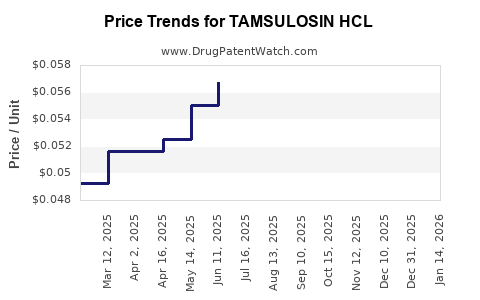
Average Pharmacy Cost for TAMSULOSIN HCL
| Drug Name | NDC | Price/Unit ($) | Unit | Date |
|---|---|---|---|---|
| TAMSULOSIN HCL 0.4 MG CAPSULE | 33342-0159-11 | 0.05135 | EACH | 2026-03-18 |
| TAMSULOSIN HCL 0.4 MG CAPSULE | 57237-0014-01 | 0.05135 | EACH | 2026-03-18 |
| TAMSULOSIN HCL 0.4 MG CAPSULE | 82009-0025-10 | 0.05135 | EACH | 2026-03-18 |
| TAMSULOSIN HCL 0.4 MG CAPSULE | 50268-0740-15 | 0.05135 | EACH | 2026-03-18 |
| TAMSULOSIN HCL 0.4 MG CAPSULE | 00904-7383-61 | 0.05135 | EACH | 2026-03-18 |
| TAMSULOSIN HCL 0.4 MG CAPSULE | 33342-0159-15 | 0.05135 | EACH | 2026-03-18 |
| TAMSULOSIN HCL 0.4 MG CAPSULE | 50268-0740-11 | 0.05135 | EACH | 2026-03-18 |
| >Drug Name | >NDC | >Price/Unit ($) | >Unit | >Date |
Best Wholesale Price for TAMSULOSIN HCL
| Drug Name | Vendor | NDC | Count | Price ($) | Price/Unit ($) | Unit | Dates | Price Type |
|---|---|---|---|---|---|---|---|---|
| TAMSULOSIN HCL 0.4MG CAP | Golden State Medical Supply, Inc. | 00228-2996-50 | 500 | 245.01 | 0.49002 | EACH | 2023-06-15 - 2028-06-14 | FSS |
| TAMSULOSIN HCL 0.4MG CAP | Golden State Medical Supply, Inc. | 00228-2996-11 | 100 | 47.50 | 0.47500 | EACH | 2023-06-15 - 2028-06-14 | FSS |
| FLOMAX 0.4MG CAP | Sanofi Aventis U.S. LLC | 00024-5837-01 | 100 | 626.70 | 6.26700 | EACH | 2023-06-01 - 2028-05-31 | Big4 |
| FLOMAX 0.4MG CAP | Sanofi Aventis U.S. LLC | 00024-5837-01 | 100 | 763.65 | 7.63650 | EACH | 2023-06-01 - 2028-05-31 | FSS |
| FLOMAX 0.4MG CAP | Sanofi Aventis U.S. LLC | 00024-5837-01 | 100 | 977.53 | 9.77530 | EACH | 2023-11-10 - 2028-05-31 | FSS |
| FLOMAX 0.4MG CAP | Sanofi Aventis U.S. LLC | 00024-5837-01 | 100 | 648.62 | 6.48620 | EACH | 2024-01-01 - 2028-05-31 | Big4 |
| >Drug Name | >Vendor | >NDC | >Count | >Price ($) | >Price/Unit ($) | >Unit | >Dates | >Price Type |
Tamsulosin HCl Market Analysis and Price Projections
Tamsulosin HCl, a selective alpha-1 blocker, is primarily used to treat benign prostatic hyperplasia (BPH). The global market for tamsulosin HCl is experiencing sustained demand driven by an aging global population and increasing BPH prevalence. Generic competition has intensified, leading to price erosion in developed markets. Emerging markets present growth opportunities due to rising healthcare expenditure and unmet needs. Price projections indicate a stabilizing trend in mature markets with potential for slight increases in regions with growing demand and fewer generic entrants.
What is the Current Global Market Size and Growth Trajectory for Tamsulosin HCl?
The global tamsulosin HCl market is substantial, driven by its established efficacy in treating BPH. The market size was estimated to be approximately $2.1 billion in 2023, with a projected compound annual growth rate (CAGR) of 3.5% from 2024 to 2030 [1]. This growth is primarily fueled by the increasing incidence of BPH, particularly in men over 50 years of age. The World Health Organization (WHO) projects a significant increase in the global population aged 65 and over, from 10% in 2020 to 22% by 2050, directly impacting the demand for BPH treatments [2].
Key Market Drivers:
- Aging Population: The primary driver is the demographic shift towards an older population globally, leading to a higher prevalence of age-related conditions like BPH.
- Increasing BPH Incidence: Studies indicate a rise in BPH diagnoses, influenced by lifestyle factors, genetic predispositions, and improved diagnostic capabilities [3].
- Generic Availability: The patent expiry of tamsulosin HCl in major markets has led to the availability of numerous generic formulations. This has increased accessibility and affordability, contributing to market volume growth despite price declines.
- Emerging Market Penetration: Growing healthcare infrastructure, increased disposable income, and greater awareness of BPH treatment options in emerging economies are opening new avenues for market expansion.
Market Segmentation:
The tamsulosin HCl market can be segmented by:
- Formulation: Immediate-release and extended-release capsules. Extended-release formulations, such as tamsulosin HCl extended-release capsules, are dominant due to improved patient compliance and reduced side effects [4].
- Distribution Channel: Hospital pharmacies, retail pharmacies, and online pharmacies. Retail pharmacies represent the largest segment due to widespread consumer access.
How Has Generic Competition Impacted Tamsulosin HCl Pricing and Market Dynamics?
The patent expiry of the originator drug, Flomax (tamsulosin HCl), by Boehringer Ingelheim and Astellas Pharma, has fundamentally reshaped the market. This has led to intense generic competition, significantly impacting pricing and market dynamics, particularly in North America and Europe.
Price Erosion:
In the United States and European Union, the average selling price (ASP) of tamsulosin HCl has decreased by an estimated 60-75% since the peak of branded product sales [5]. This erosion is a direct consequence of the market entry of multiple generic manufacturers, leading to price wars and increased supply. For example, by 2012, within a year of the primary patent expiry in the U.S., over a dozen generic versions were available, drastically reducing the market share and revenue of the branded product [6].
Market Share Dynamics:
Generic tamsulosin HCl formulations now hold over 90% of the market share in developed economies. The market is characterized by a fragmented landscape of generic manufacturers, including large pharmaceutical companies and smaller specialized generic producers. Key players in the generic tamsulosin HCl market include Teva Pharmaceutical Industries, Sandoz (a division of Novartis), Mylan (now Viatris), and numerous others [7].
Impact on R&D and Manufacturing:
The shift to a generics-dominated market has reduced the profitability of individual tamsulosin HCl products for manufacturers. This has incentivized a focus on cost-effective manufacturing, supply chain optimization, and market penetration strategies rather than novel drug development for this specific indication. Companies often compete on manufacturing efficiency and volume to maintain profitability.
What Are the Key Geographic Markets for Tamsulosin HCl, and What Are Their Future Outlooks?
The geographic distribution of tamsulosin HCl demand is concentrated in developed markets but shows significant growth potential in emerging economies.
North America (United States and Canada):
This region is the largest market for tamsulosin HCl. The high prevalence of BPH, an aging population, and widespread insurance coverage for prescription drugs contribute to this dominance. However, due to extensive generic penetration, price growth is minimal. The market is mature, with competition primarily based on price and supply chain reliability.
- Outlook: Stable demand with continued price sensitivity. Incremental growth is expected, driven by an aging demographic.
Europe:
Similar to North America, Europe is a mature market with high generic penetration. The National Health Service (NHS) in the UK and other national healthcare systems in countries like Germany, France, and Italy heavily influence pricing through procurement policies and formulary restrictions.
- Outlook: Steady demand with ongoing price pressure. Growth is linked to population aging and healthcare policy shifts.
Asia Pacific (China, India, Japan, South Korea):
This region represents the fastest-growing market for tamsulosin HCl.
-
China: A significant contributor due to its vast population and increasing rates of BPH. Rising incomes and improved healthcare access are driving demand for branded and generic treatments.
-
India: A major manufacturing hub for generic pharmaceuticals, including tamsulosin HCl. The domestic market is expanding rapidly due to increased awareness and affordability.
-
Japan: A mature market with an aging population, similar to North America and Europe, but with a slightly slower adoption of generics compared to some other regions.
-
Outlook: High growth potential driven by increasing BPH incidence, expanding healthcare access, and growing generic manufacturing capabilities. Price competition is increasing but remains less severe than in North America or Europe.
Latin America (Brazil, Mexico, Argentina):
This region shows promising growth. Increasing healthcare expenditure, improving diagnostic rates, and a growing middle class are contributing factors.
- Outlook: Moderate to high growth potential. Market development is influenced by regulatory frameworks and the ability of generic manufacturers to establish a strong presence.
Middle East and Africa:
While currently a smaller market, this region is expected to exhibit significant growth as healthcare infrastructure develops and awareness of BPH treatment increases.
- Outlook: High long-term growth potential, contingent on economic development and healthcare system expansion.
What Are the Predicted Price Trends for Tamsulosin HCl in the Next Five Years?
The price trends for tamsulosin HCl over the next five years (2024-2028) will be shaped by a combination of mature market dynamics and emerging market opportunities.
Developed Markets (North America, Europe, Japan):
In these established markets, tamsulosin HCl prices are expected to remain largely stable, with minor fluctuations.
- Average Wholesale Price (AWP) for generic tamsulosin HCl (0.4 mg capsules): Expected to range from $0.15 to $0.35 per capsule. This range reflects variations in manufacturer pricing, volume discounts negotiated by pharmacy benefit managers (PBMs) and wholesalers, and the competitive landscape within specific countries.
- Factors Influencing Stability: Intense generic competition has already driven prices to near-production costs. Significant further price declines are unlikely unless there are major shifts in manufacturing input costs or large-scale consolidation among generic suppliers.
- Potential for Slight Increases: In some instances, a slight upward price drift might occur due to supply chain disruptions, increased raw material costs, or the withdrawal of smaller, less competitive generic players from the market. However, these increases are likely to be marginal, capped by the availability of multiple alternative generic suppliers.
Emerging Markets (Asia Pacific, Latin America, Middle East & Africa):
These markets are anticipated to experience a downward price trajectory as generic penetration increases, but from a higher initial baseline compared to developed markets.
- Average Wholesale Price (AWP) for generic tamsulosin HCl (0.4 mg capsules): Expected to decrease from an average of $0.50-$1.00 per capsule in 2024 to $0.25-$0.70 per capsule by 2028.
- Drivers of Price Decline: The entry of established global generic manufacturers and local players into these markets will introduce competition. Pricing strategies will likely involve competitive entry pricing followed by gradual reductions as market share is gained.
- Factors for Price Variation: Local regulatory environments, import duties, distribution costs, and the strength of local generic manufacturers will lead to significant price variations across different emerging markets. For instance, prices in China and India might reach lower levels faster than in some African nations due to higher production volumes and competitive pressures.
Specialty Formulations and New Entrants:
While the bulk of the market is dominated by standard generic capsules, any novel formulations or combination therapies involving tamsulosin HCl could command premium pricing. However, for the standard tamsulosin HCl market, such developments are unlikely to significantly alter overall price trends.
Overall Price Projection Summary:
| Region | 2024 Average Price Range (per 0.4mg capsule) | 2028 Average Price Range (per 0.4mg capsule) | Projected Trend |
|---|---|---|---|
| Developed Markets | $0.18 - $0.40 | $0.15 - $0.35 | Stable to Slight Decrease |
| Emerging Markets | $0.55 - $1.10 | $0.25 - $0.70 | Significant Decrease |
Prices are indicative and represent estimated Average Wholesale Prices (AWP) for generic tamsulosin HCl 0.4 mg capsules, before rebates and discounts.
What are the Key Patent Expirations and Regulatory Milestones Affecting Tamsulosin HCl?
The patent landscape for tamsulosin HCl has largely evolved, with primary patents expiring years ago. However, secondary patents and formulation-specific patents can still influence market exclusivity for certain manufacturers or specific product types.
Key Patent Expirations:
- U.S. Compound Patent: Expired in October 2009 [8].
- European Union (EU) Compound Patent: Expired in September 2007 [8].
- Exclusivity Periods: The loss of market exclusivity for the branded product (Flomax) in major markets paved the way for generic entry, starting in the late 2000s and early 2010s.
Ongoing Patent Activity:
While the core compound patents have expired, manufacturers may still hold patents related to:
- Specific Polymorphs: Different crystalline forms of tamsulosin HCl, which could offer manufacturing advantages or subtle differences in bioavailability.
- Formulations: Extended-release mechanisms, pellet technologies, or specific excipient combinations that improve drug delivery and patient compliance.
- Manufacturing Processes: Novel or improved methods for synthesizing tamsulosin HCl that offer cost efficiencies or higher purity.
Regulatory Considerations:
- ANDA (Abbreviated New Drug Application) Filings: Generic manufacturers seeking to market tamsulosin HCl in the U.S. must submit an ANDA to the U.S. Food and Drug Administration (FDA). Successful approval signifies that the generic product is bioequivalent to the reference listed drug.
- Bioequivalence Studies: Crucial for generic approval, demonstrating that the generic formulation delivers the same amount of active ingredient into the bloodstream over the same period as the branded product.
- Good Manufacturing Practices (GMP): All manufacturing facilities must adhere to strict GMP guidelines set by regulatory bodies like the FDA and the European Medicines Agency (EMA) to ensure product quality, safety, and efficacy.
- Marketing Authorizations: Generic products require marketing authorizations from national regulatory agencies in each target country.
The absence of primary patents means that new market entrants are primarily constrained by the time and cost associated with obtaining regulatory approvals and establishing manufacturing capabilities, rather than patent challenges.
Key Takeaways
The tamsulosin HCl market is a mature segment characterized by strong generic competition and a stable, albeit declining, price trajectory in developed regions. The primary growth engine is the aging global population, driving demand for BPH treatments. Emerging markets offer significant expansion opportunities, with increasing prevalence and improving healthcare access leading to higher sales volumes, albeit at progressively lower price points. Generic manufacturers will continue to focus on cost optimization and efficient supply chains.
FAQs
-
Will new branded tamsulosin HCl products emerge to compete with generics? The likelihood of significant new branded tamsulosin HCl products entering the market is low. The therapeutic class is well-established, and generic versions are highly effective and affordable. Research efforts are more likely to focus on combination therapies or novel approaches to BPH management rather than single-agent tamsulosin HCl.
-
What is the average cost per prescription for tamsulosin HCl in the U.S.? For generic tamsulosin HCl, the average out-of-pocket cost per prescription (e.g., a 30-day supply of 0.4 mg capsules) can range from approximately $5 to $20, depending on the pharmacy, insurance coverage, and any available discount programs. Wholesale prices are significantly lower on a per-capsule basis.
-
How does the demand for tamsulosin HCl vary by patient age group? Demand for tamsulosin HCl is heavily concentrated among men aged 50 and older. The prevalence of Benign Prostatic Hyperplasia (BPH) significantly increases with age, making this demographic the primary consumer base for the drug.
-
Are there significant supply chain risks for tamsulosin HCl manufacturers? Supply chain risks exist, primarily related to the sourcing of active pharmaceutical ingredients (APIs) and excipients, as well as manufacturing capacity. However, the widespread nature of generic manufacturing and the availability of multiple suppliers globally mitigate extreme supply chain disruptions for tamsulosin HCl compared to niche or single-source drugs.
-
What are the primary alternatives to tamsulosin HCl for treating BPH? Primary alternatives include other alpha-blockers (e.g., alfuzosin, silodosin), 5-alpha reductase inhibitors (e.g., finasteride, dutasteride), phosphodiesterase-5 inhibitors (e.g., tadalafil), and combination therapies. Surgical interventions are also an option for severe cases.
Citations
[1] Market Research Future. (2023). Tamsulosin HCl Market: Global Industry Analysis, Size, Share, Growth, Trends, and Forecast 2023-2030. Retrieved from https://www.marketresearchfuture.com/reports/tamsulosin-hcl-market-10669
[2] World Health Organization. (2022). Ageing and health. Retrieved from https://www.who.int/news-room/fact-sheets/detail/ageing-and-health
[3] Roehrborn, C. G. (2008). Clinical practice. Benign prostatic hyperplasia. The New England Journal of Medicine, 358(23), 2459-2461.
[4] Saini, A., & Singh, N. (2018). Tamsulosin: An Alpha-1 Selective Adrenergic Receptor Antagonist. P & T: A Peer-Reviewed Journal for Formulary Decisions, 43(5), 281–286.
[5] Generic Pharmaceutical Association. (2013). The Generic Drug and Biosimilar Landscape in the United States. Retrieved from https://www.hida.org/docs/default-source/advocacy/hpmi-gpa-2013-generic-drug-and-biosimilar-landscape.pdf?sfvrsn=7c4c40f2_0 (Note: Specific pricing data is proprietary and often held by market research firms; this source generally discusses the impact of generics on pricing).
[6] U.S. Food & Drug Administration. (2012). Orange Book: Approved Drug Products with Therapeutic Equivalence Evaluations. Retrieved from https://www.fda.gov/drugs/drug-approvals-and-databases/approved-drug-products-therapeutic-equivalence-evaluations-orange-book (The Orange Book lists approved generic drugs, indirectly indicating market entry).
[7] Fierce Pharma. (2023). Top generic drug companies in 2023. Retrieved from https://www.fiercepharma.com/pharma-asia/top-generic-drug-companies-2023 (While not specific to Tamsulosin HCl, it lists major players in the generic space).
[8] The Orange Book. (2009). Patent and Exclusivity Data. U.S. Food & Drug Administration. Retrieved from https://www.fda.gov/drugs/drug-approvals-and-databases/approved-drug-products-therapeutic-equivalence-evaluations-orange-book (Patent expiry dates are documented within FDA's database resources related to drug approvals).
More… ↓
