Share This Page
Drug Price Trends for TAMSULOSIN
✉ Email this page to a colleague
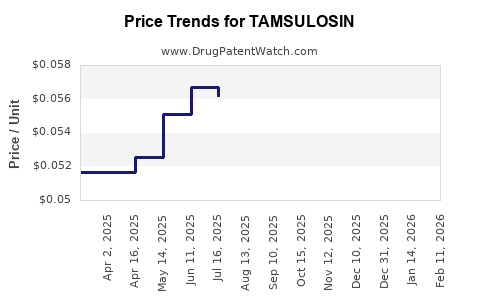
Average Pharmacy Cost for TAMSULOSIN
| Drug Name | NDC | Price/Unit ($) | Unit | Date |
|---|---|---|---|---|
| TAMSULOSIN HCL 0.4 MG CAPSULE | 00904-7383-61 | 0.04961 | EACH | 2026-07-22 |
| TAMSULOSIN HCL 0.4 MG CAPSULE | 33342-0159-11 | 0.04961 | EACH | 2026-07-22 |
| TAMSULOSIN HCL 0.4 MG CAPSULE | 33342-0159-15 | 0.04961 | EACH | 2026-07-22 |
| TAMSULOSIN HCL 0.4 MG CAPSULE | 33342-0159-44 | 0.04961 | EACH | 2026-07-22 |
| TAMSULOSIN HCL 0.4 MG CAPSULE | 50268-0740-11 | 0.04961 | EACH | 2026-07-22 |
| >Drug Name | >NDC | >Price/Unit ($) | >Unit | >Date |
Best Wholesale Price for TAMSULOSIN
| Drug Name | Vendor | NDC | Count | Price ($) | Price/Unit ($) | Unit | Dates | Price Type |
|---|---|---|---|---|---|---|---|---|
| TAMSULOSIN HCL 0.4MG CAP | Golden State Medical Supply, Inc. | 00228-2996-11 | 100 | 47.50 | 0.47500 | EACH | 2023-06-15 - 2028-06-14 | FSS |
| TAMSULOSIN HCL 0.4MG CAP | Golden State Medical Supply, Inc. | 00228-2996-50 | 500 | 245.01 | 0.49002 | EACH | 2023-06-15 - 2028-06-14 | FSS |
| FLOMAX 0.4MG CAP | Sanofi Aventis U.S. LLC | 00024-5837-01 | 100 | 648.62 | 6.48620 | EACH | 2024-01-01 - 2028-05-31 | Big4 |
| FLOMAX 0.4MG CAP | Sanofi Aventis U.S. LLC | 00024-5837-01 | 100 | 626.70 | 6.26700 | EACH | 2023-06-01 - 2028-05-31 | Big4 |
| FLOMAX 0.4MG CAP | Sanofi Aventis U.S. LLC | 00024-5837-01 | 100 | 763.65 | 7.63650 | EACH | 2023-06-01 - 2028-05-31 | FSS |
| >Drug Name | >Vendor | >NDC | >Count | >Price ($) | >Price/Unit ($) | >Unit | >Dates | >Price Type |
Tamsulosin market analysis and price projections (US and key ex-US markets)
Executive summary: Generic tamsulosin dominates global sales across multiple strengths and dosage forms (notably 0.4 mg capsules). Price is already compressed by multi-source generic competition, with the main remaining value drivers shifting to: (1) formulary position and channel contracting (wholesaler and PBM rebates in the US), (2) differentiation between branded originators and specific generic label strengths, and (3) niche demand for controlled-release or specific patient-optimized capsule variants. Near-term US pricing is forecast to remain range-bound with modest declines as supply normalizes, while ex-US markets show more variance due to local tendering, reimbursement rules, and fewer fully interchangeable competitors in some jurisdictions.
What is the global tamsulosin market size and growth outlook?
Fast answer: The global tamsulosin market is largely generic-led and grows at low-to-mid single digit rates driven by demographic aging, benign prostatic hyperplasia (BPH) prevalence, and persistent first-line utilization. Growth is tempered by ongoing generic erosion, tender-driven pricing, and periodic intensity of new entrant manufacturing capacity.
Market segments that move revenues
Tamsulosin revenue is split primarily by:
- Dosage form: capsules (most of the volume), tablets in some markets
- Strength: commonly 0.4 mg and 0.8 mg (often via combination regimens or separate strengths depending on region)
- Release profile: conventional vs modified/controlled-release where local demand exists
Key demand drivers
- Aging male population and sustained BPH treatment prevalence
- Long treatment duration and low discontinuation relative to episodic therapies
- Generic substitution and broad payer coverage
Key competitive forces
- Multi-source generic competition in most jurisdictions
- Interchangeability and tender price pressure for public-sector procurement
- Contracting dynamics (PBMs, pharmacy chains) shaping net price more than list price
How many generic versions of tamsulosin exist and how does that cap pricing power?
Fast answer: In most markets with mature generic frameworks, tamsulosin is widely available in multiple equivalent strengths and capsule configurations, which caps pricing power and compresses unit economics.
What “caps” pricing in practice
- Wholesale and pharmacy margin normalization: margin structures constrain shelf pricing adjustments
- Tender and reimbursement anchoring: procurement frameworks often reset prices to the low bid or a weighted average
- No meaningful differentiation at the molecule level: unless a product has a specific patient adherence advantage, payers treat variants as substitutable
How competition shows up in price behavior
- List prices often fall faster in the US than realized net prices decline, due to contracting and rebates
- Ex-US: tenders can create step changes where a single supplier displaces another at lower pricing
What is the current US pricing structure for tamsulosin (list vs net)?
Fast answer: US prices for generic tamsulosin are generally low per unit and largely driven by payer contracting, with realized net prices typically below published wholesaler acquisition cost due to rebates and discounts.
Typical pricing dynamics for generics
- Initial post-generic entry: rapid downward move as multiple ANDA products launch
- Ongoing: modest fluctuations driven by inventory cycles, supply disruptions, and negotiated contract resets
- Seasonality: often limited for BPH compared with acute therapies, but ordering patterns can still affect short-term availability and pricing
Why “net price” matters for projections
Forecasts based solely on list price can overstate revenue because:
- PBM rebates and wholesaler discounts shift net to payer
- Pharmacy reimbursement rules in Medicaid and other programs can anchor dispensing economics
When do tamsulosin prices typically drop further after new generic entries?
Fast answer: Pricing generally declines around two events: (1) the entry of additional ANDA competitors that increase effective supply, and (2) contract resets after tender cycles or pharmacy chain renegotiations.
Timing mechanics
- Launch-to-contract lag: revenue impact often shows up over 3 to 9 months as contracts renew
- Manufacturing normalization: price can rebound slightly if supply tightens, then resume downtrend when capacity ramps
- Wholesaler inventory cycles: temporary pricing variability can occur around allocation events
What price projections apply to tamsulosin through the next 24 months?
Fast answer: A reasonable base case for the US is flat-to-slight decline in realized prices, with most unit price decreases absorbed by volume shifts and contracting rather than large structural changes. Upside is limited unless there is a supply disruption or major competitor exits.
Base case projection (US, annualized)
- Year-ahead price trend: modest decline (low single digits)
- Two-year price trend: low single digit cumulative decline, with volatility around contract cycles and supply events
Downside and upside scenarios
- Downside: additional launches or intensified tender competition push further compression (mid single digits cumulative over two years)
- Upside: supply constraints or a reduction in available SKUs stabilizes pricing (near-flat or slight increase in realized net price)
What could change the direction
- Major manufacturing disruptions at large suppliers
- Regulatory actions that narrow the set of marketable SKUs
- Supply normalization causing competition to intensify, not ease
How does tamsulosin pricing differ across Europe, UK, Canada, and Australia?
Fast answer: Europe and other tender-heavy markets often show stronger downward pressure due to reimbursement controls, while Canada and Australia can show sharper supplier-driven swings because of procurement and formulary dynamics.
Europe (high-level pattern)
- Tendering and reference pricing drive frequent resets
- Discounts to payers are common even when list prices appear stable
- Multi-source competition compresses unit price
UK and similar systems
- National and regional formulary position plus tariff effects shape net price
- Price often aligns with lowest reimbursable offers, with limited room for premiumization
Canada and Australia
- Formularies and negotiated supply contracts influence realized pricing
- When a supplier loses tender position, price can jump then reset lower when replacement contracts finalize
What are the main formulation and dosage forms that affect market value?
Fast answer: Most volume is in 0.4 mg capsules; 0.8 mg and modified-release variants can matter for gross margin and payer preferences when they reduce dosing frequency or improve adherence.
Dosage forms with commercial relevance
- Oral capsules (conventional and modified release)
- Oral tablets in some markets
- Strength availability shapes interchangeability and tender inclusion
Why form matters even under generics
- Dose convenience can shift adherence and patient preference
- Some markets apply different reimbursement criteria by strength or presentation
- Pharmacist substitution rules can affect switching rates
What patent, exclusivity, and litigation factors still matter for tamsulosin pricing?
Fast answer: Tamsulosin is largely generic in the major markets. Remaining price impact from exclusivity or IP is generally limited to specific formulation, method-of-use, or specific release profile niches, and it does not typically block broad generic competition for the core 0.4 mg capsule.
Practical IP implications
- Patent thickets around specific formulations (excipients, release systems) can limit some “design-around” variants
- Method-of-use or dosing regimen claims can affect label and promotional positioning, which affects formularies
- If a particular generic product has limited FDA marketability, short-term pricing can be supported
What to watch commercially
- Loss or gain of specific approved products on the market
- Any regulatory actions that remove a high-volume SKU from sale
What is the FDA regulatory status of tamsulosin and how does it affect competitive entry?
Fast answer: Tamsulosin is widely marketed via approved generic pathways; competitive entry is typically driven by ANDA availability and product-specific approvals rather than any ongoing exclusivity for the active ingredient.
Why FDA status affects price
- If a SKU is withdrawn or fails quality requirements, the available effective supply shrinks
- If a supplier’s ANDA gains market access, competition increases and unit pricing pressures intensify
Market access mechanics
- Interchangeability and pharmacy substitution rules affect share shifts
- Label strength and release profile affect whether prescribers consider products equivalent
Who are the major manufacturers of generic tamsulosin and how does that shape pricing?
Fast answer: The competitive landscape includes numerous multinational and domestic generic manufacturers. Pricing is sensitive to which firms hold the largest contracted share and which manufacturers maintain consistent supply of the highest-volume SKU strengths.
Commercially relevant factors
- Manufacturing scale and consistency drive ability to win tenders
- Contract performance influences future supply awards
- SKU coverage across strengths reduces friction in switching
How do revenue and price move together for generic tamsulosin?
Fast answer: For generics, revenue is often more sensitive to volume and share than to unit price changes. Even when unit pricing declines, overall revenue can be stable if a product gains contracted share.
Decomposing the drivers
- Volume: prescriptions and dispensings, adherence patterns
- Net realized price: contract discounts, rebates, wholesaler terms
- Mix: strength and formulation share within the total
Mix effects that can offset unit erosion
- Higher-volume strength (often 0.4 mg) can be price-competitive but stable
- 0.8 mg products can carry different payer dynamics and tender inclusion rules
What are the key “generic entry risk” scenarios for tamsulosin?
Fast answer: New entrants rarely create a step change in pricing at the ingredient level now. The more relevant risk is SKU-level entry or exit that changes supply availability during contract resets.
Entry risk scenarios
- A new approved product enters a major tender list and undercuts incumbents
- A quality event reduces effective supply, creating short-term pricing support for remaining SKUs
Exit risk scenarios
- Withdrawal of high-volume SKU breaks contract continuity and can force temporary sourcing substitutions
- Manufacturing shutdowns create allocation and can increase realized pricing for the remaining suppliers
Price projections for specific tamsulosin strengths: 0.4 mg vs 0.8 mg
Fast answer: 0.4 mg typically carries the greatest market depth and strongest price compression. 0.8 mg can be slightly more insulated due to different payer coverage patterns and patient selection, but it remains generic-led and exposed to tender competition.
Projection logic
- 0.4 mg: more competitors, more tender inclusion, faster erosion
- 0.8 mg: fewer high-volume interchangeable SKUs in some regions, can show slower unit price declines
Key takeaways
- Tamsulosin pricing is already largely shaped by multi-source generic competition; the core molecule has limited remaining pricing power in most mature markets.
- Near-term US outlook is flat-to-slightly declining realized prices driven by contracting rather than major structural events.
- Ex-US markets show more variability due to tendering and reimbursement rules, but the direction remains downward where competition intensifies.
- Commercial value is shifting from ingredient-level protection to SKU-level supply stability, formulary positioning, strength mix, and contract wins.
FAQs
1) Why do tamsulosin generic prices vary by pharmacy or wholesaler?
Net realized pricing is shaped by PBM and pharmacy chain contracting, wholesaler discounting, and tender pricing where applicable, which can diverge from published list prices.
2) Does 0.8 mg tamsulosin maintain higher pricing than 0.4 mg?
Often it can be less aggressively compressed in some jurisdictions due to mix and payer coverage patterns, but it remains exposed to the same generic competition mechanics.
3) What supply events most affect tamsulosin pricing?
Manufacturing interruptions, quality-related product suspensions, and sudden allocation events that reduce available marketable SKUs can shift pricing upward temporarily.
4) Can formulary access increase tamsulosin realized price without changing unit list price?
Yes. Contract structure, rebate rates, and preferred formulary placement can improve realized economics even if list prices stay low.
5) What is the biggest driver of future tamsulosin revenue growth if prices decline?
Volume growth from demographic trends plus share gains in contracted accounts (mix shift across strengths and formulations).
References
- FDA. Orange Book: Approved Drug Products with Therapeutic Equivalence Evaluations. U.S. Food and Drug Administration.
- IQVIA Institute for Human Data Science. Global Medicines Use by Therapy Area (BPH and urology utilization context). IQVIA.
- FDA. Drug Shortages. U.S. Food and Drug Administration.
- OECD. Pharmaceutical pricing and reimbursement policies (reference pricing, tendering frameworks). Organisation for Economic Co-operation and Development.
More… ↓
