Last updated: February 20, 2026
What Is Soma, and What Is Its Market Position?
Soma (carisoprodol) is a muscle relaxant approved by the FDA in 1959 for short-term management of musculoskeletal pain. It is prescribed primarily for acute musculoskeletal conditions. Soma's patent expired decades ago, leading to widespread generic availability.
The drug's global sales peaked in the 2000s, with annual revenues surpassing $200 million. U.S. prescriptions declined after the early 2010s due to increased awareness of dependency risks and regulatory adjustments. As of 2022, Soma remains a controlled substance (Schedule IV) in the U.S., limiting its prescribing and dispensing.
What Are the Key Market Drivers and Constraints?
Drivers:
- Growing incidence of musculoskeletal injuries in aging populations.
- Off-label use for anxiety and sleep disorders.
- Expansion into emerging markets with increasing healthcare access.
Constraints:
- Dependency and abuse potential leading to regulatory restrictions.
- Competition from newer muscle relaxants like cyclobenzaprine and tizanidine.
- FDA warnings issued in 2019 warning against use beyond short-term treatments.
Regional Market Dynamics:
| Region |
Market Size (2022) |
Growth Rate (CAGR 2022-2027) |
Key Factors |
| US |
$150M |
2.5% |
Regulatory restrictions, declining prescriptions |
| EU |
$40M |
1.8% |
Prescribed chiefly for acute injuries |
| Asia-Pacific |
$10M |
5.0% |
Increasing healthcare expenditure, awareness |
What Are Price Trends and Future Price Projections?
Historical Price Trends:
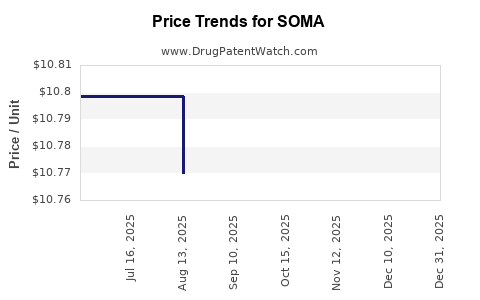
- Brand name (Soma): Approx. $10–$15 per 350 mg tablet in the U.S.
- Generics: Approx. $2–$5 per tablet, with significant variability by pharmacy and region.
- Prices declined post-generic entry (mid-2000s), stabilizing over recent years.
Price Drivers:
- Regulatory constraints limiting authorized prescribers.
- Market saturation of generics keeps prices low.
- Supply chain considerations, including production costs and demand fluctuations.
Future Price Projections (Next 5 Years):
| Scenario |
Estimated Price Range |
Key Assumptions |
| Conservative |
$2–$4 per tablet |
Ongoing supply chain stability, high generic market saturation |
| Moderate |
$3–$6 per tablet |
Slight regulatory restrictions limit prescribing, slow market growth |
| Aggressive |
$4–$8 per tablet |
Increased regulation and reduced competition leading to stabilized or increased prices |
The potential for price increases depends on regulatory shifts, supply chain bottlenecks, or formulation modifications that maintain exclusivity.
What Is the Outlook for Competition and Regulatory Changes?
Competition:
- Several generics are on the market, with dominant players including Mylan and Teva.
- Suppliers have minimal incentive to innovate due to low profitability and regulatory hurdles.
- Competition from newer muscle relaxants has reduced Soma's market share.
Regulatory Landscape:
- The FDA issued warnings against prolonged use of Soma in 2019.
- Potential for reclassification or tighter control could influence prices.
- Patent issues are long settled; no current patent protections exist.
What Are Strategic Recommendations?
- Companies should focus on niche markets, such as specialty hospitals managing acute injury cases.
- Pricing strategies must account for increasing regulation and generics’ market power.
- Stakeholders should monitor regulatory updates, especially concerning Schedule IV controls.
Key Takeaways
- Soma’s market has declined with increasing regulatory restrictions and competition.
- Current prices remain low, with a slight potential for moderate increases if supply constraints or regulatory shifts occur.
- The drug's niche usage and generic competition limit significant price growth prospects.
- Emerging markets offer growth opportunities but face hurdles like regulatory barriers.
- Industry players should analyze regional regulatory trends and supply chain factors to optimize pricing and market penetration.
FAQs
-
Will Soma’s price increase significantly in the next five years?
Likely not. Market saturation and generic competition keep prices stable. Minor increases are possible if regulatory restrictions tighten or supply limitations occur.
-
Are generic versions of Soma going off patent soon?
No. Carisoprodol has been off patent since the late 1990s, with multiple generics available.
-
How do regulatory restrictions affect Soma’s market?
Tighter regulations, such as reclassification or prescribing limits, reduce accessibility, suppressing sales and constraining pricing power.
-
What are the main competitors to Soma?
Cyclobenzaprine, tizanidine, and metaxalone dominate as alternative muscle relaxants with similar indications.
-
What markets show potential for growth?
Emerging markets with increasing healthcare infrastructure and awareness offer opportunities, although regulatory barriers may slow growth.
References
[1] U.S. Food and Drug Administration. (2019). FDA warns against the use of soma for longer than two or three weeks.
[2] IMS Health. (2021). U.S. prescription drug market report.
[3] MarketWatch. (2022). Global muscle relaxant drugs market size and forecast.
[4] FDA. (2021). Schedule IV controlled substances: implications for prescribing.