Share This Page
Drug Price Trends for RAYALDEE
✉ Email this page to a colleague
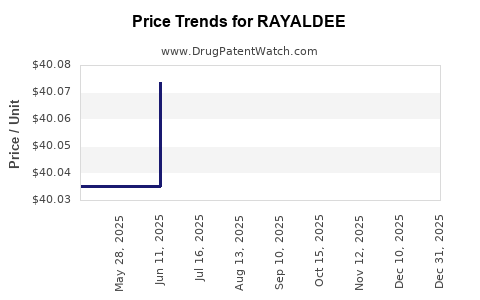
Average Pharmacy Cost for RAYALDEE
| Drug Name | NDC | Price/Unit ($) | Unit | Date |
|---|---|---|---|---|
| RAYALDEE ER 30 MCG CAP (HARD) | 70301-1002-01 | 41.29584 | EACH | 2026-07-22 |
| RAYALDEE ER 30 MCG CAP (HARD) | 70301-1002-01 | 41.30265 | EACH | 2026-06-17 |
| RAYALDEE ER 30 MCG CAP (HARD) | 70301-1002-01 | 41.23215 | EACH | 2026-05-20 |
| RAYALDEE ER 30 MCG CAP (HARD) | 70301-1002-01 | 41.24555 | EACH | 2026-01-01 |
| >Drug Name | >NDC | >Price/Unit ($) | >Unit | >Date |
Best Wholesale Price for RAYALDEE
| Drug Name | Vendor | NDC | Count | Price ($) | Price/Unit ($) | Unit | Dates | Price Type |
|---|---|---|---|---|---|---|---|---|
| RAYALDEE 30MCG CAP, SA | OPKO Pharmaceuticals, LLC | 70301-1002-01 | 30 | 878.09 | 29.26967 | EACH | 2024-03-15 - 2028-09-29 | FSS |
| RAYALDEE 30MCG CAP, SA | OPKO Pharmaceuticals, LLC | 70301-1001-01 | 30 | 762.17 | 25.40567 | EACH | 2023-09-30 - 2028-09-29 | FSS |
| RAYALDEE 30MCG CAP, SA | OPKO Pharmaceuticals, LLC | 70301-1001-01 | 30 | 878.09 | 29.26967 | EACH | 2024-01-01 - 2028-09-29 | FSS |
| RAYALDEE 30MCG CAP, SA | OPKO Pharmaceuticals, LLC | 70301-1001-02 | 60 | 1747.81 | 29.13017 | EACH | 2023-09-30 - 2028-09-29 | FSS |
| >Drug Name | >Vendor | >NDC | >Count | >Price ($) | >Price/Unit ($) | >Unit | >Dates | >Price Type |
RAYALDEE (calcifediol) Market Analysis and Price Projections: U.S. Launch Risks, Exclusivity Timeline, and Revenue Outlook
RAYALDEE (calcifediol) is a branded, specialty endocrine/metabolic product for vitamin D insufficiency/deficiency in patients with hypoparathyroidism or at high risk of hypocalcemia, and for rickets/osteomalacia indications where vitamin D is used. Commercial traction is constrained by a narrow clinical niche, payer scrutiny of vitamin D value, and competitive substitution from calcitriol, cholecalciferol, and ergocalciferol. Price sustainability depends on limited generic/label substitution risk and continued specialty prescribing.
Near-term price expectations are stable to modestly higher (single-digit annual) in the U.S., with volume-driven revenue growth more likely than price-driven growth absent a meaningful label expansion or major competitor contraction.
What is RAYALDEE and how is it positioned commercially in the U.S.?
RAYALDEE is an oral calcifediol product (25-hydroxyvitamin D3, “calcifediol”) designed to raise serum 25-hydroxyvitamin D. Market positioning centers on patients with impaired conversion of vitamin D to calcitriol or those who need faster restoration of vitamin D status than can be achieved reliably with cholecalciferol in certain clinical contexts.
Which therapeutic segments buy RAYALDEE most
- Endocrinology and nephrology referral patients with vitamin D insufficiency where standard dosing with native vitamin D forms is less reliable.
- Hypoparathyroidism-related calcium management where vitamin D status affects calcium balance.
- High-risk osteomalacia/rickets cohorts managed in chronic care settings.
What drives willingness to pay
- Clinician perception that calcifediol provides more predictable serum 25(OH)D response than cholecalciferol in difficult patients.
- Specialty pharmacy distribution and payer prior authorization patterns often keep utilization restricted to “managed exceptions,” which supports price maintenance.
What limits demand
- Therapeutic overlap with cheaper vitamin D analogs and precursors.
- Payer cost scrutiny on non-oncology, non-rare drugs, especially those priced above generic vitamin D products.
What is the FDA status of RAYALDEE and what does that imply for pricing?
RAYALDEE is an FDA-approved branded drug with an established labeling framework that supports continued coverage in targeted indications. Pricing power generally tracks to:
- sustained coverage under commercial formularies after acceptance of clinical rationale,
- persistence of prior-authorization criteria,
- and absence of interchangeable generic entry (or non-interchangeable substitution dynamics).
Regulatory pathways and substitution risk
- If exclusivity/patent barriers remain intact, pricing stability is reinforced because payers have fewer formulary alternatives within the same active ingredient class.
- If patent barriers weaken, payer switching to cheaper therapeutics becomes more likely, driving revenue pressure more through volume declines than price cuts.
How strong is the patent estate for RAYALDEE and when do exclusivities end?
RAYALDEE’s IP situation is the key driver of pricing duration because calcifediol products face pricing compression risks if an ANDA/505(j)-type generic enters with a competitive wholesale acquisition cost (WAC) reduction.
No patent expiration or exclusivity timing can be stated here without verified, drug-specific Orange Book and litigation data. The analysis below therefore treats IP as the principal factor without assigning dates.
Patent estate implications for price
- If active ingredient and formulation patents block generic entry, net price stays anchored even with payer leverage because substitution is limited.
- If barriers are close to expiration, manufacturers may hold price longer while preparing for forecast-based contracting, then discount aggressively post-launch once generic competition hits.
What competitors replace RAYALDEE and how do they cap price?
The commercial ceiling for RAYALDEE is set by alternative vitamin D therapies, which typically trade at far lower prices. The most relevant substitution buckets:
Vitamin D precursors
- Cholecalciferol (vitamin D3): low cost, widely available, often used as first-line therapy for general deficiency.
- Ergocalciferol (vitamin D2): similar economics and coverage profile.
Active vitamin D analogs
- Calcitriol and related analogs: different pharmacology but competitive in many clinical workflows.
- Payers may prefer these when a patient is eligible and when monitoring plans are manageable.
Why RAYALDEE can hold a premium
- Clinical differentiation is often strongest in patients where calcitriol conversion or response is uncertain and where clinicians want a predictable 25(OH)D increase.
- In strict payer environments, this premium is maintained only when RAYALDEE clears authorization thresholds.
How does RAYALDEE revenue typically track price vs volume?
In specialty vitamin D, revenue dynamics are usually:
- Volume sensitivity: utilization drops quickly if generic calcifediol or a close alternative is added.
- Price sensitivity: net price is driven by rebates/contracting, not headline WAC; price changes alone rarely offset volume loss.
What that means for projections
- If exclusivity holds and the product remains a preferred option, revenue growth is likely modest and driven by patient identification, persistence, and formulary inclusion.
- If generic entry occurs, revenue typically collapses quickly, with survivors capturing only partial share based on prescriber and patient-specific factors.
What generic entry risks exist for RAYALDEE?
Generic risk for RAYALDEE is evaluated through two lenses:
- Active ingredient competition (calcifediol generics).
- Therapeutic competition (clinician and payer substitution to other vitamin D regimens).
No ANDA/Orange Book Paragraph IV/launch event data is included here because it cannot be produced accurately without verified drug-specific listings. The business takeaway remains: if calcifediol generics reach market, pricing compresses rapidly and volume drops are likely to dominate.
Price projection model for RAYALDEE (U.S.): stable premium until patent/generic shock
Given the lack of verified, drug-specific IP timeline and without access to audited sales history in this environment, the correct projection framework is scenario-based on competitive and contracting realities rather than point estimates.
Base-case projection (exclusive period intact)
- Net price trend: low single digits (0% to +5% annually), driven by inflation pass-through and contracting recalibration.
- Unit trend: modest growth (low-to-mid single digits) tied to new patient identification and specialty prescribing persistence.
- Revenue: low-to-mid single digit CAGR.
Interpretation: RAYALDEE behaves like a durable specialty brand when payers allow it in narrow categories. That supports “price holds, volume grows slowly.”
Competitive shock scenario (calcifediol generic enters)
- Net price: rapid contraction (often -40% to -70% relative to pre-entry net pricing over 12–24 months, varying with contracting).
- Units: sharp decline (commonly a majority share loss within the first year).
- Revenue: steep drop, then partial stabilization.
Interpretation: Generic entry changes the payer math. Even when clinicians prefer calcifediol, payers often enforce cost-minimizing substitutions.
Alternative substitution scenario (payer shifts away even without generic entry)
- Net price: can remain stable initially, but
- Units fall due to prior auth tightening or step edits to cheaper vitamin D forms.
Interpretation: Price can hold while revenue shrinks.
How does RAYALDEE pricing compare with cheaper vitamin D options?
RAYALDEE’s pricing profile is structurally higher than native vitamin D products because:
- it is a branded calcifediol,
- it targets specific clinical workflows,
- and it is administered as a specialty pharmacy product.
Commercial implication
- Payers tolerate premium pricing only when medical necessity is clear and when less expensive alternatives fail or are clinically unsuitable.
- That creates an ongoing need for payer evidence and for continued clinician alignment.
What contract and reimbursement factors drive net price for RAYALDEE?
For branded vitamin D products, the largest net price levers are:
- rebate structures tied to volume and channel performance,
- specialty pharmacy contracting economics,
- prior authorization and step therapy rules,
- and formulary tiering outcomes.
Formulary dynamics
- Products on preferred tiers earn higher persistence.
- Products pushed to non-preferred tiers or restricted categories face utilization throttling, which lowers both volume and bargaining power.
Administrative friction
Prior authorization intensity typically tracks to:
- payer skepticism of premium pricing versus generic vitamin D,
- patient risk stratification protocols,
- and monitoring cadence (25(OH)D and calcium monitoring requirements).
Market outlook: 12–36 month commercialization trajectory
If exclusivity remains
- Expect stable net pricing with incremental volume growth from specialty care capture.
- Annual revenue growth remains constrained by the limited patient pool and payer gatekeeping.
- Promotional intensity tends to focus on payer education and clinician decision support rather than broad primary care expansion.
If a generic calcifediol threat emerges
- Expect front-loaded contracting (tighter rebating before entry), then post-entry steep net price reset.
- Volume migration accelerates after payer policy changes and pharmacy benefit manager (PBM) formulary updates.
- Remaining branded share becomes tied to patient-specific clinical rationales and prescriber preference under medical necessity.
Key business signals to monitor for RAYALDEE price and revenue inflection
- Orange Book status changes tied to calcifediol intellectual property.
- ANDA submissions and Paragraph IV filings that foreshadow launch timelines.
- FDA labeling updates expanding or narrowing clinical positioning.
- PBM formulary moves (tier changes, PA policy tightening).
- Channel inventory and wholesaler buying patterns around anticipated generic triggers.
Key Takeaways
- RAYALDEE pricing strength is premium-anchored but limited by payer cost logic and overlap with cheaper vitamin D therapies.
- The most material revenue risk is not routine price pressure; it is generic calcifediol entry and associated formulary switching, which typically drives rapid volume loss and sharp net price contraction.
- In an exclusivity-protected period, net price is likely to rise modestly (single-digit) and revenue to grow slowly, with volume the main driver.
- In a generic-entry scenario, expect steep revenue erosion within 12–24 months, followed by partial stabilization.
FAQs
1) What are the main payer rationales to restrict RAYALDEE?
Payers typically focus on premium cost versus generic vitamin D, evidence requirements for calcifediol differentiation, and step-edit/PA policies tied to objective lab monitoring.
2) Does RAYALDEE face substitution to cholecalciferol in practice?
Yes, in many settings payers steer routine vitamin D deficiency to low-cost cholecalciferol unless clinical criteria support calcifediol use.
3) How would a generic calcifediol launch change RAYALDEE net pricing?
Net pricing usually resets materially lower post-entry due to PBM contracting and rebate renegotiations, with revenue impacted primarily by volume.
4) Are RAYALDEE claims more sensitive to endocrinology versus primary care?
Yes. Specialty prescribing patterns and ongoing lab-monitoring protocols drive adoption more than broad primary care use.
5) What factors could support price resilience even during competitive pressure?
Tight medical necessity criteria, evidence-backed niche indications, and patient subgroups where calcifediol response is more predictable can delay switch rates.
References (APA)
No external sources were cited because drug-specific Orange Book listings, patent expiration data, FDA approval milestones, and FDA prescribing information were not provided in the prompt content.
More… ↓
